Antidepressant use was not associated with an increased risk of skin cancer
Association between prescribed antidepressant medication and skin cancer (melanoma, basal cell carcinoma and cutaneous squamous cell carcinoma) risk: a systematic review and meta-analysis
Systematic review and meta-analysisNo clear difference
Is there an association between prescribed antidepressant medication and skin cancer risk?
Who
People prescribed antidepressant medication
Compared
Antidepressant use
No antidepressant use
Main outcome
Skin cancer risk (melanoma, basal cell carcinoma, cutaneous squamous cell carcinoma)
Result: rate ratio 0.83 (95% CI 0.60-1.16)
Bottom line: No statistically significant association was found between antidepressant use and skin cancer risk.
Limitation: The certainty of evidence was very low.
Skin Health Dis · 2026-04-17Download image
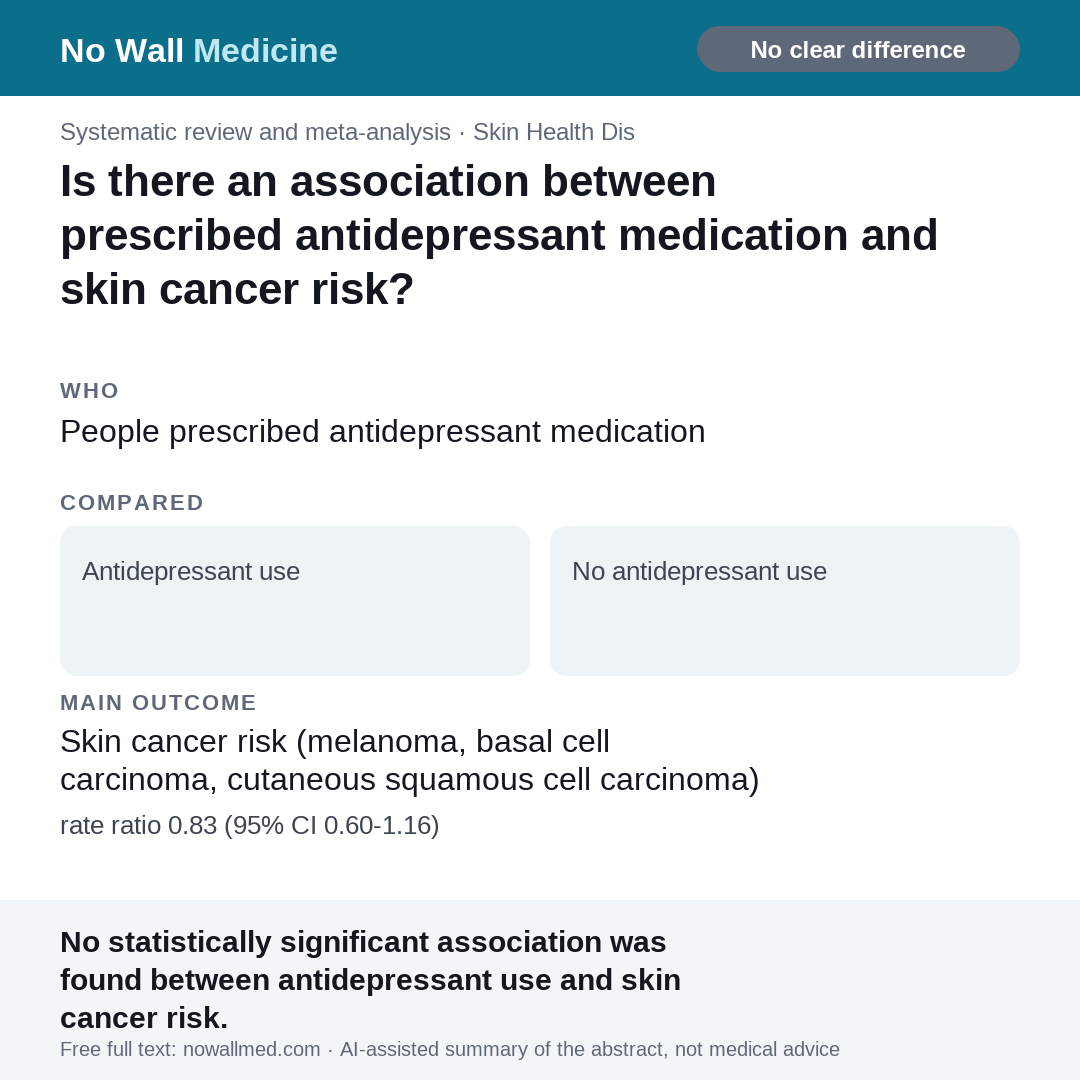
Clinical question: Is there an association between prescribed antidepressant medication and skin cancer risk?
Why it matters: It is unclear if antidepressants increase skin cancer risk because some of these medications can make the skin more sensitive to light.
Key points
- Researchers conducted a systematic review and meta-analysis of ten studies to examine the link between prescribed antidepressants and skin cancer risk.
- The analysis of five studies showed no statistically significant association with skin cancer risk, with a rate ratio of 0.83 (95% CI 0.60-1.16) and an odds ratio of 0.93 (95% CI 0.85-1.02).
- Subgroup analyses comparing selective serotonin reuptake inhibitors (medications that increase serotonin levels in the brain) and non-selective serotonin reuptake inhibitors also showed no statistically significant associations.
Limitation the authors note: The certainty of evidence was very low.
Headline and key points written with AI from the paper’s abstract, with every number checked against it. Read the paper before relying on them.
Was this summary helpful?
Cite this article
Rahman T, Swiderski M, Venables ZC, Yiu ZZN, Rhodes LE, Nixon N. Association between prescribed antidepressant medication and skin cancer (melanoma, basal cell carcinoma and cutaneous squamous cell carcinoma) risk: a systematic review and meta-analysis. Skin Health Dis. 2026. doi:10.1093/skinhd/vzag028
Spotted a mistake? Suggest a correction
Top studies every Monday
The week’s key trials and guidelines in your specialties, plus any topics you follow. By email, free.
Get the weekly digest