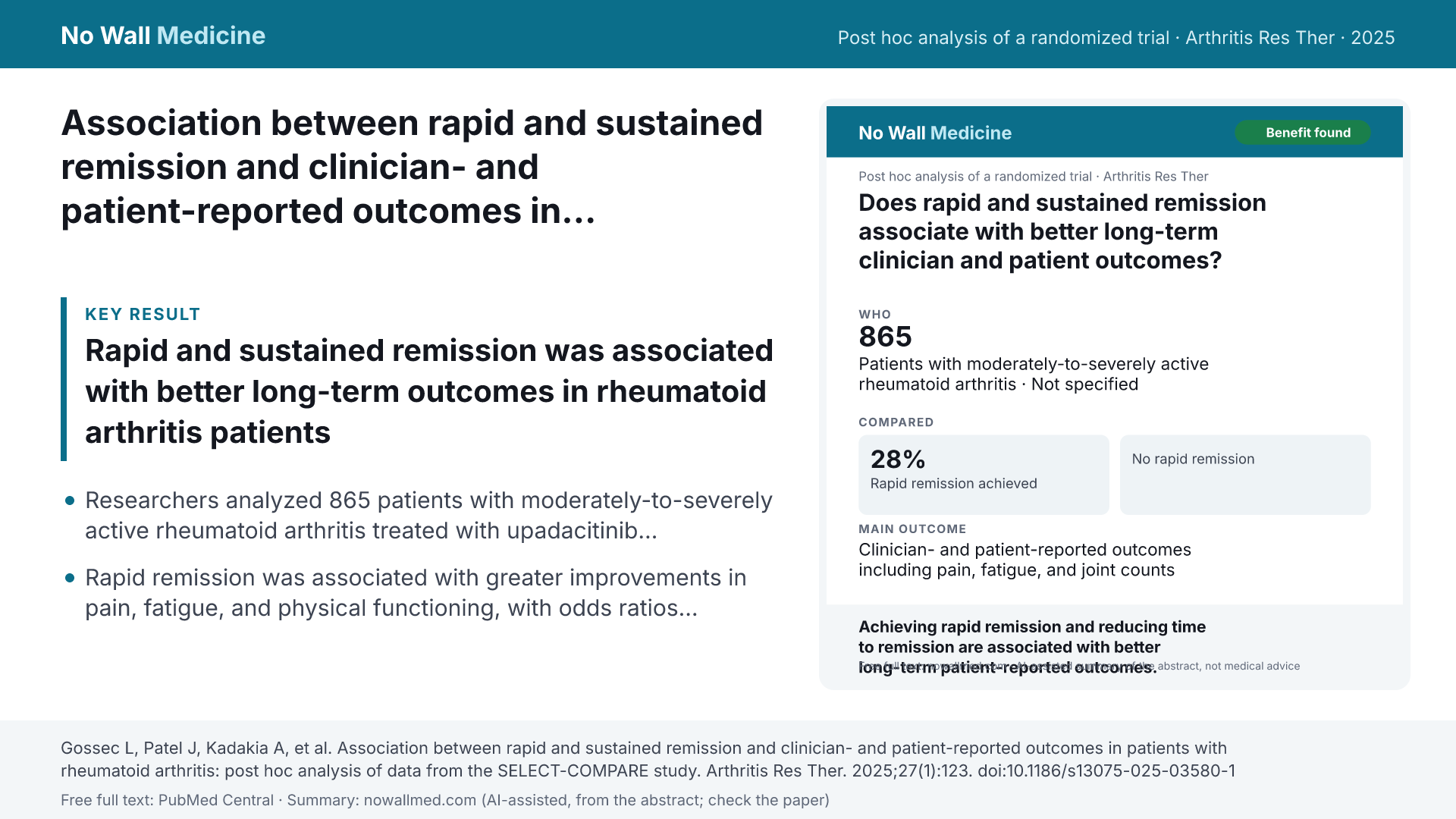
Rapid and sustained remission was associated with better long-term outcomes in rheumatoid arthritis patients
Association between rapid and sustained remission and clinician- and patient-reported outcomes in patients with rheumatoid arthritis: post hoc analysis of data from the SELECT-COMPARE study
Post hoc analysis of a randomized trialBenefit found
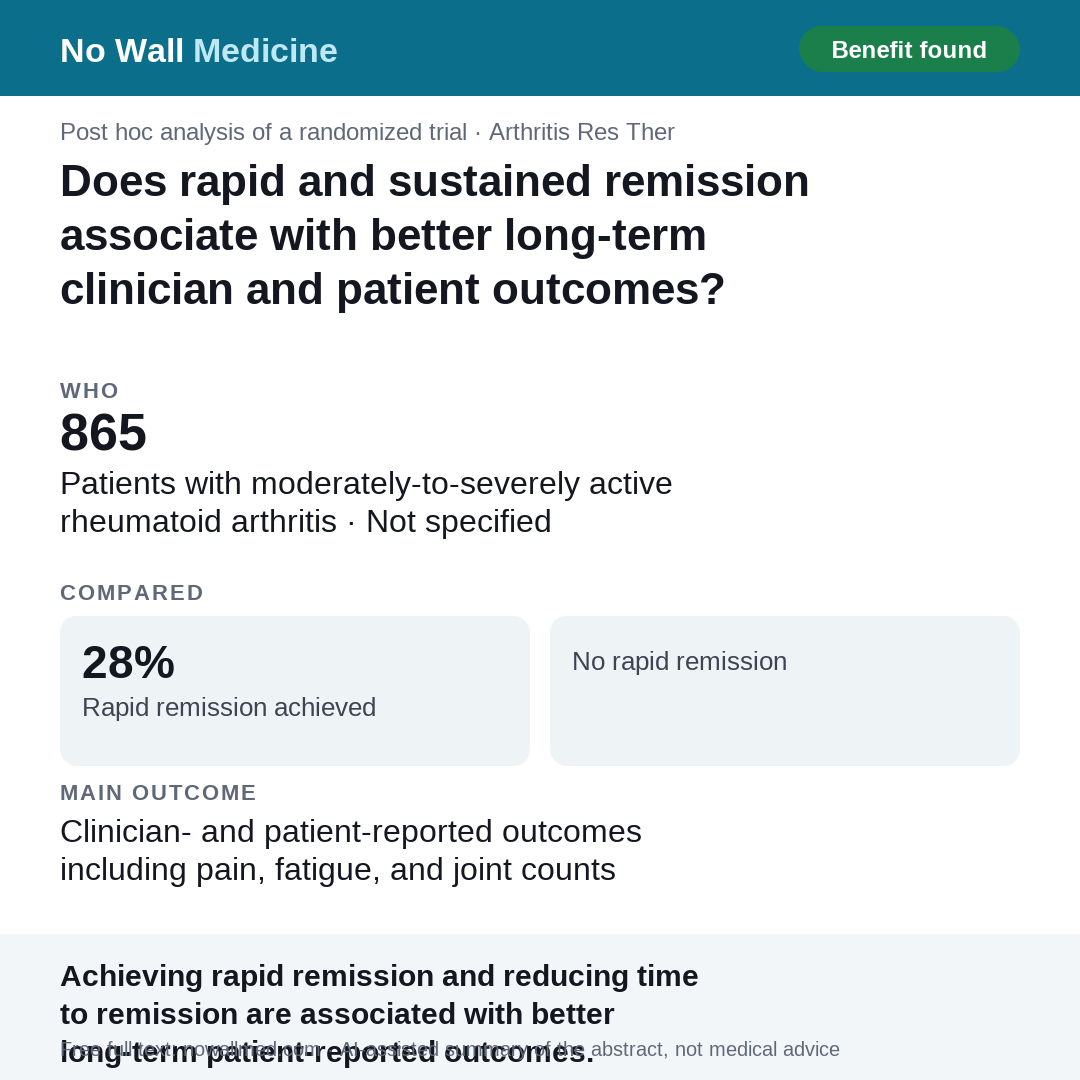
Does rapid and sustained remission associate with better long-term clinician and patient outcomes?
Who
865
Patients with moderately-to-severely active rheumatoid arthritis · Not specified
Compared
28%Rapid remission achieved (247/865)
No rapid remission
Main outcome
Clinician- and patient-reported outcomes including pain, fatigue, and joint counts
Result: adjusted odds ratios 2.2-5.6 for MCIDs and 1.6-9.8 for normative values
Bottom line: Achieving rapid remission and reducing time to remission are associated with better long-term patient-reported outcomes.
Arthritis Res Ther · 2025-06-13Download image
Clinical question: Does rapid and sustained remission associate with better long-term clinician and patient outcomes?
Why it matters: It is unclear how achieving rapid and sustained remission affects long-term clinician- and patient-reported outcomes in patients treated with biologic or targeted synthetic disease-modifying antirheumatic drugs.
Key points
- Researchers analyzed 865 patients with moderately-to-severely active rheumatoid arthritis treated with upadacitinib or adalimumab for up to 5 years.
- Rapid remission was associated with greater improvements in pain, fatigue, and physical functioning, with odds ratios for achieving minimal clinically important differences ranging from 2.2-5.6.
- Every month of delay in achieving remission was associated with a 13% average decrease in the likelihood of achieving minimal clinically important differences or normative values.
Headline and key points written with AI from the paper’s abstract, with every number checked against it. Read the paper before relying on them.
Was this summary helpful?
Subject terms
Cite this article
Gossec L, Patel J, Kadakia A, et al. Association between rapid and sustained remission and clinician- and patient-reported outcomes in patients with rheumatoid arthritis: post hoc analysis of data from the SELECT-COMPARE study. Arthritis Res Ther. 2025. doi:10.1186/s13075-025-03580-1
Spotted a mistake? Suggest a correction