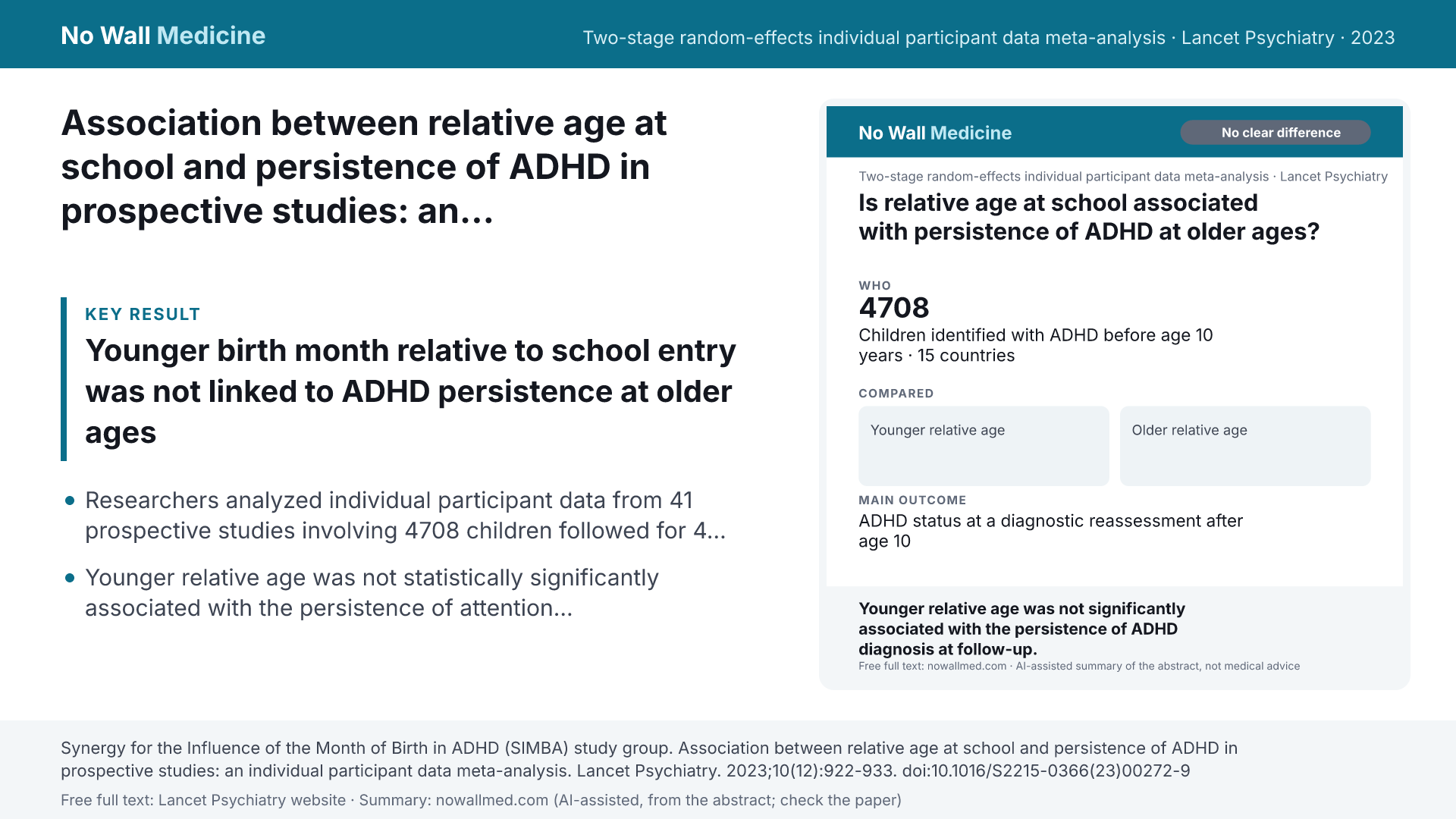
Younger birth month relative to school entry was not linked to ADHD persistence at older ages
Association between relative age at school and persistence of ADHD in prospective studies: an individual participant data meta-analysis
Two-stage random-effects individual participant data meta-analysisNo clear difference
Is relative age at school associated with persistence of ADHD at older ages?
Who
4708
Children identified with ADHD before age 10 years · 15 countries
Compared
Younger relative age
Older relative age
Main outcome
ADHD status at a diagnostic reassessment after age 10
Result: odds ratio 1·02, 95% CI 0·99-1·06
Bottom line: Younger relative age was not significantly associated with the persistence of ADHD diagnosis at follow-up.
Limitation: Exclusion of 16 studies in regions with flexible school entry systems.
Lancet Psychiatry · 2023-10-25 · Save PNG
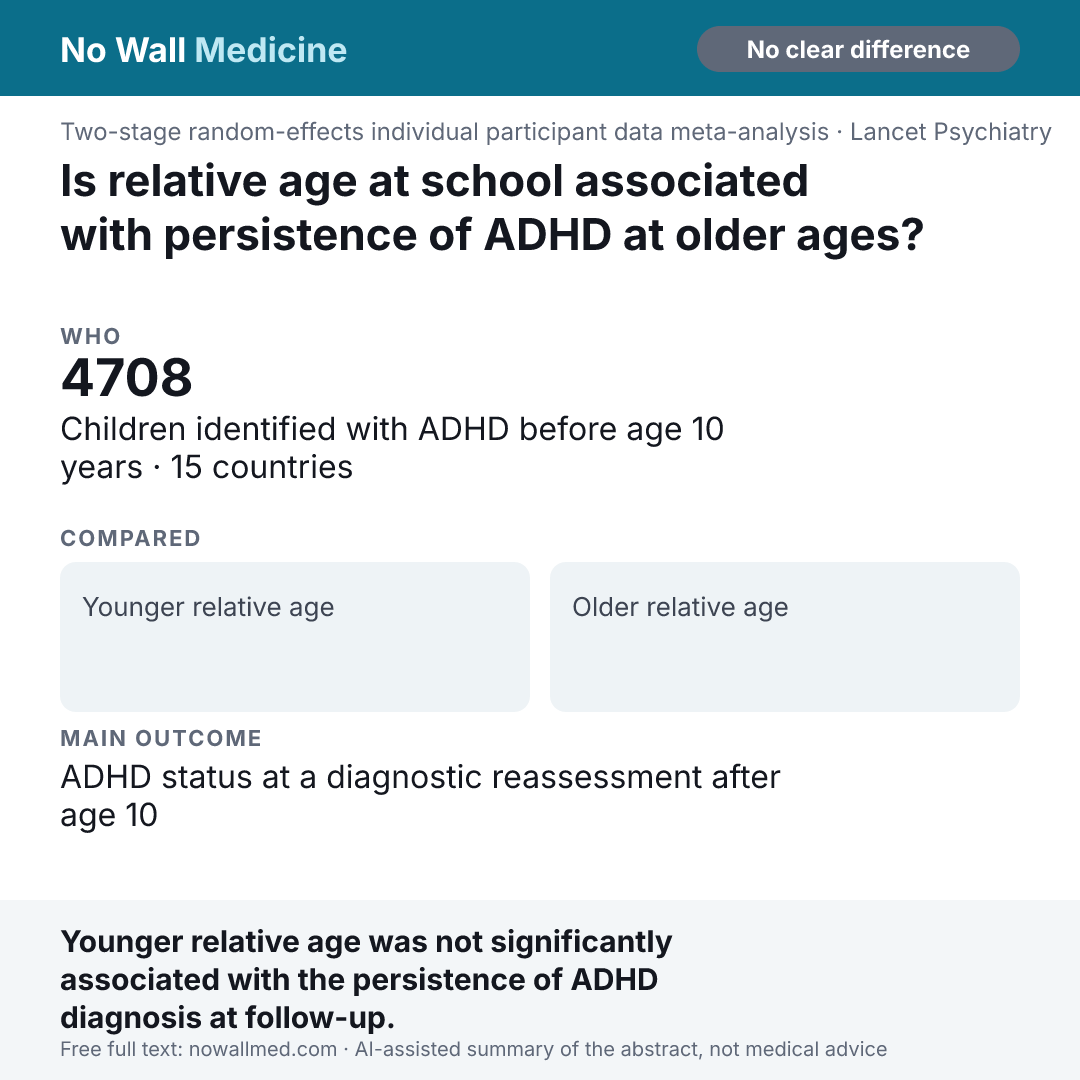
Clinical question: Is relative age at school associated with persistence of ADHD at older ages?
Key points
- Researchers analyzed individual participant data from 41 prospective studies involving 4708 children followed for 4 to 33 years.
- Younger relative age was not statistically significantly associated with the persistence of attention deficit hyperactivity disorder at follow-up (odds ratio 1.02, 95% CI 0.99-1.06; p=0.19).
- The results remained similar in sensitivity analyses involving children with a clinical diagnosis or follow-up durations exceeding 10 years.
Headline and key points written with AI from the paper’s abstract, with every number checked against it. Read the paper before relying on them.
Was this summary helpful?
Abstract
Background
The youngest children in a school class are more likely than the oldest to be diagnosed with ADHD, but this relative age effect is less frequent in older than in younger school-grade children. However, no study has explored the association between relative age and the persistence of ADHD diagnosis at older ages. We aimed to quantify the association between relative age and persistence of ADHD at older ages. Methods
For this meta-analysis, we searched MEDLINE, Embase, CINAHL, PsycINFO, and PubPsych up to April 1, 2022, with terms related to "cohort" and "ADHD" with no date, publication type, or language restrictions. We gathered individual participant data from prospective cohorts that included at least ten children identified with ADHD before age 10 years. ADHD was defined by either a clinical diagnosis or symptoms exceeding clinical cutoffs. Relative age was recorded as the month of birth in relation to the school-entry cutoff date. Study authors were invited to share raw data or to apply a script to analyse data locally and generate anonymised results. Our outcome was ADHD status at a diagnostic reassessment, conducted at least 4 years after the initial assessment and after age 10 years. No information on sex, gender, or ethnicity was collected. We did a two-stage random-effects individual participant data meta-analysis to assess the association of relative age with persistence of ADHD at follow-up. This study was registered with PROSPERO, CRD42020212650. Findings
Of 33 119 studies generated by our search, we identified 130 eligible unique studies and were able to gather individual participant data from 57 prospective studies following up 6504 children with ADHD. After exclusion of 16 studies in regions with a flexible school entry system that did not allow confident linkage of birthdate to relative age, the primary analysis included 41 studies in 15 countries following up 4708 children for a period of 4 to 33 years. We found that younger relative age was not statistically significantly associated with ADHD persistence at follow-up (odds ratio 1·02, 95% CI 0·99-1·06; p=0·19). We observed statistically significant heterogeneity in our model (Q=75·82, p=0·0011, I2=45%). Participant-level sensitivity analyses showed similar results in cohorts with a robust relative age effect at baseline and when restricting to cohorts involving children with a clinical diagnosis of ADHD or with a follow-up duration of more than 10 years. Interpretation
The diagnosis of ADHD in younger children in a class is no more likely to be disconfirmed over time than that of older children in the class. One interpretation is that the relative age effect decreases the likelihood of children of older relative age receiving a diagnosis of ADHD, and another is that assigning a diagnostic label of ADHD leads to unexplored carryover effects of the initial diagnosis that persist over time. Future studies should be conducted to explore these interpretations further. Funding
None.
Abstract reproduced under the article’s CC BY licence.
Subject terms
Headline, design, result, key points, caveat and citation as plain text.
Cite this article
Synergy for the Influence of the Month of Birth in ADHD (SIMBA) study group. Association between relative age at school and persistence of ADHD in prospective studies: an individual participant data meta-analysis. Lancet Psychiatry. 2023;10(12):922-933. doi:10.1016/S2215-0366(23)00272-9
Spotted a mistake? Suggest a correction