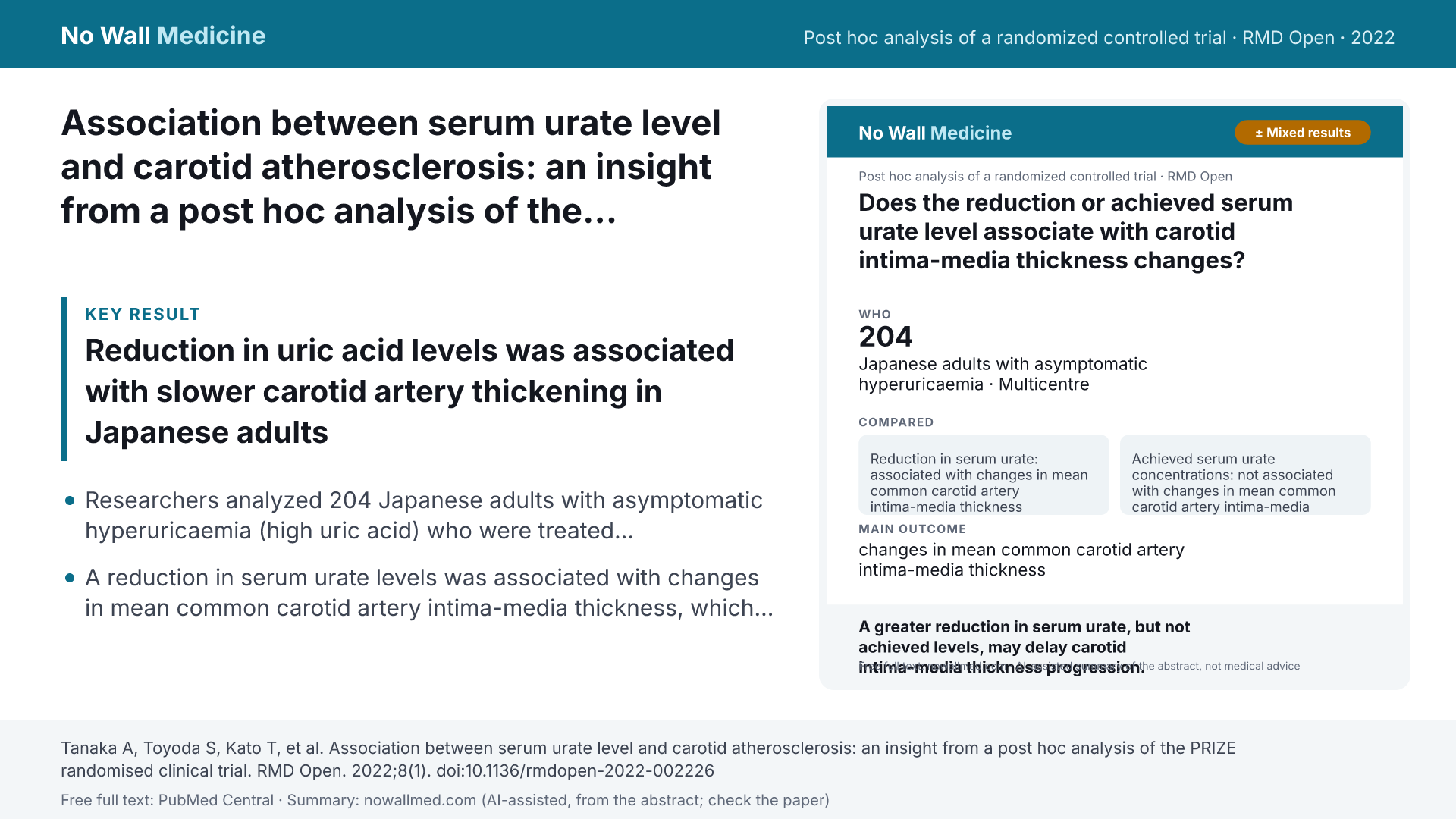
Reduction in uric acid levels was associated with slower carotid artery thickening in Japanese adults
Association between serum urate level and carotid atherosclerosis: an insight from a post hoc analysis of the PRIZE randomised clinical trial
Post hoc analysis of a randomized controlled trialMixed results
Does the reduction or achieved serum urate level associate with carotid intima-media thickness changes?
Who
204
Japanese adults with asymptomatic hyperuricaemia · Multicentre
Compared
Reduction in serum urate: associated with changes in mean common carotid artery intima-media thickness (p=0.025)
Achieved serum urate concentrations: not associated with changes in mean common carotid artery intima-media thickness
Main outcome
changes in mean common carotid artery intima-media thickness
Bottom line: A greater reduction in serum urate, but not achieved levels, may delay carotid intima-media thickness progression.
RMD Open · 2022-04-12Download image
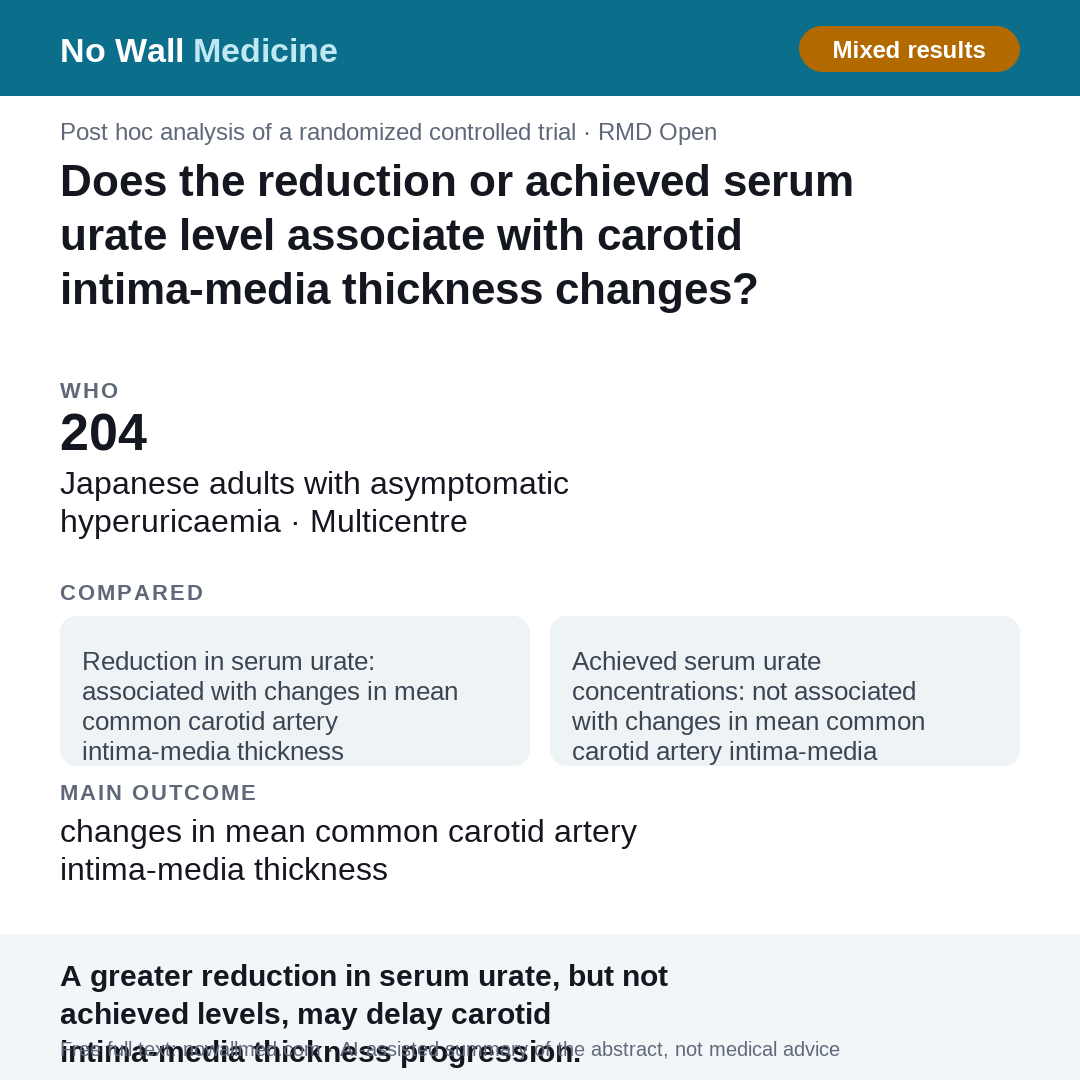
Clinical question: Does the reduction or achieved serum urate level associate with carotid intima-media thickness changes?
Why it matters: The optimal serum urate level for delaying the progression of atherosclerosis in patients with hyperuricaemia remains uncertain.
Key points
- Researchers analyzed 204 Japanese adults with asymptomatic hyperuricaemia (high uric acid) who were treated with febuxostat for 24 months.
- A reduction in serum urate levels was associated with changes in mean common carotid artery intima-media thickness, which is a measure of arterial wall thickening.
- The final achieved serum urate concentrations were not associated with changes in the carotid artery wall thickness at 24 months.
Headline and key points written with AI from the paper’s abstract, with every number checked against it. Read the paper before relying on them.
Was this summary helpful?
Abstract
Objectives
Elevated serum urate (SU) levels are associated with arterial atherosclerosis and subsequent cardiovascular events. However, an optimal therapeutic target SU level for delaying atherosclerotic progression in patients with hyperuricaemia remains uncertain. The aim of this analysis was to assess an association between changes in SU level and carotid intima-media thickness (IMT) to examine whether an optimal SU concentration exists to delay atherosclerotic progression. Methods
This was a post hoc analysis of the PRIZE (programme of vascular evaluation under uric acid control by xanthine oxidase inhibitor, febuxostat: multicentre, randomised controlled) study of Japanese adults with asymptomatic hyperuricaemia. The primary endpoint of this analysis was an association between changes in SU levels and mean common carotid artery IMT (CCA-IMT) after 24 months of febuxostat treatment. Results
Among subjects treated with febuxostat (n=239), a total of 204 who had both data on SU and mean CCA-IMT at baseline and 24 months were included in this analysis. The mean baseline SU level was 7.7±1.0 mg/dL, and febuxostat treatment significantly reduced SU concentrations at 24 months (estimated mean change ‒3.051 mg/dL, 95% CI ‒3.221 to ‒2.882). A multivariable linear regression analysis revealed that a reduction in SU level was associated with changes in mean CCA-IMT values at 24 months (p=0.025). In contrast, the achieved SU concentrations were not associated with changes in mean CCA-IMT at 24 months. Conclusion
A greater reduction in SU, but not its achieved concentrations, may be associated with delayed progression of carotid IMT in patients with asymptomatic hyperuricaemia treated with febuxostat. Trial registration number
UMIN000012911.
Abstract reproduced under the article’s CC BY licence.
Subject terms
Cite this article
Tanaka A, Toyoda S, Kato T, Yoshida H, Hamasaki S, Watarai M. Association between serum urate level and carotid atherosclerosis: an insight from a post hoc analysis of the PRIZE randomised clinical trial. RMD Open. 2022. doi:10.1136/rmdopen-2022-002226
Spotted a mistake? Suggest a correction
Top studies every Monday
The week’s key trials and guidelines in your specialties, plus any topics you follow. By email, free.
Get the weekly digest