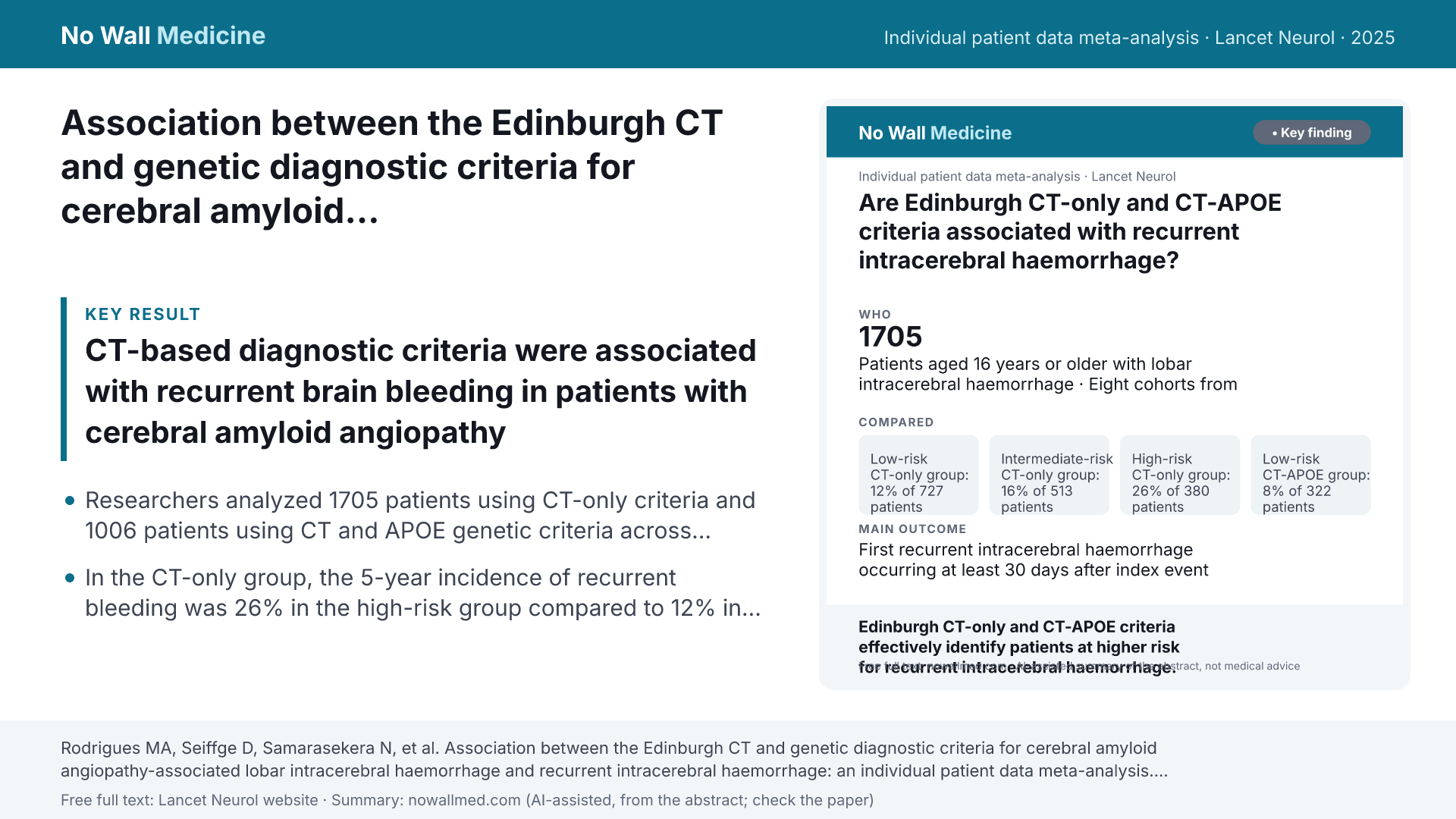
CT-based diagnostic criteria were associated with recurrent brain bleeding in patients with cerebral amyloid angiopathy
Association between the Edinburgh CT and genetic diagnostic criteria for cerebral amyloid angiopathy-associated lobar intracerebral haemorrhage and recurrent intracerebral haemorrhage: an individual patient data meta-analysis
Individual patient data meta-analysisKey finding
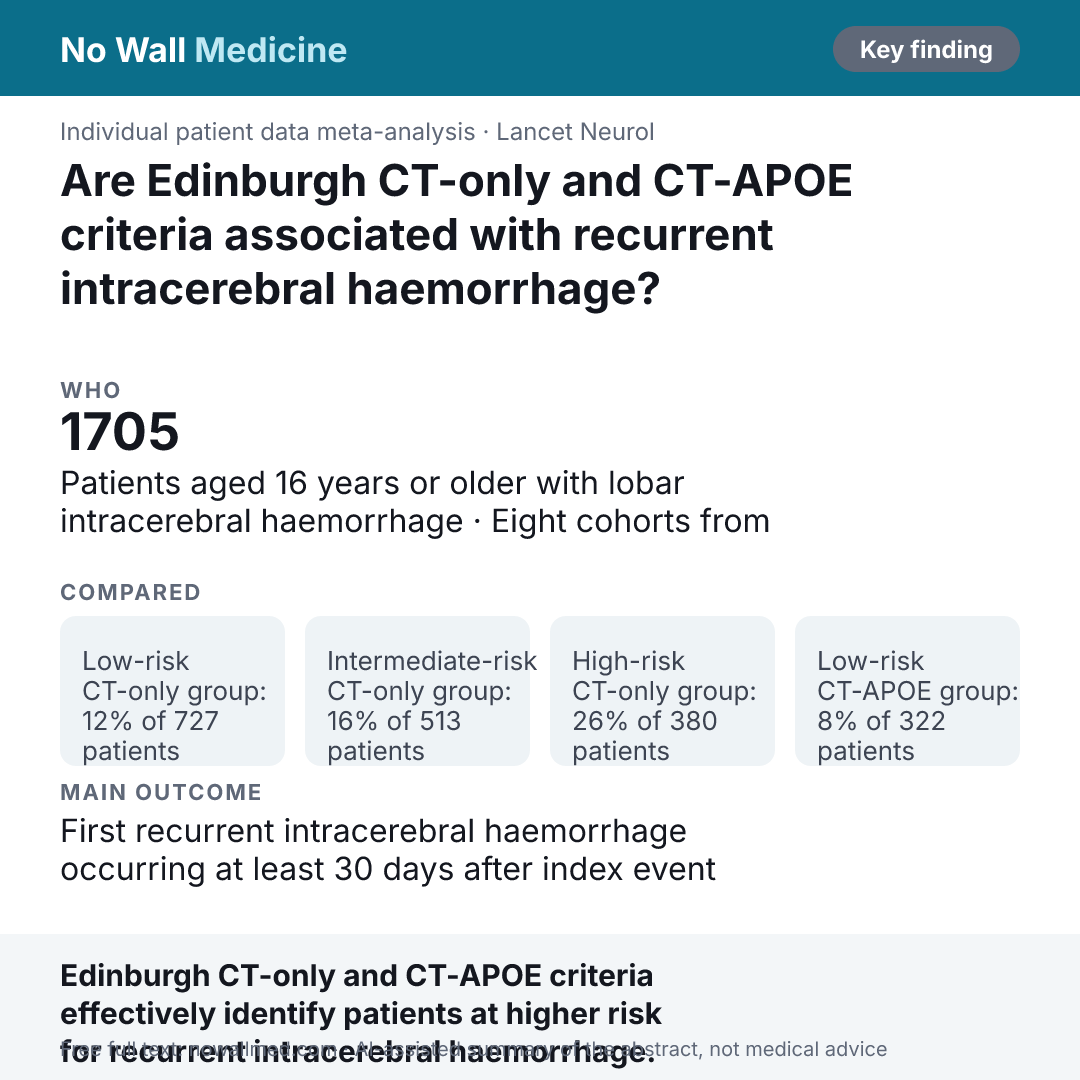
Are Edinburgh CT-only and CT-APOE criteria associated with recurrent intracerebral haemorrhage?
Who
1705
Patients aged 16 years or older with lobar intracerebral haemorrhage · Eight cohorts from Austria, France, Germany, Italy, UK, and USA
Compared
Low-risk CT-only group: 12% of 727 patients
Intermediate-risk CT-only group: 16% of 513 patients
High-risk CT-only group: 26% of 380 patients
Low-risk CT-APOE group: 8% of 322 patients
Main outcome
First recurrent intracerebral haemorrhage occurring at least 30 days after index event
Result: adjusted sub-distribution HR 2.97 (95% CI 1.50 to 5.89)
Bottom line: Edinburgh CT-only and CT-APOE criteria effectively identify patients at higher risk for recurrent intracerebral haemorrhage.
Limitation: Insufficient outcomes in individual CT-APOE cohorts to do the two-stage meta-analysis.
Lancet Neurol · 2025-09-21 · Save PNG
Clinical question: Are Edinburgh CT-only and CT-APOE criteria associated with recurrent intracerebral haemorrhage?
Why it matters: Access to MRI is limited for identifying biomarkers of cerebral amyloid angiopathy, which is a condition that increases the risk of recurrent brain bleeding.
Key points
- Researchers analyzed 1705 patients using CT-only criteria and 1006 patients using CT and APOE genetic criteria across eight cohorts.
- In the CT-only group, the 5-year incidence of recurrent bleeding was 26% in the high-risk group compared to 12% in the low-risk group.
- In the CT-APOE group, the 3-year incidence of recurrent bleeding was 15% in the high-risk group compared to 8% in the low-risk group.
Headline and key points written with AI from the paper’s abstract, with every number checked against it. Read the paper before relying on them.
Was this summary helpful?
Abstract
Background
Patients with lobar intracerebral haemorrhage and MRI biomarkers of cerebral amyloid angiopathy have a greater risk of recurrent intracerebral haemorrhage than patients without these biomarkers. However, access to MRI is limited. We aimed to determine whether the Edinburgh CT-only and CT-APOE diagnostic criteria for cerebral amyloid angiopathy-related lobar intracerebral haemorrhage are associated with recurrent intracerebral haemorrhage. Methods
We did a meta-analysis of individual patient data from cohort studies identified at the 2018 International cerebral amyloid angiopathy conference in Lille, France, assessing patients with lobar intracerebral haemorrhage with available diagnostic CT imaging that had been, or could be, rated for the Edinburgh cerebral amyloid angiopathy criteria imaging features, and with follow-up data for recurrent intracerebral haemorrhage and death. Eligible patients were aged 16 years or older with first or recurrent spontaneous lobar intracerebral haemorrhage diagnosed by non-contrast brain CT, with no evidence of an underlying cause other than cerebral small vessel disease. Collaborators provided individual patient-level data. The primary outcome was first recurrent intracerebral haemorrhage occurring at least 30 days after the index event, analysed using primary two-stage (cohort-level) and secondary one-stage (pooled) meta-analyses with multivariable regression models with a competing risk of death, adjusted for age, sex, and CT small vessel disease score. Pooled analyses were adjusted for previous intracerebral haemorrhage, dementia, hypertension, and cohort clustering. All analyses were done in R Project for Statistical Computing (version 4.5.0). Findings
We included eight cohorts from Austria, France, Germany, Italy, the UK, and the USA, with 1705 eligible patients for the CT-only criteria. In the primary two-stage meta-analysis of the CT-only criteria (562 patients from three European cohorts, median age 76 years [IQR 68-82], 282 [50%] female and 280 [50%] male), 69 patients had a recurrent intracerebral haemorrhage over 1381 person-years' follow-up. The proportion with recurrent intracerebral haemorrhage during 5-year follow-up in the intermediate-risk and high-risk CT-only cerebral amyloid angiopathy criteria group was 48 (16%) of 307 patients compared with 21 (8%) of 255 patients in the low-risk group (adjusted sub-distribution hazard ratio [HR] 1·79, 95% CI 1·05-3·05, p=0·032). In the one-stage meta-analysis of the CT-only criteria (1620 patients with lobar intracerebral haemorrhage from eight cohorts, median age 73 years [IQR 62-80], 763 [47%] female and 857 [53%] male), 171 patients had a recurrent intracerebral haemorrhage over 3208 person-years' follow-up. Cumulative 5-year incidence of recurrent intracerebral haemorrhage in the low-risk CT-only cerebral amyloid angiopathy criteria group was 45 (12%) of 727 patients compared with 54 (16%) of 513 patients in the intermediate-risk group (adjusted sub-distribution HR 1·68, 95% CI 1·21-2·32; p=0·0018), and 72 (26%) of 380 patients in the high-risk group (adjusted sub-distribution HR 2·97, 1·50-5·89, p=0·0018). We included six cohorts with 1021 eligible patients for the CT-APOE criteria; 15 patients with missing baseline data were excluded. There were insufficient outcomes in individual CT-APOE cohorts to do the two-stage meta-analysis. In the one-stage meta-analysis of the CT-APOE criteria (1006 patients, median age 71 years [IQR 58-79, 477 [47%] female and 529 [53%] male), 74 patients had a recurrent intracerebral haemorrhage over 1495 person-years' follow-up. Cumulative 3-year incidence of recurrent intracerebral haemorrhage was 34 (15%) of 320 patients in the high-risk CT-APOE cerebral amyloid angiopathy criteria group versus 14 (8%) of 322 patients in the low-risk group (adjusted sub-distribution HR 2·22 [95% CI 1·36-3·61], p=0·0014). Interpretation
The Edinburgh CT-only and CT-APOE diagnostic criteria for cerebral amyloid angiopathy-associated lobar intracerebral haemorrhage were associated with a greater incidence of recurrent intracerebral haemorrhage. These findings could aid personalised prediction and targeted secondary prevention in standard clinical practice where brain CT is available. Funding
UK Medical Research Council, The Stroke Association, The Wellcome Trust, and The British Heart Foundation.
Abstract reproduced under the article’s CC BY licence.
Subject terms
Headline, design, result, key points, caveat and citation as plain text.
Cite this article
Rodrigues MA, Seiffge D, Samarasekera N, et al. Association between the Edinburgh CT and genetic diagnostic criteria for cerebral amyloid angiopathy-associated lobar intracerebral haemorrhage and recurrent intracerebral haemorrhage: an individual patient data meta-analysis. Lancet Neurol. 2025;24(10):828-839. doi:10.1016/S1474-4422(25)00285-6
Spotted a mistake? Suggest a correction