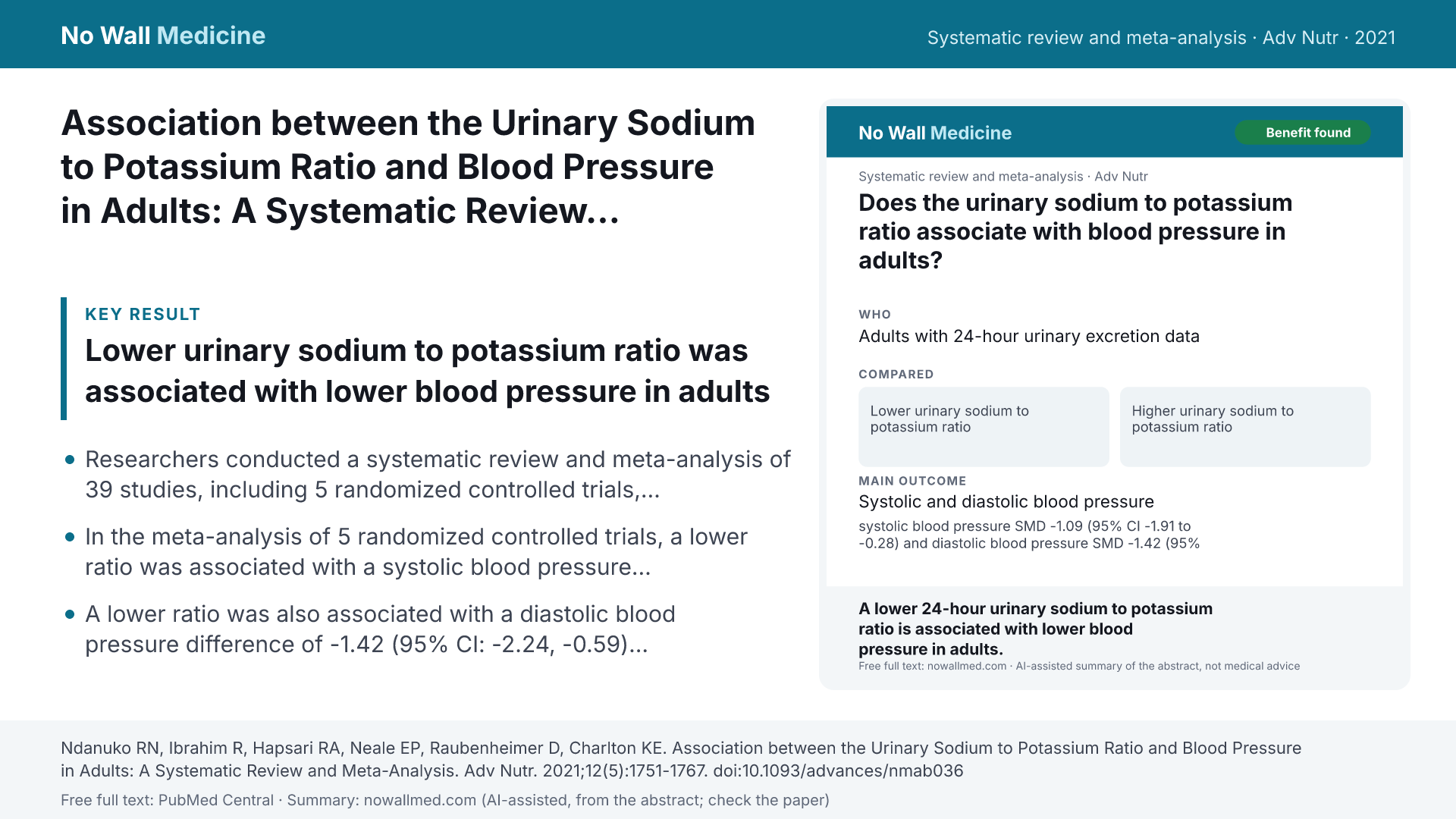
Lower urinary sodium to potassium ratio was associated with lower blood pressure in adults
Association between the Urinary Sodium to Potassium Ratio and Blood Pressure in Adults: A Systematic Review and Meta-Analysis
Systematic review and meta-analysisBenefit found
Does the urinary sodium to potassium ratio associate with blood pressure in adults?
Who
Adults with 24-hour urinary excretion data
Compared
Lower urinary sodium to potassium ratio
Higher urinary sodium to potassium ratio
Main outcome
Systolic and diastolic blood pressure
Result: systolic blood pressure SMD -1.09 (95% CI -1.91 to -0.28) and diastolic blood pressure SMD -1.42 (95% CI -2.24 to -0.59)
Bottom line: A lower 24-hour urinary sodium to potassium ratio is associated with lower blood pressure in adults.
Adv Nutr · 2021-06-13 · Save PNG
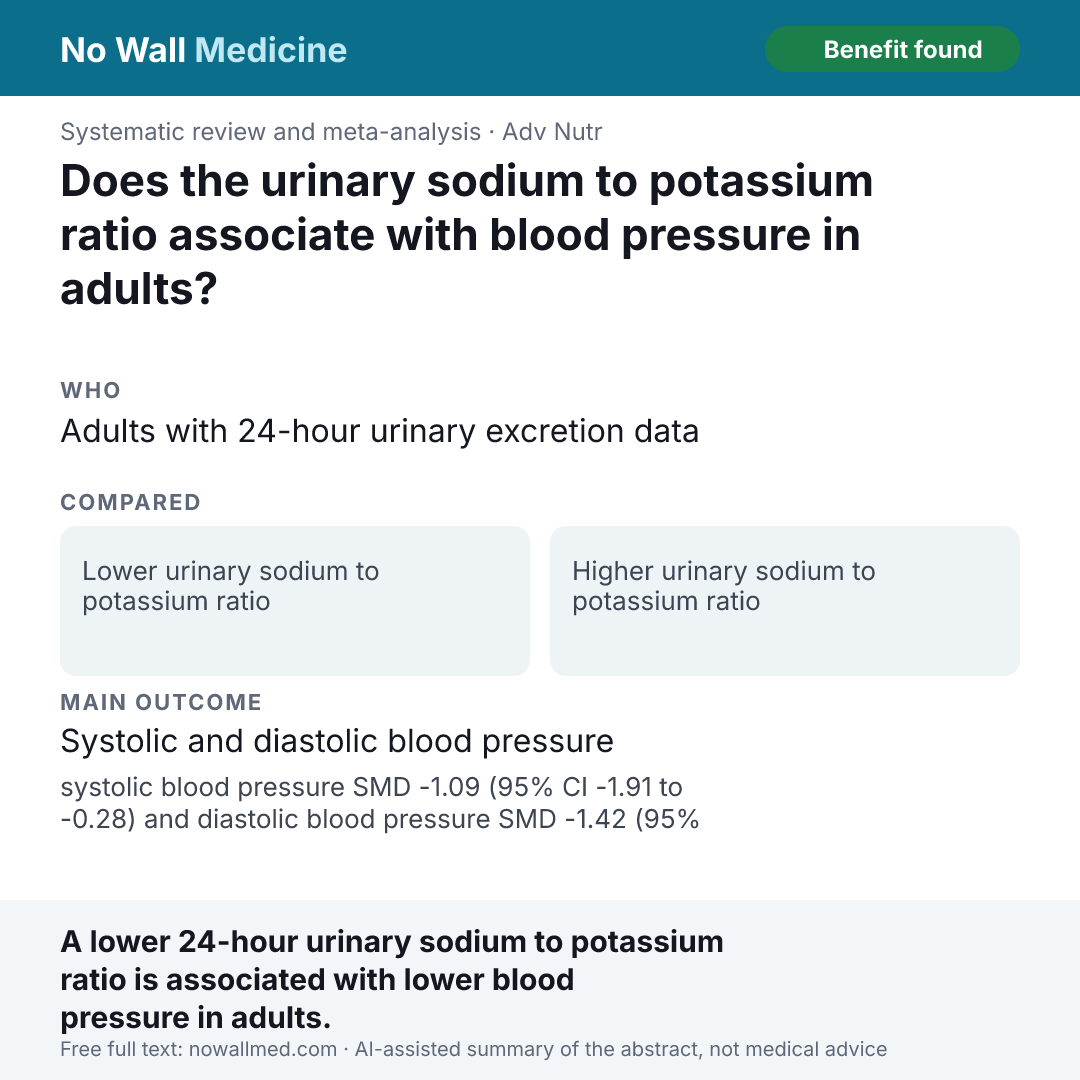
Clinical question: Does the urinary sodium to potassium ratio associate with blood pressure in adults?
Why it matters: The relative contribution of sodium to potassium intake regarding blood pressure regulation has not been sufficiently investigated.
Key points
- Researchers conducted a systematic review and meta-analysis of 39 studies, including 5 randomized controlled trials, to examine the relationship between urinary sodium to potassium ratio and blood pressure.
- In the meta-analysis of 5 randomized controlled trials, a lower ratio was associated with a systolic blood pressure difference of -1.09 (95% CI: -1.91, -0.28) mmHg.
- A lower ratio was also associated with a diastolic blood pressure difference of -1.42 (95% CI: -2.24, -0.59) mmHg compared to a higher ratio.
Headline and key points written with AI from the paper’s abstract, with every number checked against it. Read the paper before relying on them.
Was this summary helpful?
Subject terms
Headline, design, result, key points, caveat and citation as plain text.
Cite this article
Ndanuko RN, Ibrahim R, Hapsari RA, Neale EP, Raubenheimer D, Charlton KE. Association between the Urinary Sodium to Potassium Ratio and Blood Pressure in Adults: A Systematic Review and Meta-Analysis. Adv Nutr. 2021;12(5):1751-1767. doi:10.1093/advances/nmab036
Spotted a mistake? Suggest a correction