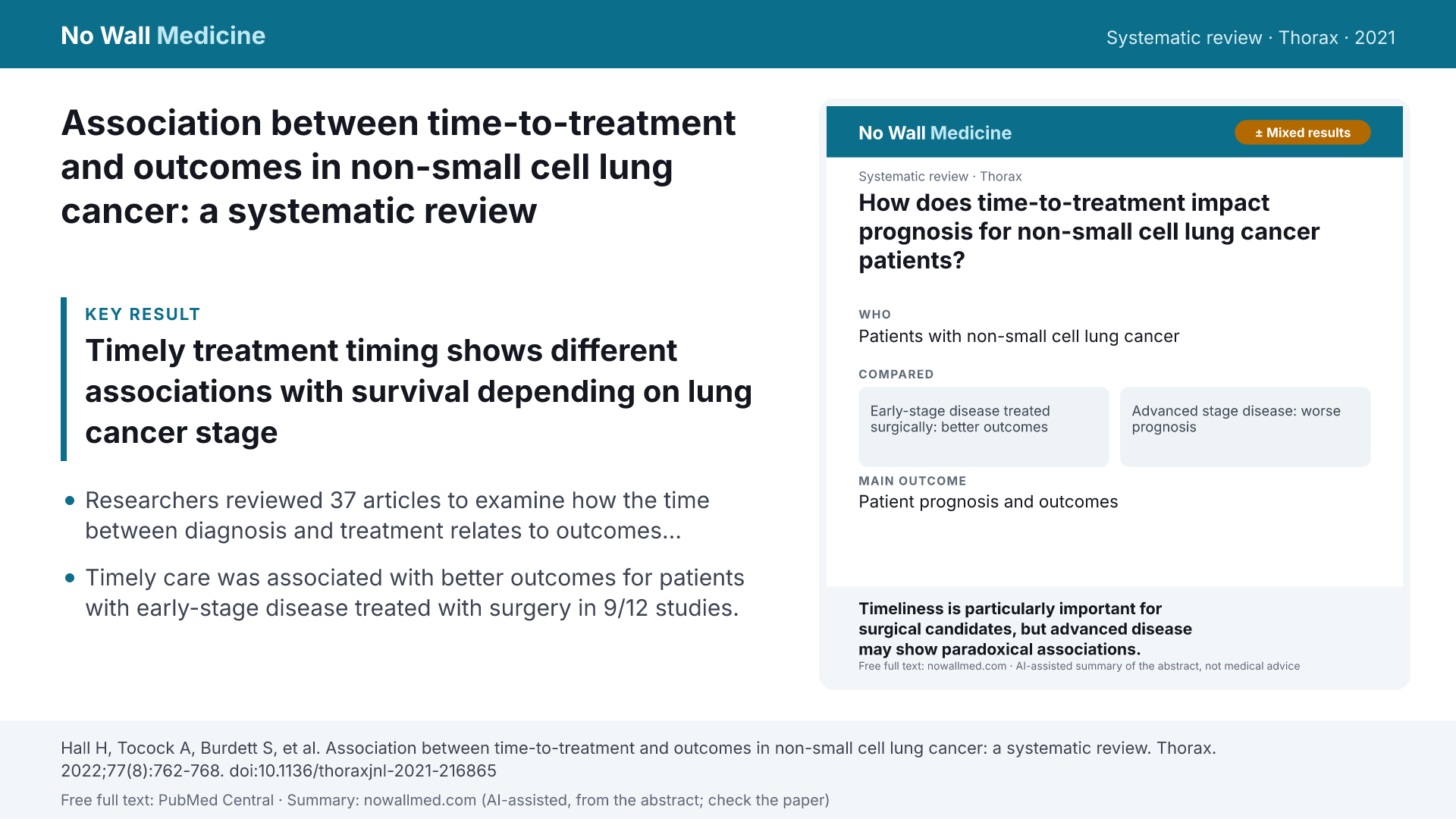
Timely treatment timing shows different associations with survival depending on lung cancer stage
Association between time-to-treatment and outcomes in non-small cell lung cancer: a systematic review
Systematic reviewMixed results
How does time-to-treatment impact prognosis for non-small cell lung cancer patients?
Who
Patients with non-small cell lung cancer
Compared
Early-stage disease treated surgically: better outcomes
Advanced stage disease: worse prognosis
Main outcome
Patient prognosis and outcomes
Bottom line: Timeliness is particularly important for surgical candidates, but advanced disease may show paradoxical associations.
Limitation: Most included studies were observational and evidence is limited.
Thorax · 2021-08-17 · Save PNG
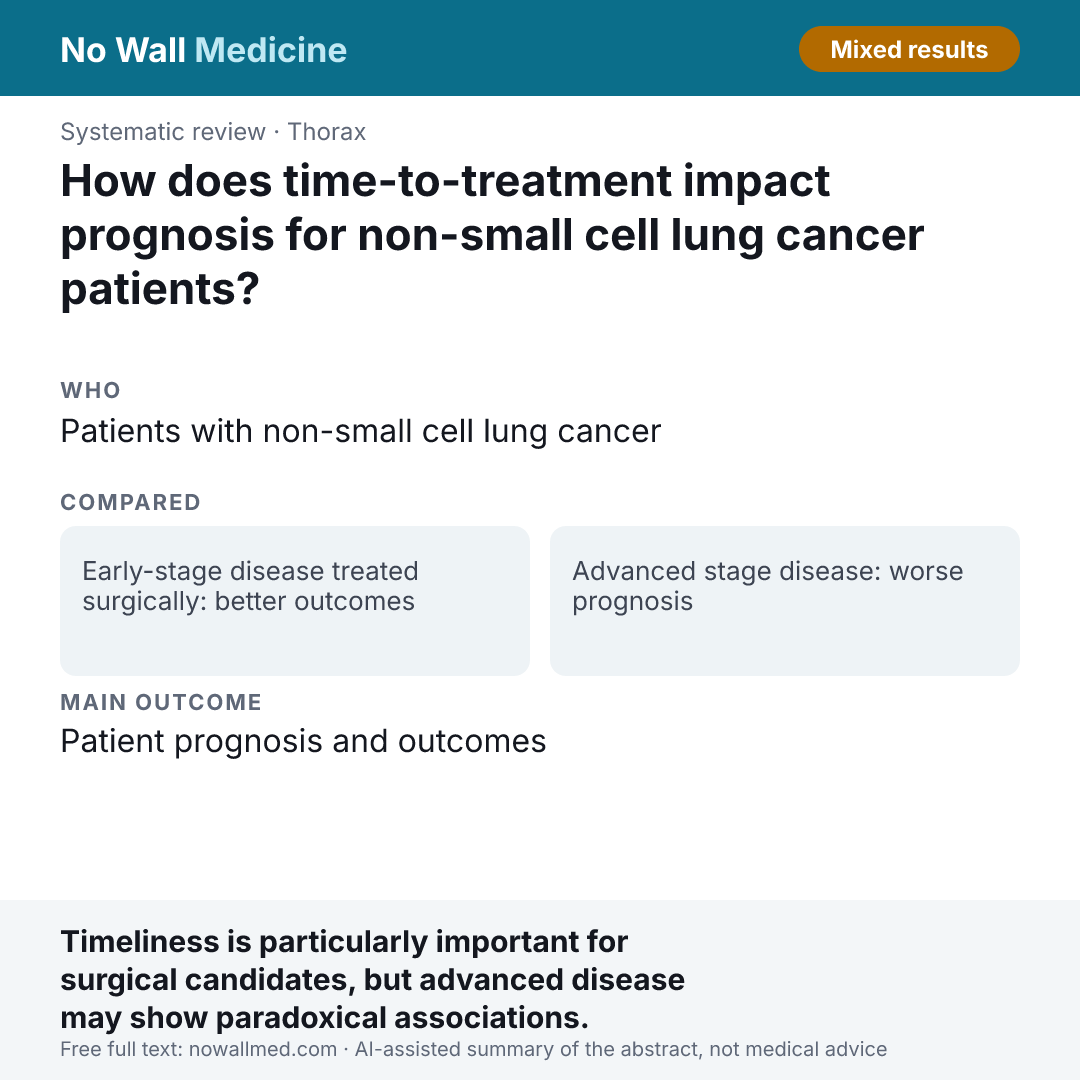
Clinical question: How does time-to-treatment impact prognosis for non-small cell lung cancer patients?
Key points
- Researchers reviewed 37 articles to examine how the time between diagnosis and treatment relates to outcomes in non-small cell lung cancer patients.
- Timely care was associated with better outcomes for patients with early-stage disease treated with surgery in 9/12 studies.
- In 6/8 studies, timely care was associated with a worse prognosis for patients with advanced stage disease.
Limitation the authors note: Most of the included studies were observational rather than randomized controlled trials.
Headline and key points written with AI from the paper’s abstract, with every number checked against it. Read the paper before relying on them.
Was this summary helpful?
Abstract
Background
National targets for timely diagnosis and management of a potential cancer are driven in part by the perceived risk of disease progression during avoidable delays. However, it is unclear to what extent time-to-treatment impacts prognosis for patients with non-small cell lung cancer, with previous reviews reporting mixed or apparently paradoxical associations. This systematic review focuses on potential confounders in order to identify particular patient groups which may benefit most from timely delivery of care. Methods
Medline, EMBASE and Cochrane databases were searched for publications between January 2012 and October 2020, correlating timeliness in secondary care pathways to patient outcomes. The protocol is registered with PROSPERO (the International Prospective Register of Systematic Reviews; ID 99239). Prespecified factors (demographics, performance status, histology, stage and treatment) are examined through narrative synthesis. Results
Thirty-seven articles were included. All but two were observational. Timely care was generally associated with a worse prognosis in those with advanced stage disease (6/8 studies) but with better outcomes for patients with early-stage disease treated surgically (9/12 studies). In one study, patients with squamous cell carcinoma referred for stereotactic ablative radiotherapy benefited more from timely care, compared with patients with adenocarcinoma. One randomised controlled trial supported timeliness as being advantageous in those with stage I-IIIA disease. Conclusion
There are limitations to the available evidence, but observed trends suggest timeliness to be of particular importance in surgical candidates. In more advanced disease, survival trends are likely outweighed by symptom burden, performance status or clinical urgency dictating timeliness of treatment.
Abstract reproduced under the article’s CC BY licence.
Subject terms
Headline, design, result, key points, caveat and citation as plain text.
Cite this article
Hall H, Tocock A, Burdett S, et al. Association between time-to-treatment and outcomes in non-small cell lung cancer: a systematic review. Thorax. 2021. doi:10.1136/thoraxjnl-2021-216865
Spotted a mistake? Suggest a correction