Association between triglyceride glucose index and arterial stiffness and coronary artery calcification: a systematic review and exposure-effect meta-analysis
Systematic review and exposure-effect meta-analysisHarm found
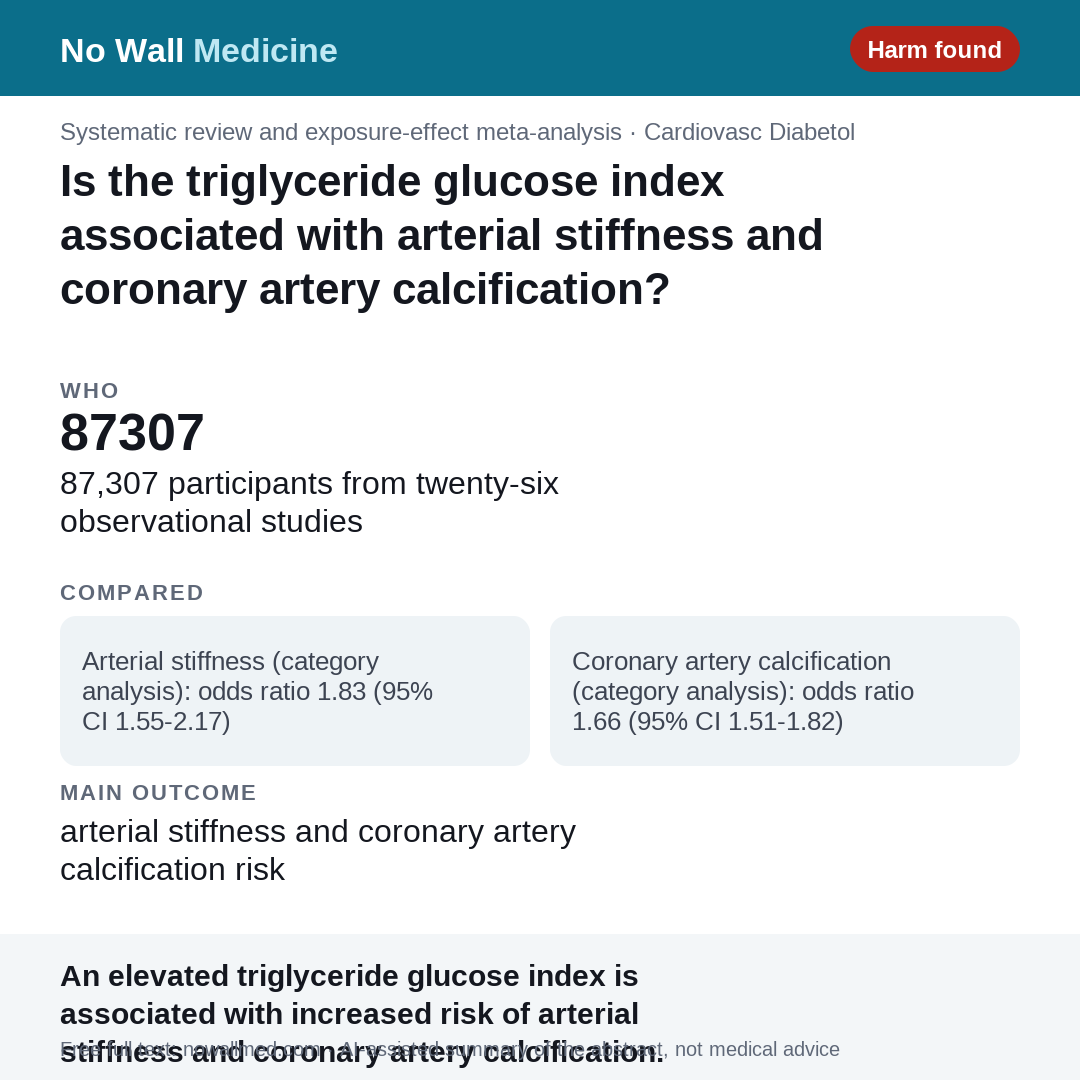
Is the triglyceride glucose index associated with arterial stiffness and coronary artery calcification?
Who
87307
87,307 participants from twenty-six observational studies
Compared
Arterial stiffness (category analysis): odds ratio 1.83 (95% CI 1.55-2.17)
Coronary artery calcification (category analysis): odds ratio 1.66 (95% CI 1.51-1.82)
Main outcome
arterial stiffness and coronary artery calcification risk
Bottom line: An elevated triglyceride glucose index is associated with increased risk of arterial stiffness and coronary artery calcification.
Limitation: Prospective studies are needed to assess causality.
Cardiovasc Diabetol · 2023-05-13Download image
Clinical question: Is the triglyceride glucose index associated with arterial stiffness and coronary artery calcification?
Abstract
Background
The triglyceride and glucose (TyG) index has been linked to various cardiovascular diseases. However, it's still unclear whether the TyG index is associated with arterial stiffness and coronary artery calcification (CAC). Methods
We conducted a systematic review and meta-analysis of relevant studies until September 2022 in the PubMed, Cochrane Library, and Embase databases. We used a random-effects model to calculate the pooled effect estimate and the robust error meta-regression method to summarize the exposure-effect relationship. Results
Twenty-six observational studies involving 87,307 participants were included. In the category analysis, the TyG index was associated with the risk of arterial stiffness (odds ratio [OR]: 1.83; 95% CI 1.55-2.17, I2 = 68%) and CAC (OR: 1.66; 95% CI 1.51-1.82, I2 = 0). The per 1-unit increment in the TyG index was also associated with an increased risk of arterial stiffness (OR: 1.51, 95% CI 1.35-1.69, I2 = 82%) and CAC (OR: 1.73, 95% CI 1.36-2.20, I2 = 51%). Moreover, a higher TyG index was shown to be a risk factor for the progression of CAC (OR = 1.66, 95% CI 1.21-2.27, I2 = 0, in category analysis, OR = 1.47, 95% CI 1.29-1.68, I2 = 41% in continuity analysis). There was a positive nonlinear association between the TyG index and the risk of arterial stiffness (Pnonlinearity < 0.001). Conclusion
An elevated TyG index is associated with an increased risk of arterial stiffness and CAC. Prospective studies are needed to assess causality.
Topics
Cite this article
Liu F, Ling Q, Xie S, Xu Y, Liu M, Hu Q. Association between triglyceride glucose index and arterial stiffness and coronary artery calcification: a systematic review and exposure-effect meta-analysis. Cardiovasc Diabetol. 2023. doi:10.1186/s12933-023-01819-2
Spotted a mistake? Suggest a correction
Top studies every Monday
The week’s key trials and guidelines in your specialties, plus any topics you follow. By email, free.
Get the weekly digest