Higher brain tissue density at 24 hours is associated with better stroke recovery outcomes
Association of 24-Hour Computed Tomography Infarct Density on Functional Outcomes in Stroke: Secondary Analysis From the AcT Trial
Secondary analysis from a randomized trialBenefit found
Does 24-hour computed tomography infarct density modify the relationship between infarct volume and functional outcomes?
Who
839
Patients with detected 24-hour computed tomography infarct and no parenchymal hematoma
Compared
Higher standardized infarct density: acOR 0.87 (95% CI 0.80-0.96) per 1-standardized-Hounsfield Unit increase
Infarct volume: acOR 0.96 (95% CI 0.90-1.01) per 5-mL increase
Main outcome
90-day ordinal modified Rankin Scale score
Result: acOR 0.87 (95% CI 0.80-0.96) per 1-standardized-Hounsfield Unit increase
Bottom line: Higher 24-hour computed tomography infarct density is independently associated with better 90-day functional outcomes in acute ischemic stroke.
J Am Heart Assoc · 2026-05-25Download image
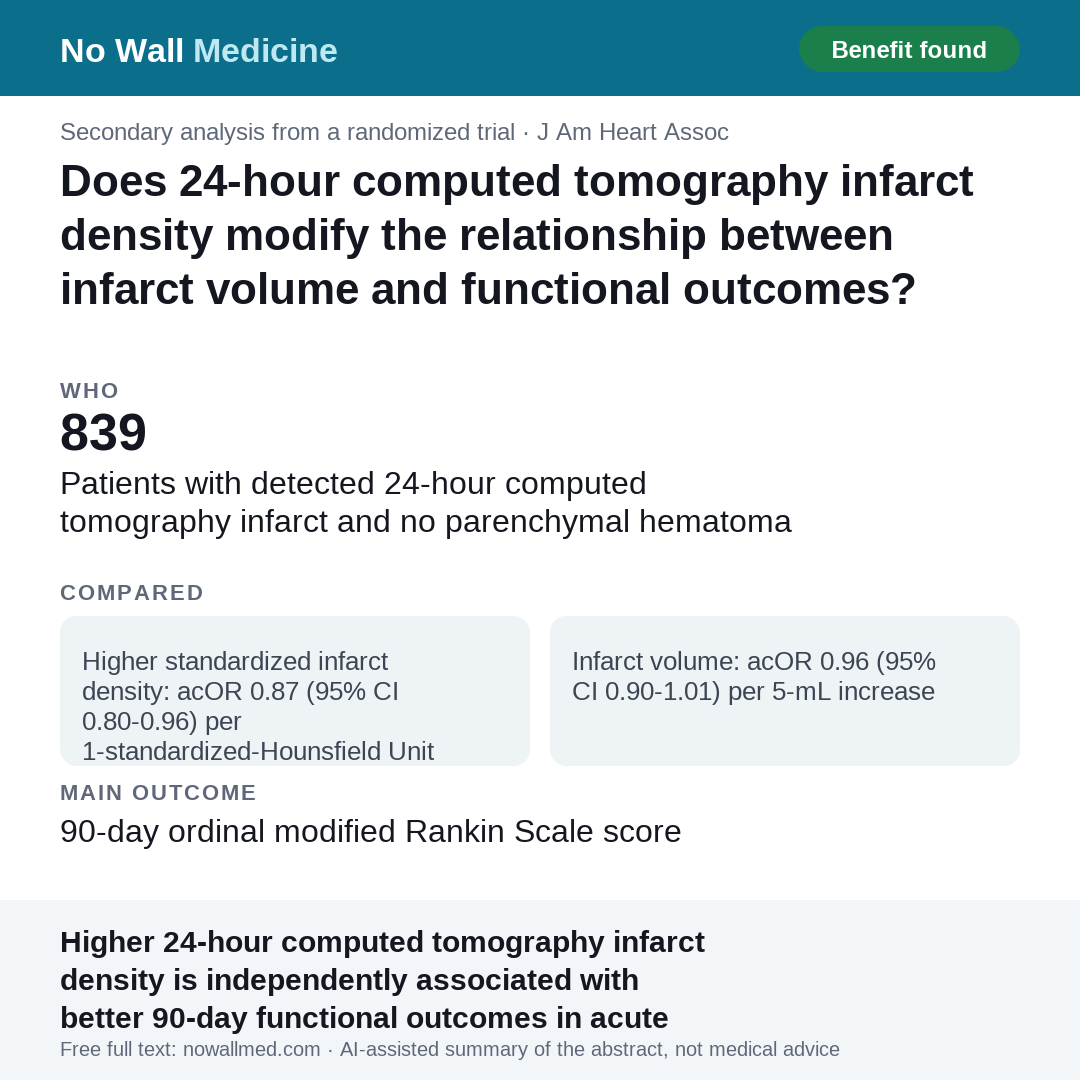
Clinical question: Does 24-hour computed tomography infarct density modify the relationship between infarct volume and functional outcomes?
Why it matters: Discrepancies frequently occur between the final volume of brain tissue damaged during a stroke and the actual functional recovery of the patient.
Key points
- Researchers analyzed 839 patients from the Alteplase Versus Tenecteplase in Acute Ischemic Stroke trial to study how brain tissue density affects recovery.
- Higher standardized infarct density was associated with better 90-day functional scores with an adjusted common odds ratio of 0.87 per 1-standardized-Hounsfield Unit increase.
- While density was linked to better outcomes, infarct volume alone was not significantly associated with the 90-day modified Rankin Scale score.
Headline and key points written with AI from the paper’s abstract, with every number checked against it. Read the paper before relying on them.
Topics
Cite this article
Pensato U, Zhang J, Barakhanov K, Tanaka K, Bala F, Kaveeta C. Association of 24-Hour Computed Tomography Infarct Density on Functional Outcomes in Stroke: Secondary Analysis From the AcT Trial. J Am Heart Assoc. 2026. doi:10.1161/JAHA.125.046038
Spotted a mistake? Suggest a correction