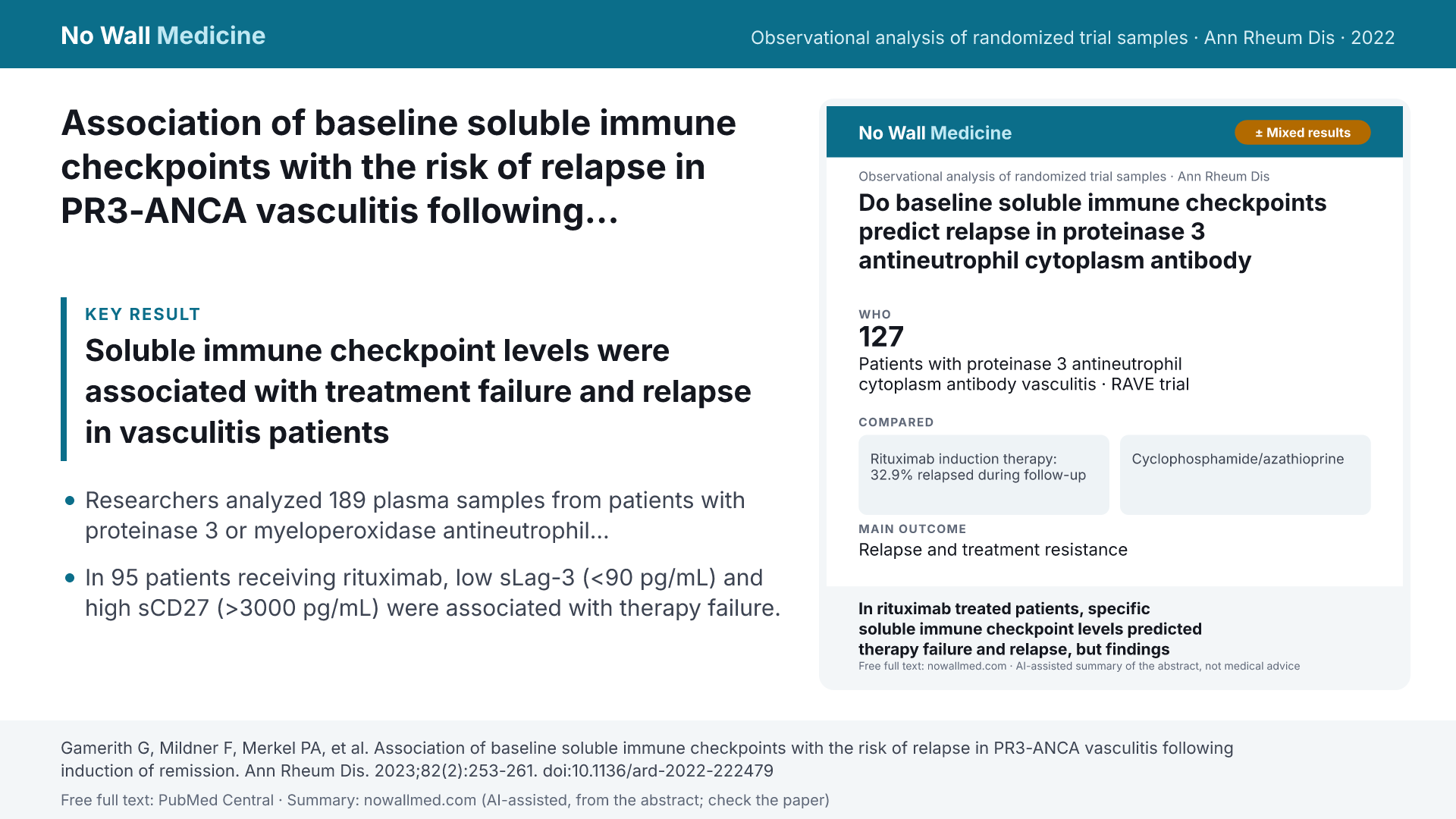
Soluble immune checkpoint levels were associated with treatment failure and relapse in vasculitis patients
Association of baseline soluble immune checkpoints with the risk of relapse in PR3-ANCA vasculitis following induction of remission
Observational analysis of randomized trial samplesMixed results
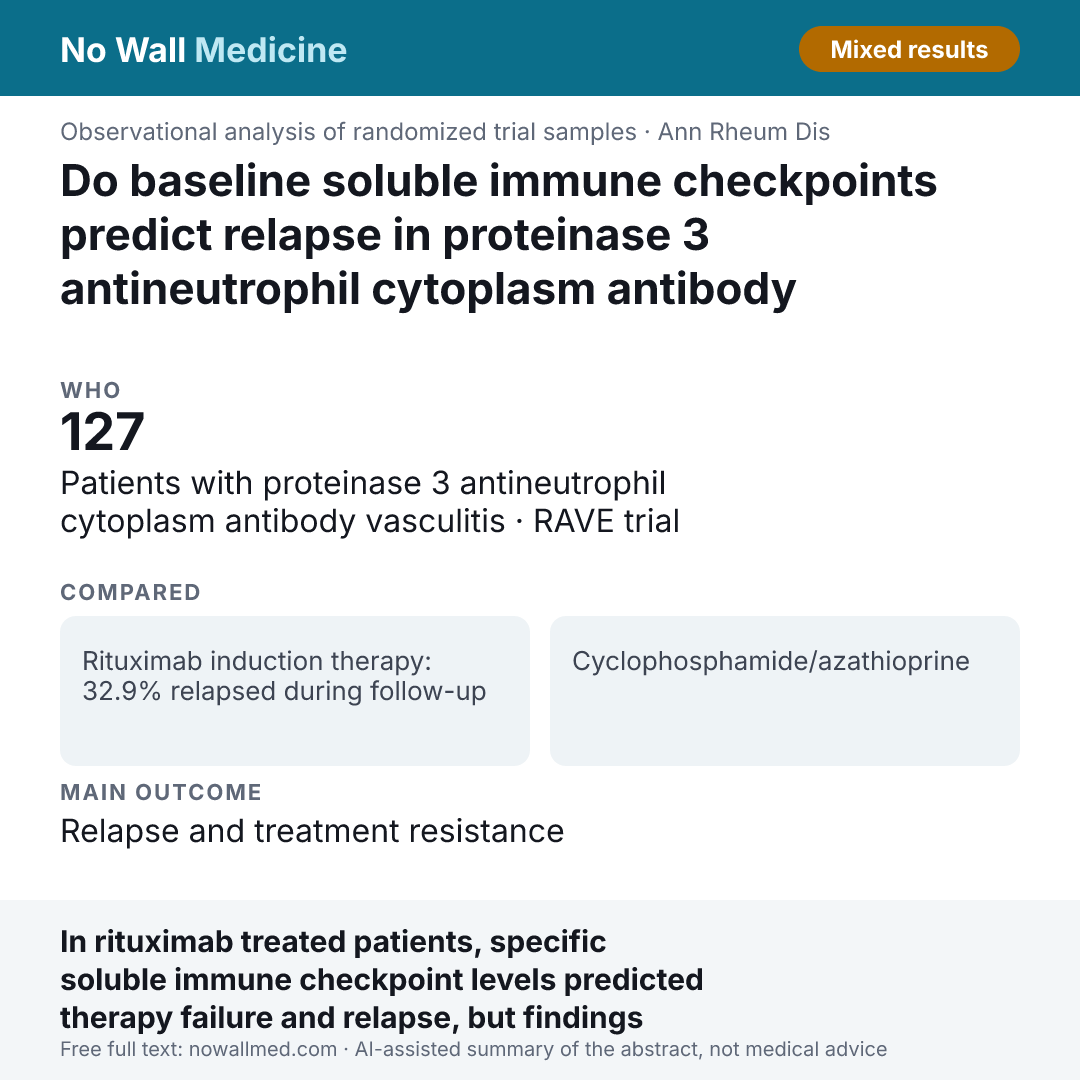
Do baseline soluble immune checkpoints predict relapse in proteinase 3 antineutrophil cytoplasm antibody vasculitis?
Who
127
Patients with proteinase 3 antineutrophil cytoplasm antibody vasculitis · RAVE trial
Compared
Rituximab induction therapy: 32.9% relapsed during follow-up
Cyclophosphamide/azathioprine
Main outcome
Relapse and treatment resistance
Bottom line: In rituximab treated patients, specific soluble immune checkpoint levels predicted therapy failure and relapse, but findings were not replicated in cyclophosphamide/azathioprine.
Ann Rheum Dis · 2022-08-16 · Save PNG
Clinical question: Do baseline soluble immune checkpoints predict relapse in proteinase 3 antineutrophil cytoplasm antibody vasculitis?
Key points
- Researchers analyzed 189 plasma samples from patients with proteinase 3 or myeloperoxidase antineutrophil cytoplasm antibody vasculitis to study soluble immune checkpoint concentrations.
- In 95 patients receiving rituximab, low sLag-3 (<90 pg/mL) and high sCD27 (>3000 pg/mL) were associated with therapy failure.
- Among 73 patients on rituximab, 32.9% who reached remission at 6 months relapsed, and high sTim-3 (>1200 pg/mL), sCD27 (>1250 pg/mL), and sBTLA (>1000 pg/mL) were associated with relapse and infections.
Headline and key points written with AI from the paper’s abstract, with every number checked against it. Read the paper before relying on them.
Was this summary helpful?
Subject terms
Headline, design, result, key points, caveat and citation as plain text.
Cite this article
Gamerith G, Mildner F, Merkel PA, et al. Association of baseline soluble immune checkpoints with the risk of relapse in PR3-ANCA vasculitis following induction of remission. Ann Rheum Dis. 2023;82(2):253-261. doi:10.1136/ard-2022-222479
Spotted a mistake? Suggest a correction