Faster declines in prostate-specific antigen levels were associated with lower mortality in prostate cancer patients
Association of Deep and Durable Prostate-specific Antigen Responses with Outcomes in Metastatic Hormone-sensitive Prostate Cancer: Insights from ARASENS and ARANOTE Trials
Analysis of two phase 3 trialsBenefit found
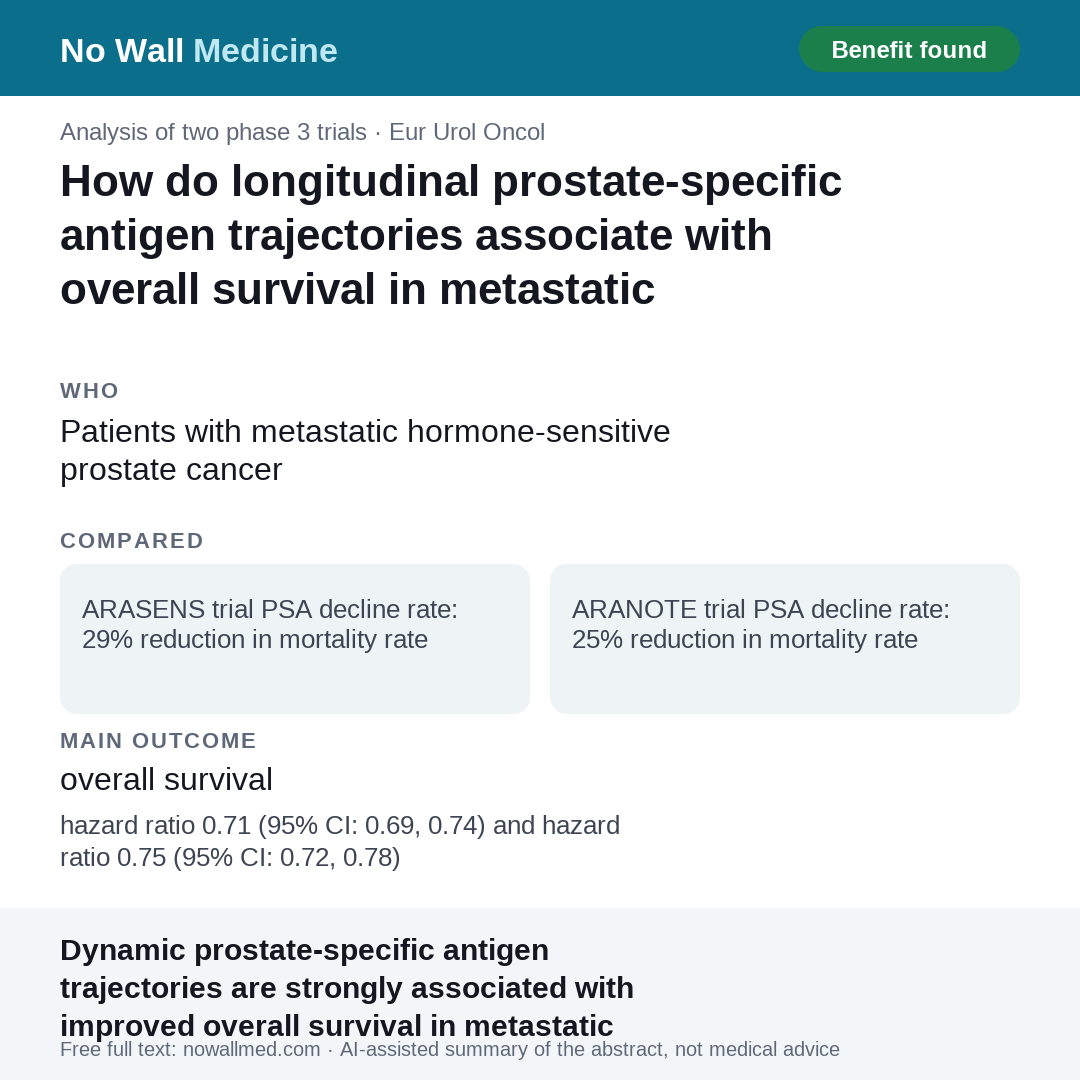
How do longitudinal prostate-specific antigen trajectories associate with overall survival in metastatic hormone-sensitive prostate cancer?
Who
Patients with metastatic hormone-sensitive prostate cancer
Compared
ARASENS trial PSA decline rate: 29% reduction in mortality rate
ARANOTE trial PSA decline rate: 25% reduction in mortality rate
Main outcome
overall survival
Result: hazard ratio 0.71 (95% CI: 0.69, 0.74) and hazard ratio 0.75 (95% CI: 0.72, 0.78)
Bottom line: Dynamic prostate-specific antigen trajectories are strongly associated with improved overall survival in metastatic hormone-sensitive prostate cancer.
Limitation: Interim overall survival data in ARANOTE and influence of prior treatments on baseline prostate-specific antigen.
Eur Urol Oncol · 2025-04-30Download image
Clinical question: How do longitudinal prostate-specific antigen trajectories associate with overall survival in metastatic hormone-sensitive prostate cancer?
Why it matters: Traditional methods often use fixed time points to categorize prostate-specific antigen levels instead of accounting for the dynamic nature of these levels over time.
Key points
- Researchers analyzed data from 1305 patients in the ARASENS trial and 669 patients in the ARANOTE trial with metastatic hormone-sensitive prostate cancer.
- In the ARASENS trial, each doubling of the prostate-specific antigen decline rate was associated with a 29% reduction in mortality rate.
- In the ARANOTE trial, each doubling of the prostate-specific antigen decline rate was associated with a 25% reduction in mortality rate.
Headline and key points written with AI from the paper’s abstract, with every number checked against it. Read the paper before relying on them.
Was this summary helpful?
Subject terms
Cite this article
Wallis CJD, Ekberg S, Morgans AK, Boegemann M, Paracha N, Gallagher E. Association of Deep and Durable Prostate-specific Antigen Responses with Outcomes in Metastatic Hormone-sensitive Prostate Cancer: Insights from ARASENS and ARANOTE Trials. Eur Urol Oncol. 2025. doi:10.1016/j.euo.2025.03.001
Spotted a mistake? Suggest a correction
Top studies every Monday
The week’s key trials and guidelines in your specialties, plus any topics you follow. By email, free.
Get the weekly digest