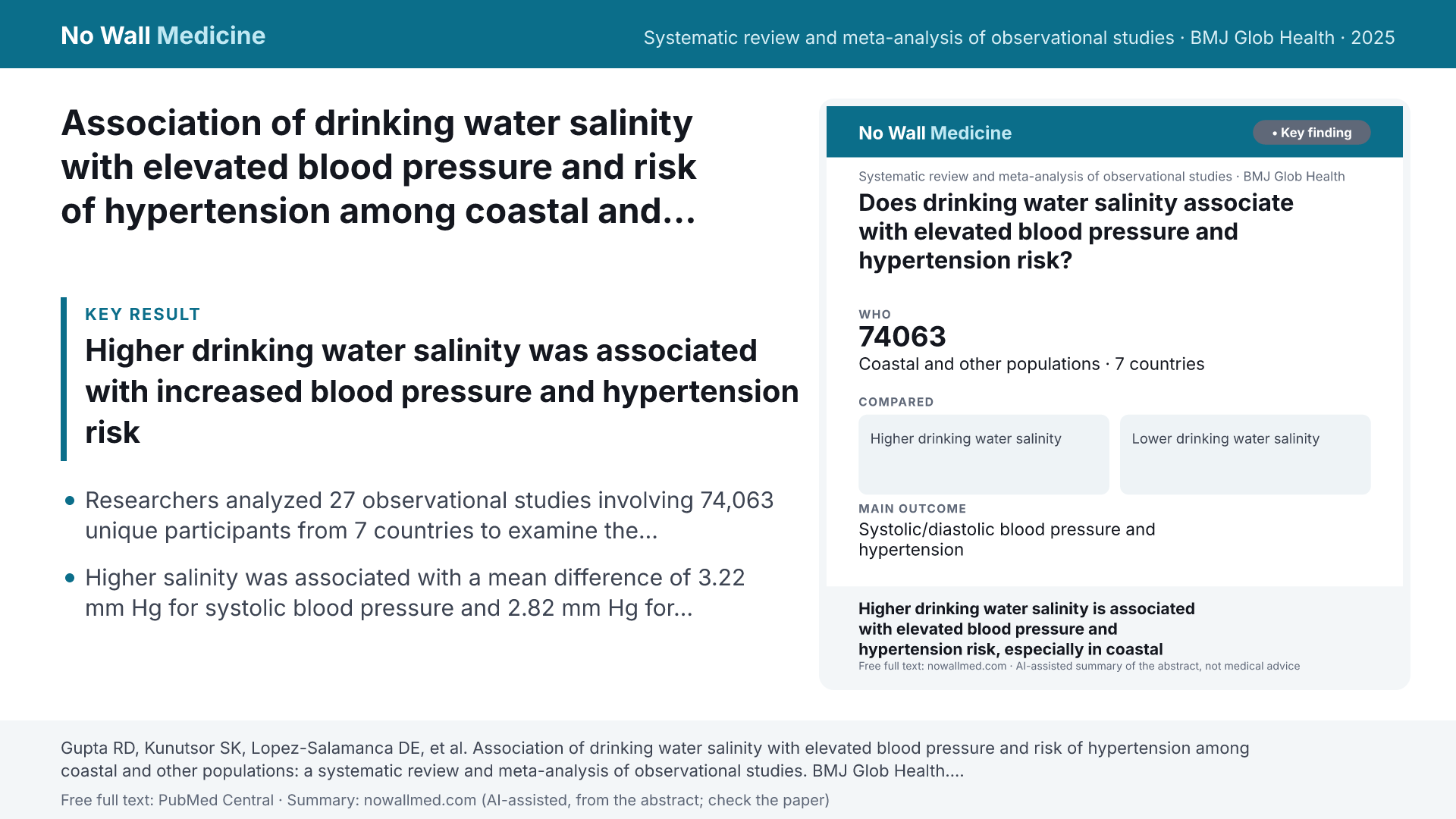
Higher drinking water salinity was associated with increased blood pressure and hypertension risk
Association of drinking water salinity with elevated blood pressure and risk of hypertension among coastal and other populations: a systematic review and meta-analysis of observational studies
Systematic review and meta-analysis of observational studiesBenefit found
Does drinking water salinity associate with elevated blood pressure and hypertension risk?
Who
74063
Coastal and other populations · 7 countries
Compared
Higher drinking water salinity
Lower drinking water salinity
Main outcome
Systolic/diastolic blood pressure and hypertension
Result: odds ratio 1.26 (95% CI 1.07 to 1.48)
Bottom line: Higher drinking water salinity is associated with elevated blood pressure and hypertension risk, especially in coastal populations.
Limitation: Insufficient number of studies with reliable data on coronary heart disease or stroke outcomes.
BMJ Glob Health · 2025-12-10Download image
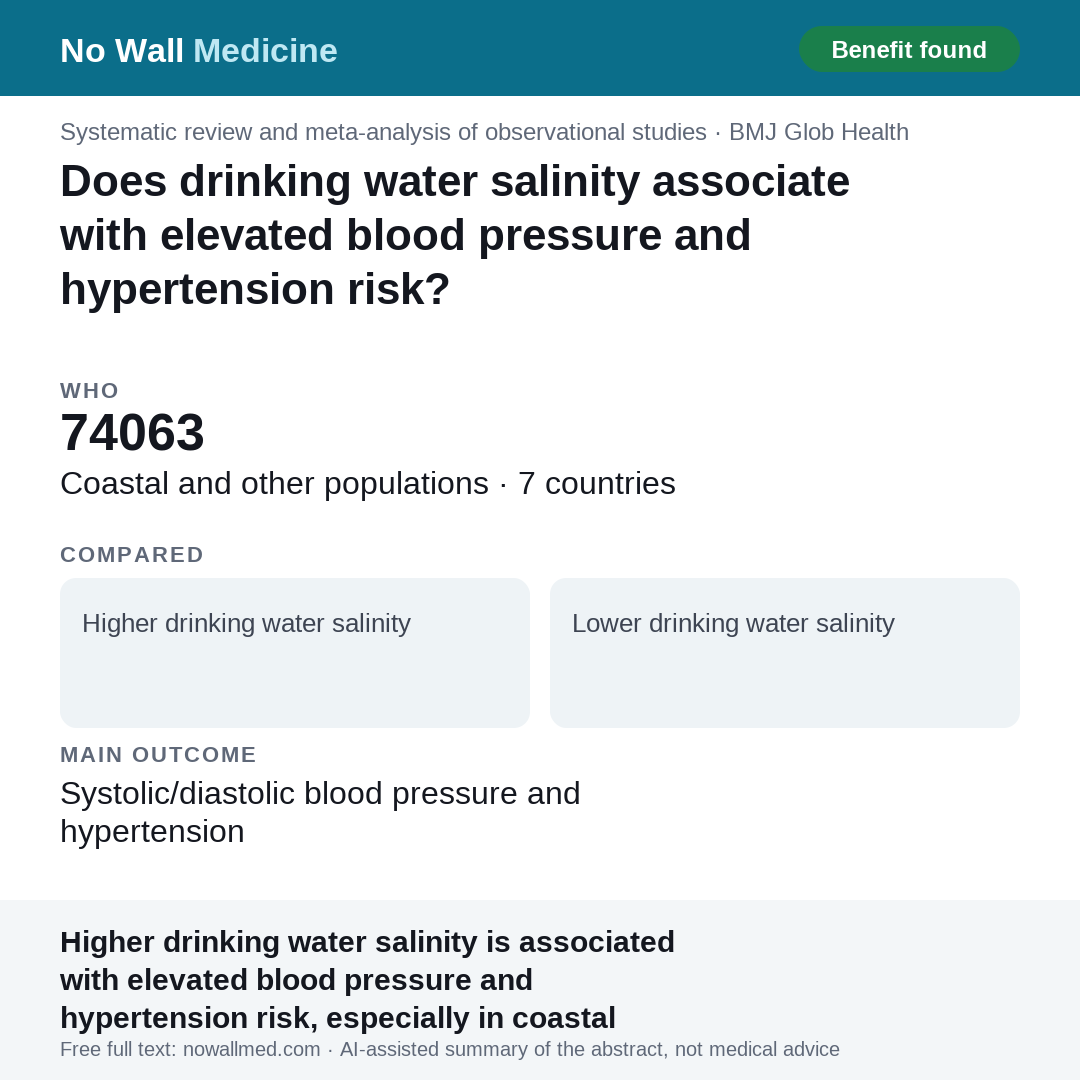
Clinical question: Does drinking water salinity associate with elevated blood pressure and hypertension risk?
Why it matters: The link between drinking water salinity and increased blood pressure and hypertension risk among coastal and other populations remains unclear.
Key points
- Researchers analyzed 27 observational studies involving 74,063 unique participants from 7 countries to examine the link between water salinity and cardiovascular health.
- Higher salinity was associated with a mean difference of 3.22 mm Hg for systolic blood pressure and 2.82 mm Hg for diastolic blood pressure.
- Higher drinking water salinity was associated with an odds ratio of 1.26 for hypertension compared to lower salinity levels.
Limitation the authors note: There was an insufficient number of studies with reliable data on coronary heart disease or stroke outcomes.
Headline and key points written with AI from the paper’s abstract, with every number checked against it. Read the paper before relying on them.
Was this summary helpful?
Abstract
Background
The link between drinking water salinity and increased blood pressure and hypertension risk among coastal and other populations remains unclear. To investigate this, we performed a systematic review and meta-analysis of observational studies on drinking water salinity and cardiovascular outcomes. Methods
We systematically searched MEDLINE, Embase and Web of Science for relevant studies published until 10 May 2025. Observational studies reporting on the association between sodium in drinking water and systolic/diastolic blood pressure (SBP/DBP), hypertension, coronary heart disease (CHD), stroke and composite cardiovascular outcomes were prespecified to be included. We assessed study quality using the Newcastle-Ottawa Scale and performed random effects meta-analysis. Results
We identified 27 observational studies (involving 74 063 unique participants from 7 countries), 15 of which included coastal populations. Comparing higher versus lower drinking water salinity, the mean differences were 3.22 mm Hg (95% CI 1.11 to 5.33) for SBP and 2.82 mm Hg (95% CI 1.44 to 4.20) for DBP. The pooled OR for hypertension, comparing higher versus lower water salinity, was 1.26 (95% CI 1.07 to 1.48). These associations were generally consistent across subgroups but were statistically significant for studies conducted in coastal populations and for those published after 2000. However, we found an insufficient number of studies with reliable data on CHD or stroke outcomes. Conclusions
Higher drinking water salinity is associated with an elevated risk of blood pressure and hypertension, especially among coastal populations. More research is needed to examine connections with CHD and stroke, and to create strategies to counter salinity's effects, particularly in climate-vulnerable coastal areas.
Abstract reproduced under the article’s CC BY NC licence.
Subject terms
Cite this article
Gupta RD, Kunutsor SK, Lopez-Salamanca DE, et al. Association of drinking water salinity with elevated blood pressure and risk of hypertension among coastal and other populations: a systematic review and meta-analysis of observational studies. BMJ Glob Health. 2025. doi:10.1136/bmjgh-2024-018543
Spotted a mistake? Suggest a correction