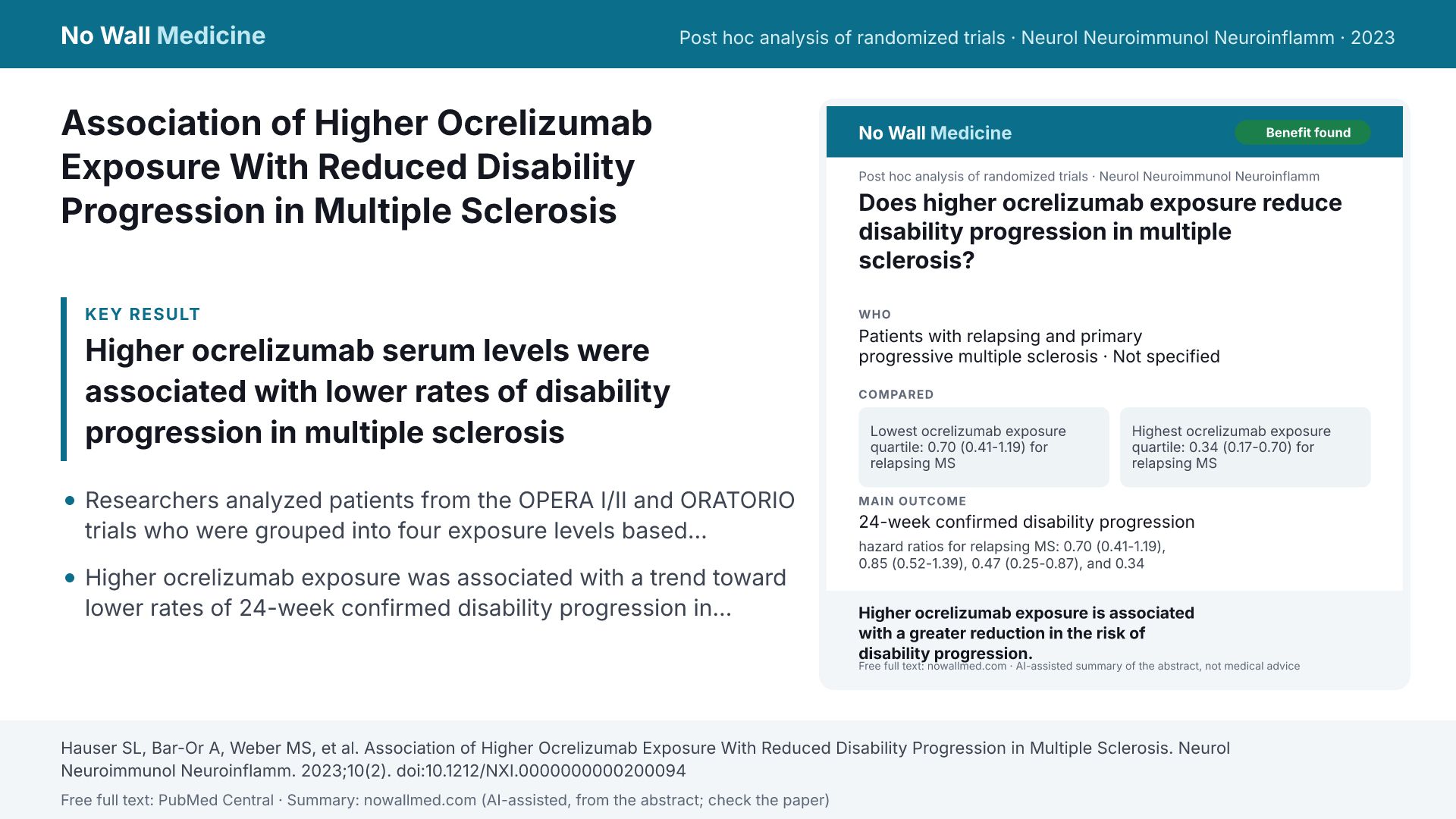
Higher ocrelizumab serum levels were associated with lower rates of disability progression in multiple sclerosis
Association of Higher Ocrelizumab Exposure With Reduced Disability Progression in Multiple Sclerosis
Post hoc analysis of randomized trialsBenefit found
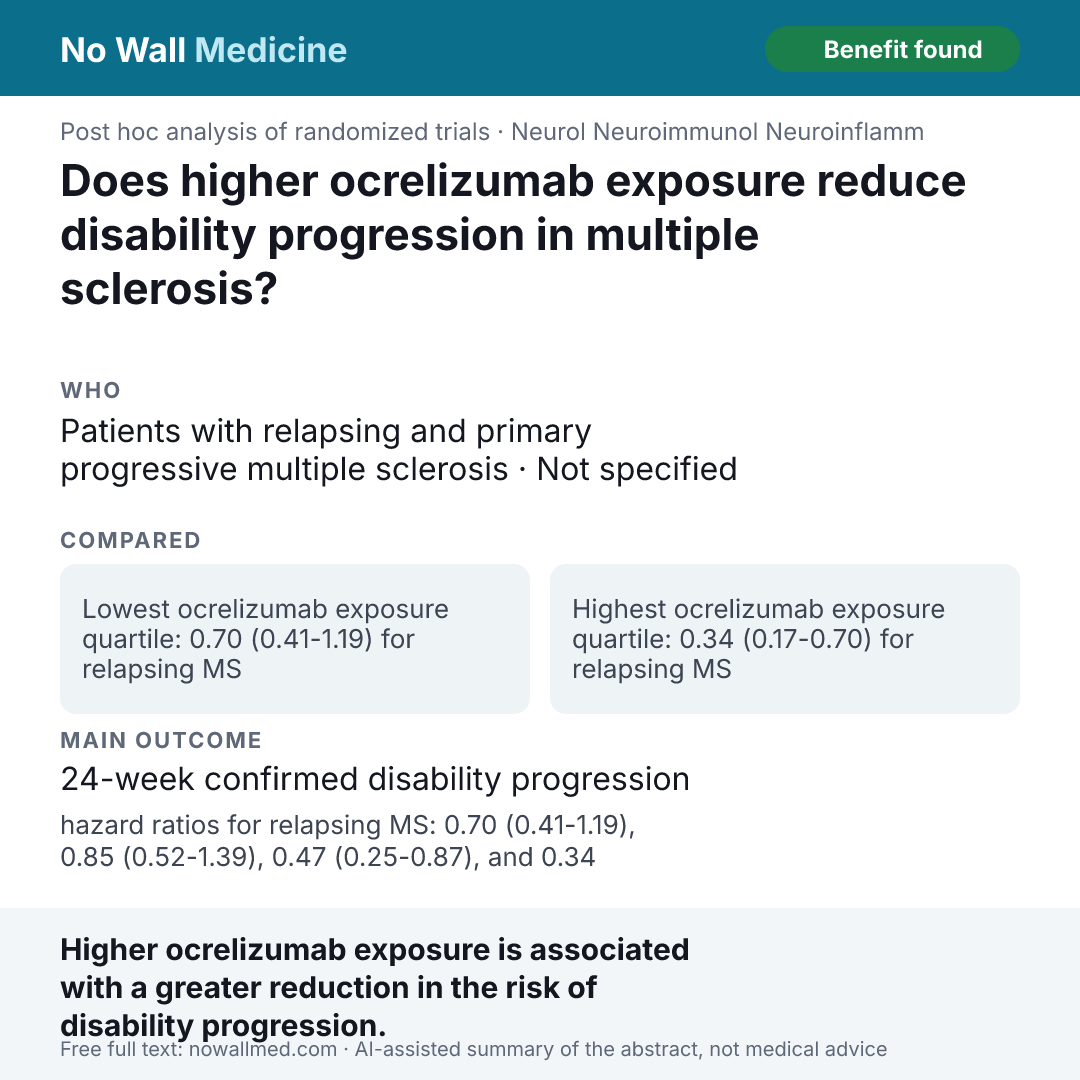
Does higher ocrelizumab exposure reduce disability progression in multiple sclerosis?
Who
Patients with relapsing and primary progressive multiple sclerosis · Not specified
Compared
Lowest ocrelizumab exposure quartile: 0.70 (0.41-1.19) for relapsing MS
Highest ocrelizumab exposure quartile: 0.34 (0.17-0.70) for relapsing MS
Main outcome
24-week confirmed disability progression
Result: hazard ratios for relapsing MS: 0.70 (0.41-1.19), 0.85 (0.52-1.39), 0.47 (0.25-0.87), and 0.34 (0.17-0.70)
Bottom line: Higher ocrelizumab exposure is associated with a greater reduction in the risk of disability progression.
Neurol Neuroimmunol Neuroinflamm · 2023-02-15 · Save PNG
Same trial (NCT01247324, NCT01412333)
Papers we list that report this registered trial, oldest first. Read a secondary analysis alongside the main results.
- Secondary analysis Benefit found
This paper Neurol Neuroimmunol Neuroinflamm 2023-02 - Main results No clear difference
Ocrelizumab treatment did not change the diversity of T-cell receptors in relapsing multiple sclerosis Neurol Neuroimmunol Neuroinflamm 2023-04 - Secondary analysis Benefit found
Ocrelizumab as first-line therapy for early-stage relapsing multiple sclerosis showed sustained efficacy over nine years Neurology 2025-01 - Related analysis Benefit found
Continuous ocrelizumab treatment for ten years was associated with lower disability progression in relapsing multiple sclerosis JAMA Neurol 2026-10
Clinical question: Does higher ocrelizumab exposure reduce disability progression in multiple sclerosis?
Key points
- Researchers analyzed patients from the OPERA I/II and ORATORIO trials who were grouped into four exposure levels based on their individual ocrelizumab serum concentrations.
- Higher ocrelizumab exposure was associated with a trend toward lower rates of 24-week confirmed disability progression in both relapsing and primary progressive multiple sclerosis.
- The annualized relapse rate in relapsing multiple sclerosis was reduced to 0.13-0.18, and infusion-related reactions or serious infections were similar across all exposure groups.
Headline and key points written with AI from the paper’s abstract, with every number checked against it. Read the paper before relying on them.
Was this summary helpful?
Subject terms
Headline, design, result, key points, caveat and citation as plain text.
Cite this article
Hauser SL, Bar-Or A, Weber MS, et al. Association of Higher Ocrelizumab Exposure With Reduced Disability Progression in Multiple Sclerosis. Neurol Neuroimmunol Neuroinflamm. 2023;10(2). doi:10.1212/NXI.0000000000200094
Spotted a mistake? Suggest a correction