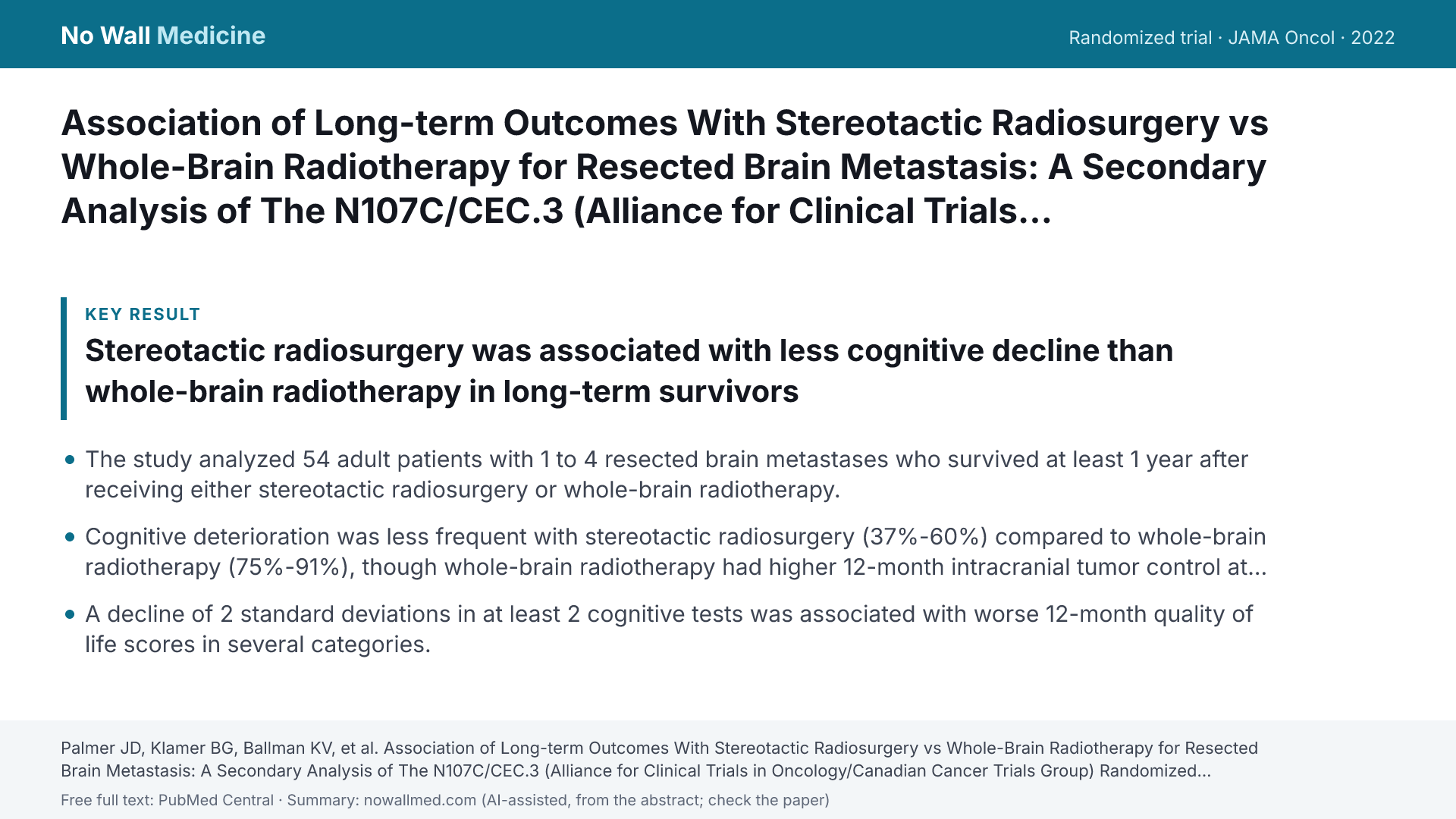
Stereotactic radiosurgery was associated with less cognitive decline than whole-brain radiotherapy in long-term survivors
Association of Long-term Outcomes With Stereotactic Radiosurgery vs Whole-Brain Radiotherapy for Resected Brain Metastasis: A Secondary Analysis of The N107C/CEC.3 (Alliance for Clinical Trials in Oncology/Canadian Cancer Trials Group) Randomized Clinical Trial
Same trial (NCT01372774)
Papers we list that report this registered trial, oldest first. Read a secondary analysis alongside the main results.
- Longer follow-up
This paper JAMA Oncol 2022-10 - Secondary analysis Mixed results
Blood protein levels were associated with cognitive decline after radiation for brain metastasis Neuro Oncol 2022-12
Key points
- The study analyzed 54 adult patients with 1 to 4 resected brain metastases who survived at least 1 year after receiving either stereotactic radiosurgery or whole-brain radiotherapy.
- Cognitive deterioration was less frequent with stereotactic radiosurgery (37%-60%) compared to whole-brain radiotherapy (75%-91%), though whole-brain radiotherapy had higher 12-month intracranial tumor control at 81.5% versus 40.7%.
- A decline of 2 standard deviations in at least 2 cognitive tests was associated with worse 12-month quality of life scores in several categories.
Headline and key points written with AI from the paper’s abstract, with every number checked against it. Read the paper before relying on them.
Was this summary helpful?
Subject terms
Headline, design, result, key points, caveat and citation as plain text.
Cite this article
Palmer JD, Klamer BG, Ballman KV, et al. Association of Long-term Outcomes With Stereotactic Radiosurgery vs Whole-Brain Radiotherapy for Resected Brain Metastasis: A Secondary Analysis of The N107C/CEC.3 (Alliance for Clinical Trials in Oncology/Canadian Cancer Trials Group) Randomized Clinical Trial. JAMA Oncol. 2022;8(12):1809-1815. doi:10.1001/jamaoncol.2022.5049
Spotted a mistake? Suggest a correction