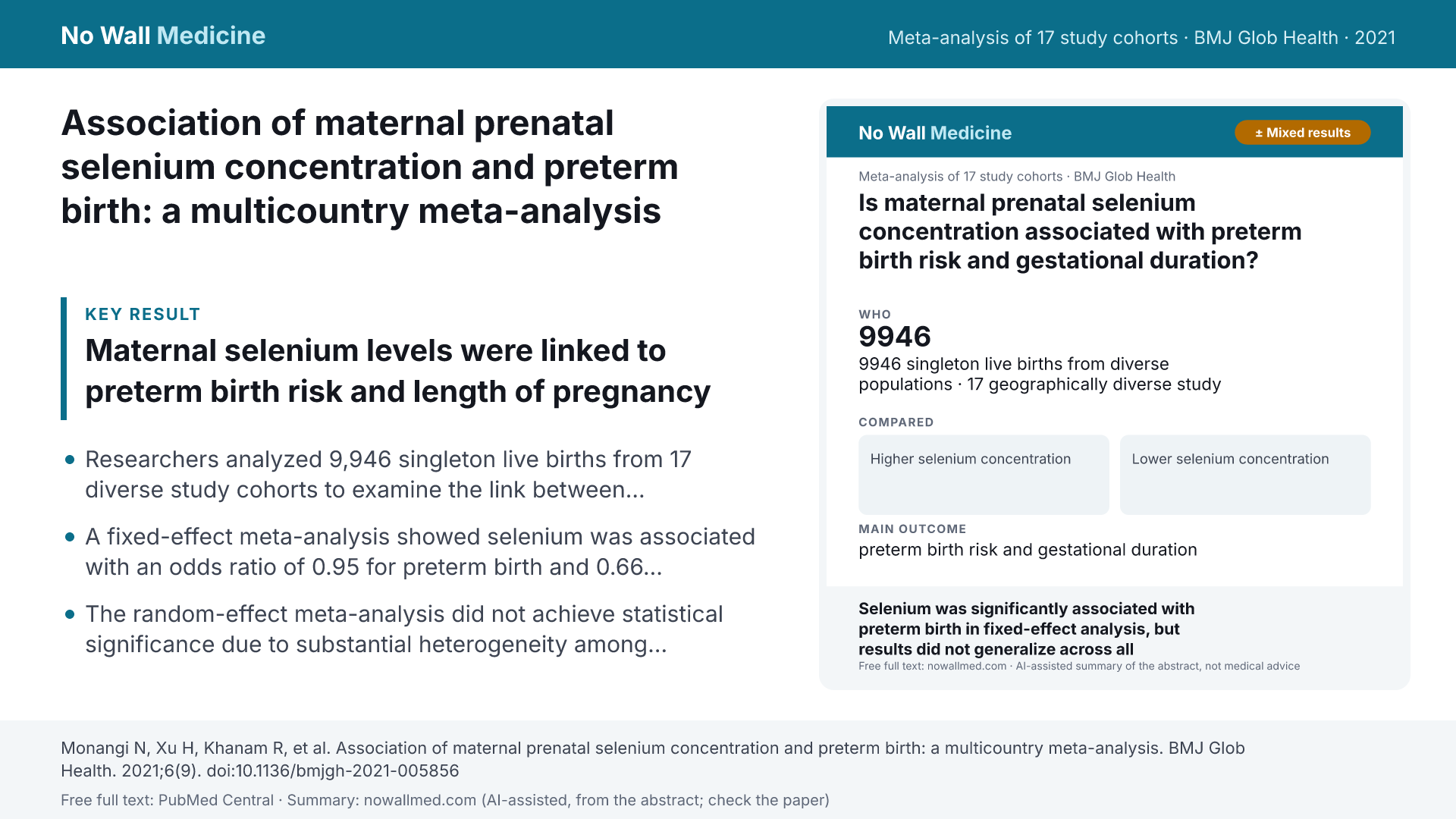
Maternal selenium levels were linked to preterm birth risk and length of pregnancy
Association of maternal prenatal selenium concentration and preterm birth: a multicountry meta-analysis
Meta-analysis of 17 study cohortsMixed results
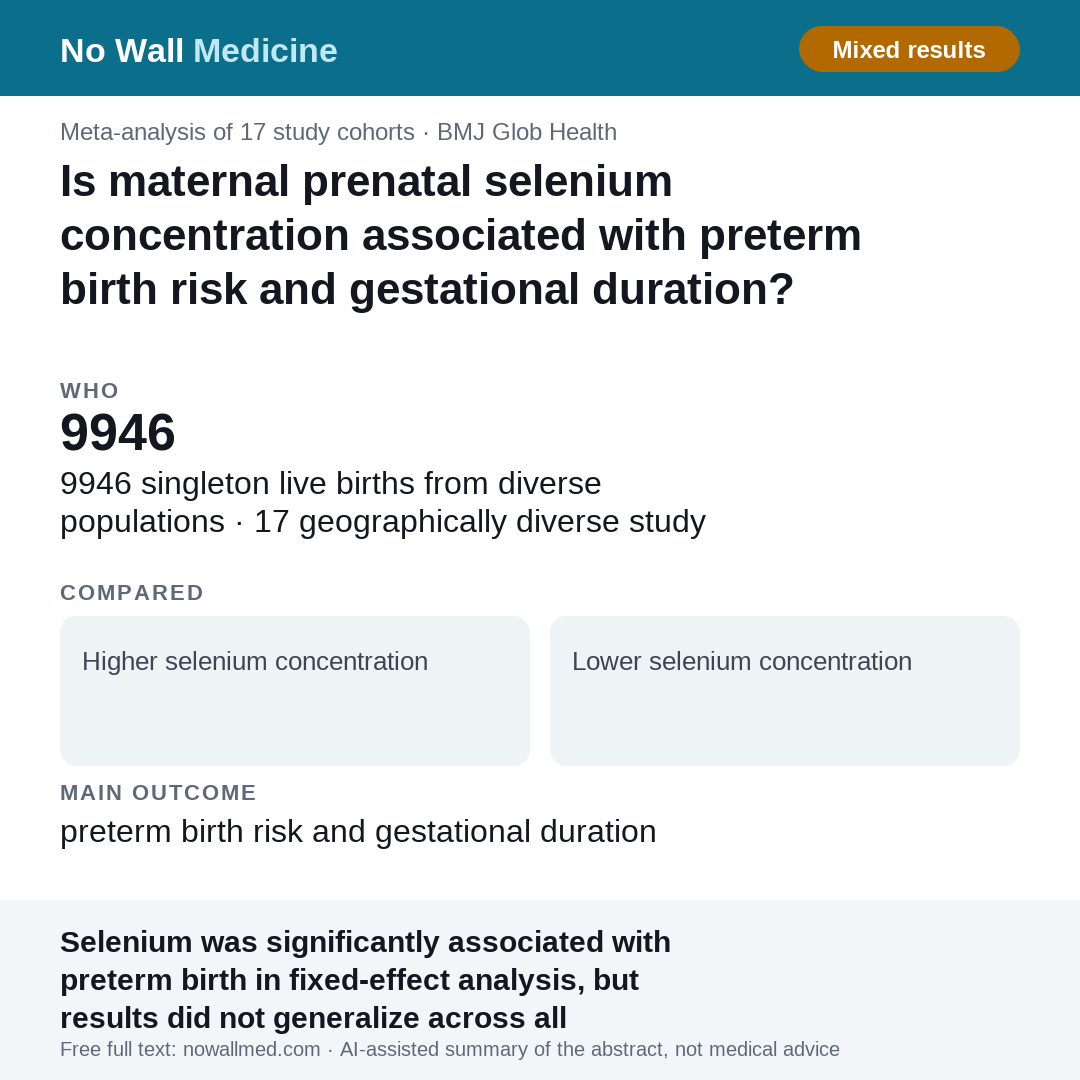
Is maternal prenatal selenium concentration associated with preterm birth risk and gestational duration?
Who
9946
9946 singleton live births from diverse populations · 17 geographically diverse study cohorts
Compared
Higher selenium concentration
Lower selenium concentration
Main outcome
preterm birth risk and gestational duration
Result: odds ratio 0.95 (95% CI: 0.9 to 1.00) for preterm birth
Bottom line: Selenium was significantly associated with preterm birth in fixed-effect analysis, but results did not generalize across all cohorts.
Limitation: Substantial heterogeneity among study cohorts prevented statistical significance in random-effect meta-analysis.
BMJ Glob Health · 2021-09-14Download image
Clinical question: Is maternal prenatal selenium concentration associated with preterm birth risk and gestational duration?
Why it matters: It is unknown if maternal selenium concentrations are consistently associated with preterm birth risk and gestational duration across diverse global populations.
Key points
- Researchers analyzed 9,946 singleton live births from 17 diverse study cohorts to examine the link between maternal selenium levels and pregnancy outcomes.
- A fixed-effect meta-analysis showed selenium was associated with an odds ratio of 0.95 for preterm birth and 0.66 days longer gestation per 15 ng/mL increase.
- The random-effect meta-analysis did not achieve statistical significance due to substantial heterogeneity among the different study cohorts.
Limitation the authors note: The authors state there was substantial heterogeneity among study cohorts, meaning the findings did not generalize across the entire group.
Headline and key points written with AI from the paper’s abstract, with every number checked against it. Read the paper before relying on them.
Was this summary helpful?
Abstract
Background
Selenium (Se), an essential trace mineral, has been implicated in preterm birth (PTB). We aimed to determine the association of maternal Se concentrations during pregnancy with PTB risk and gestational duration in a large number of samples collected from diverse populations. Methods
Gestational duration data and maternal plasma or serum samples of 9946 singleton live births were obtained from 17 geographically diverse study cohorts. Maternal Se concentrations were determined by inductively coupled plasma mass spectrometry analysis. The associations between maternal Se with PTB and gestational duration were analysed using logistic and linear regressions. The results were then combined using fixed-effect and random-effect meta-analysis. Findings
In all study samples, the Se concentrations followed a normal distribution with a mean of 93.8 ng/mL (SD: 28.5 ng/mL) but varied substantially across different sites. The fixed-effect meta-analysis across the 17 cohorts showed that Se was significantly associated with PTB and gestational duration with effect size estimates of an OR=0.95 (95% CI: 0.9 to 1.00) for PTB and 0.66 days (95% CI: 0.38 to 0.94) longer gestation per 15 ng/mL increase in Se concentration. However, there was a substantial heterogeneity among study cohorts and the random-effect meta-analysis did not achieve statistical significance. The largest effect sizes were observed in UK (Liverpool) cohort, and most significant associations were observed in samples from Malawi. Interpretation
While our study observed statistically significant associations between maternal Se concentration and PTB at some sites, this did not generalise across the entire cohort. Whether population-specific factors explain the heterogeneity of our findings warrants further investigation. Further evidence is needed to understand the biologic pathways, clinical efficacy and safety, before changes to antenatal nutritional recommendations for Se supplementation are considered.
Abstract reproduced under the article’s CC BY licence.
Subject terms
Cite this article
Monangi N, Xu H, Khanam R, et al. Association of maternal prenatal selenium concentration and preterm birth: a multicountry meta-analysis. BMJ Glob Health. 2021. doi:10.1136/bmjgh-2021-005856
Spotted a mistake? Suggest a correction