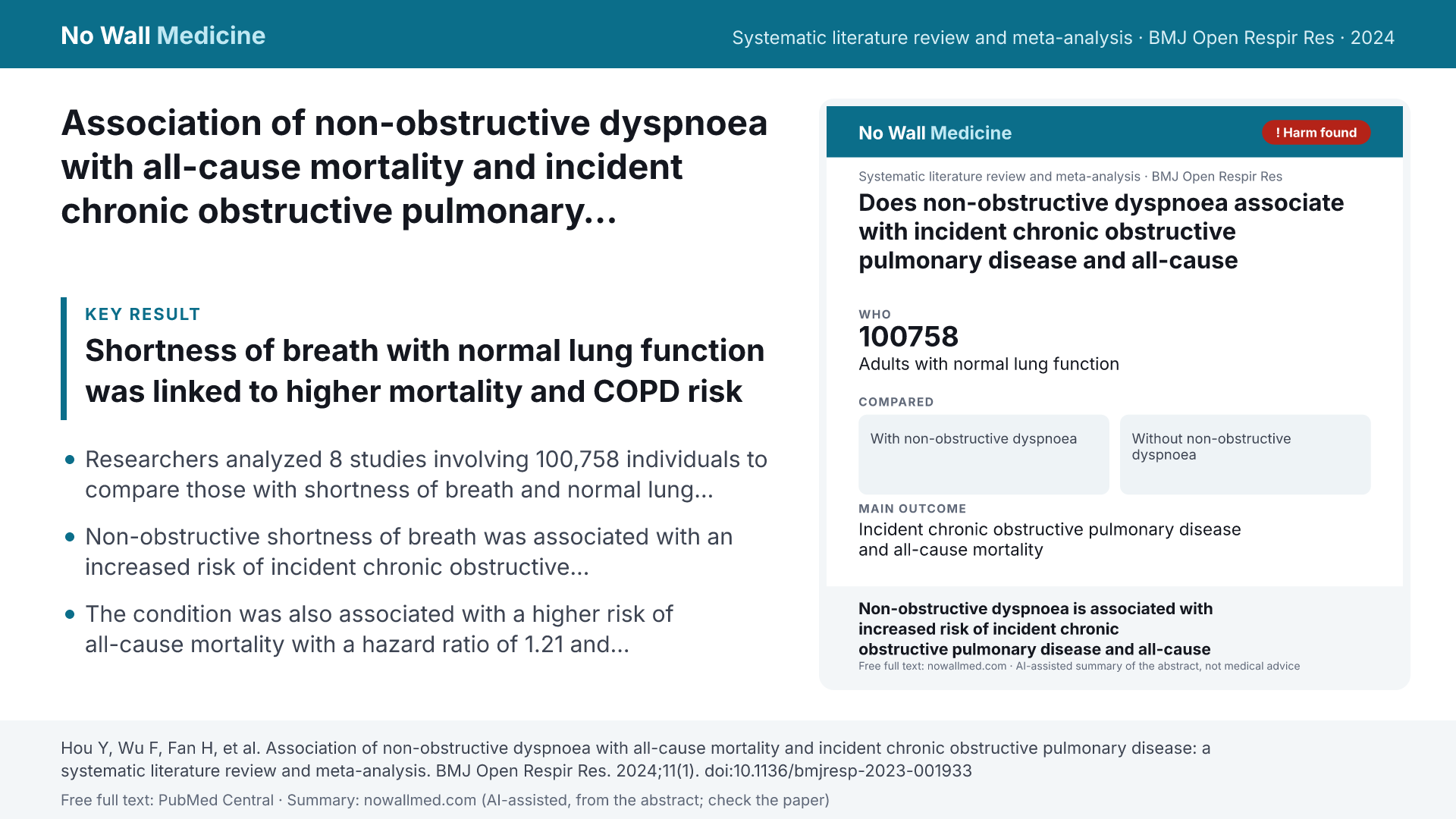
Shortness of breath with normal lung function was linked to higher mortality and COPD risk
Association of non-obstructive dyspnoea with all-cause mortality and incident chronic obstructive pulmonary disease: a systematic literature review and meta-analysis
Systematic literature review and meta-analysisHarm found
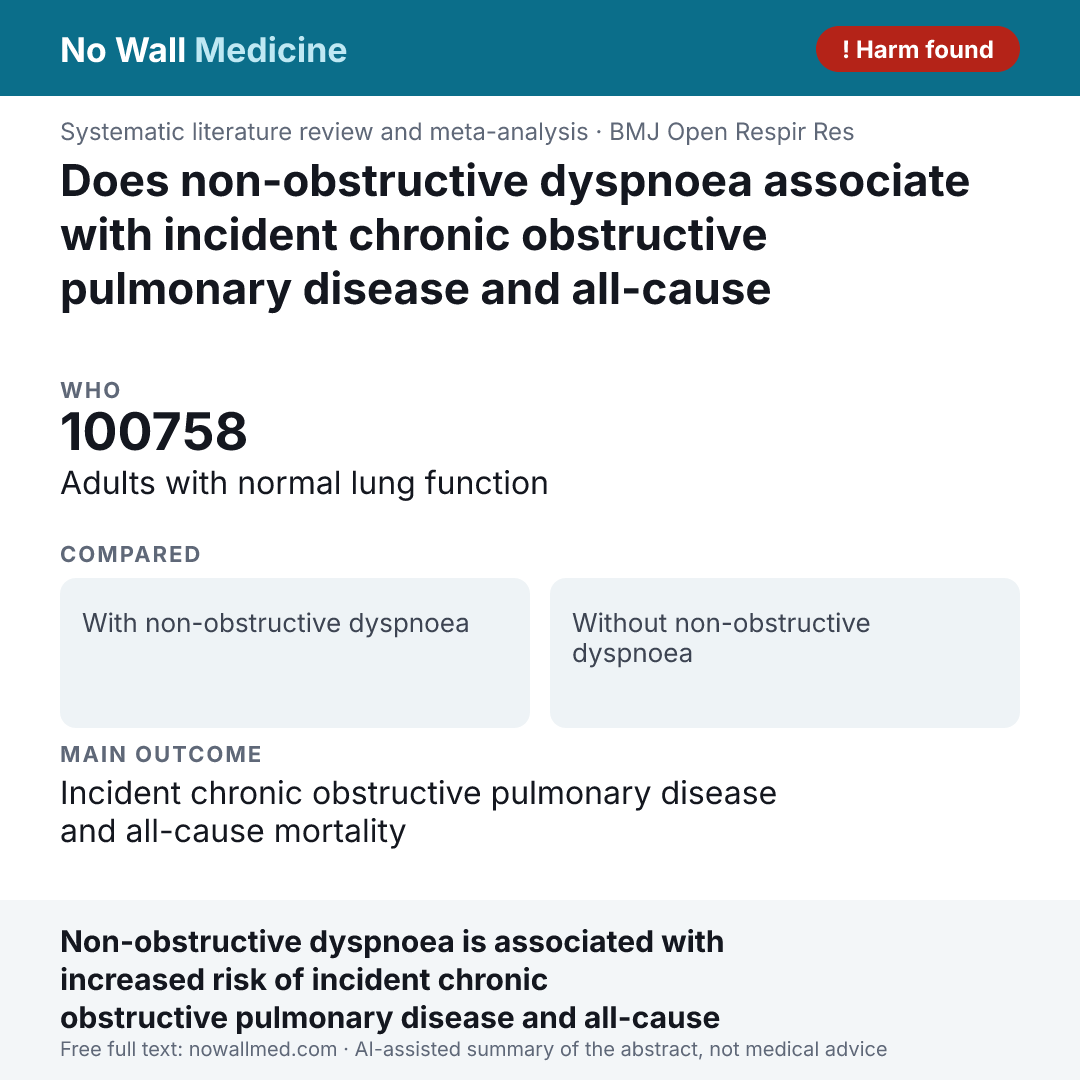
Does non-obstructive dyspnoea associate with incident chronic obstructive pulmonary disease and all-cause mortality?
Who
100758
Adults with normal lung function
Compared
With non-obstructive dyspnoea
Without non-obstructive dyspnoea
Main outcome
Incident chronic obstructive pulmonary disease and all-cause mortality
Result: relative risk 1.41 (95% CI 1.08 to 1.83) for incident COPD; hazard ratio 1.21 (95% CI 1.14 to 1.28) for all-cause mortality
Bottom line: Non-obstructive dyspnoea is associated with increased risk of incident chronic obstructive pulmonary disease and all-cause mortality.
BMJ Open Respir Res · 2024-02-23 · Save PNG
Clinical question: Does non-obstructive dyspnoea associate with incident chronic obstructive pulmonary disease and all-cause mortality?
Why it matters: It is disputed whether shortness of breath in people with normal lung function is associated with the future development of chronic obstructive pulmonary disease and death.
Key points
- Researchers analyzed 8 studies involving 100,758 individuals to compare those with shortness of breath and normal lung function to those without.
- Non-obstructive shortness of breath was associated with an increased risk of incident chronic obstructive pulmonary disease with a relative risk of 1.41.
- The condition was also associated with a higher risk of all-cause mortality with a hazard ratio of 1.21 and respiratory disease-related mortality with a hazard ratio of 1.52.
Headline and key points written with AI from the paper’s abstract, with every number checked against it. Read the paper before relying on them.
Was this summary helpful?
Abstract
Background
Controversy exists regarding the association between non-obstructive dyspnoea and the future development of chronic obstructive pulmonary disease (COPD) and mortality. Therefore, we aimed to evaluate the association of non-obstructive dyspnoea with mortality and incident COPD in adults. Methods
We searched PubMed, Embase, and Web of Science to identify studies published from inception to 13 May 2023. Eligibility screening, data extraction, and quality assessment of the retrieved articles were conducted independently by two reviewers. Studies were included if they were original articles comparing incident COPD and all-cause mortality between individuals with normal lung function with and without dyspnoea. The primary outcomes were incident COPD and all-cause mortality. The secondary outcome was respiratory disease-related mortality. We used the random-effects model to calculate pooled estimates and corresponding 95% confidence interval (CI). Heterogeneity was determined using the I² statistic. Results
Of 6486 studies, 8 studies involving 100 758 individuals fulfilled the inclusion and exclusion criteria and were included in the study. Compared with individuals without non-obstructive dyspnoea, individuals with non-obstructive dyspnoea had an increased risk of incident COPD (relative risk: 1.41, 95% CI: 1.08 to 1.83), and moderate heterogeneity was found (p=0.079, I2=52.2%). Individuals with non-obstructive dyspnoea had a higher risk of all-cause mortality (hazard ratio: 1.21, 95% CI: 1.14 to 1.28, I2=0.0%) and respiratory disease-related mortality (hazard ratio: 1.52, 95% CI: 1.14 to 2.02, I2=0.0%) than those without. Conclusions
Individuals with non-obstructive dyspnoea are at a higher risk of incident COPD and all-cause mortality than individuals without dyspnoea. Further research should investigate whether these high-risk adults may benefit from risk management and early therapeutic intervention. Prospero registration number
CRD42023395192.
Abstract reproduced under the article’s CC BY NC licence.
Subject terms
Headline, design, result, key points, caveat and citation as plain text.
Cite this article
Hou Y, Wu F, Fan H, et al. Association of non-obstructive dyspnoea with all-cause mortality and incident chronic obstructive pulmonary disease: a systematic literature review and meta-analysis. BMJ Open Respir Res. 2024;11(1). doi:10.1136/bmjresp-2023-001933
Spotted a mistake? Suggest a correction