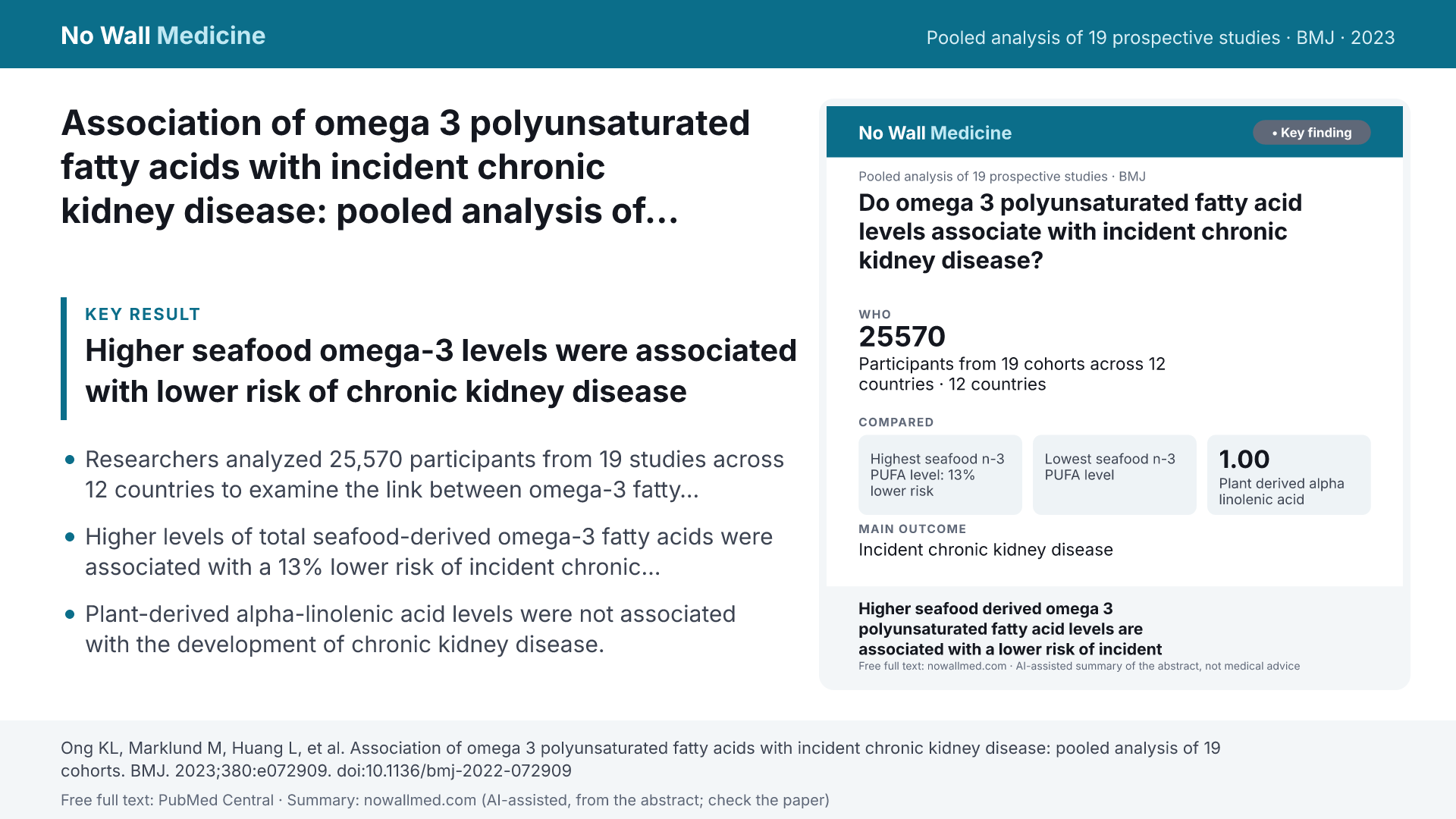
Higher seafood omega-3 levels were associated with lower risk of chronic kidney disease
Association of omega 3 polyunsaturated fatty acids with incident chronic kidney disease: pooled analysis of 19 cohorts
Pooled analysis of 19 prospective studiesKey finding
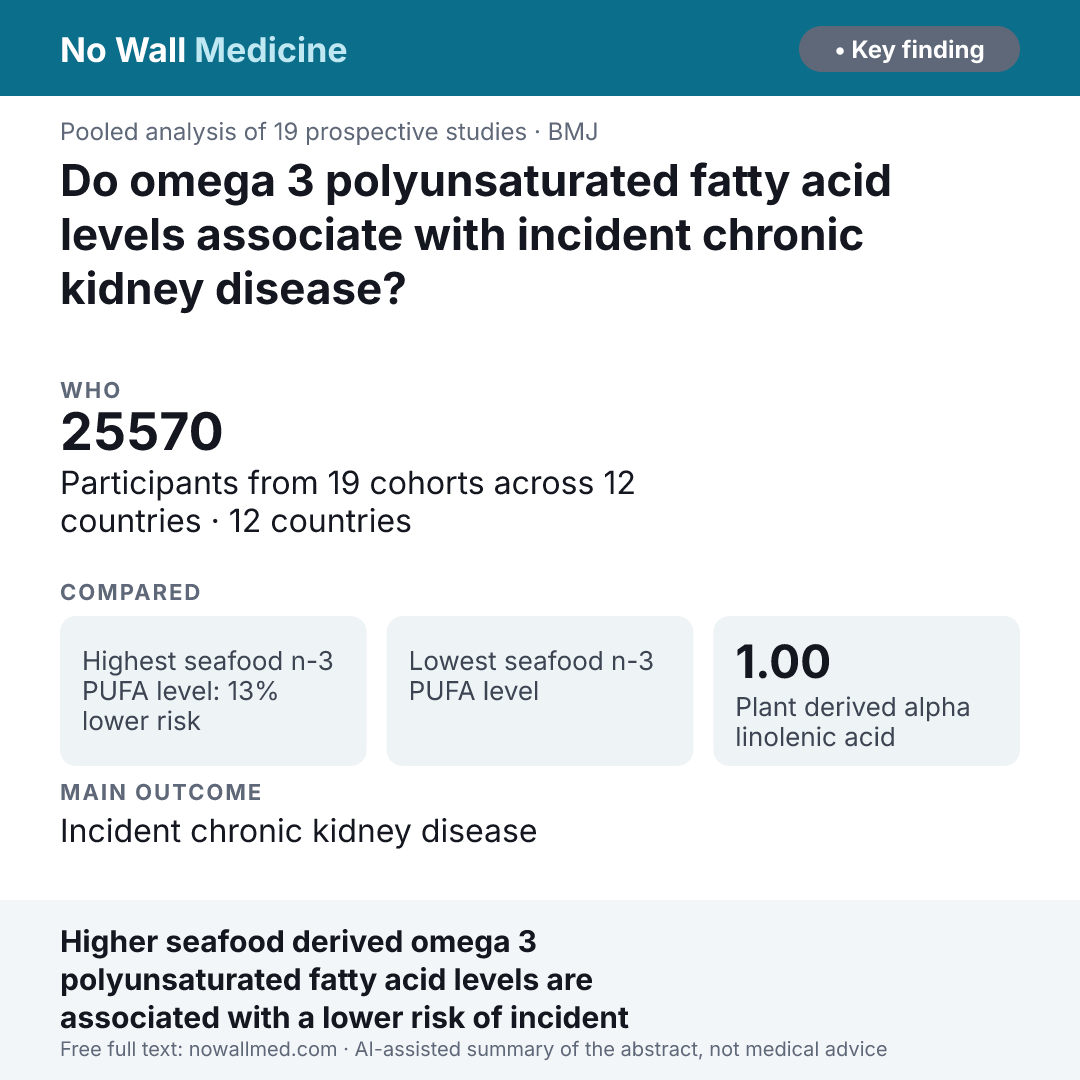
Do omega 3 polyunsaturated fatty acid levels associate with incident chronic kidney disease?
Who
25570
Participants from 19 cohorts across 12 countries · 12 countries
Compared
Highest seafood n-3 PUFA level: 13% lower risk
Lowest seafood n-3 PUFA level
1.00Plant derived alpha linolenic acid (95% CI 0.94 to 1.06)
Main outcome
Incident chronic kidney disease
Result: relative risk per interquintile range 0.92 (95% CI 0.86 to 0.98)
Bottom line: Higher seafood derived omega 3 polyunsaturated fatty acid levels are associated with a lower risk of incident chronic kidney disease.
BMJ · 2023-01-18 · Save PNG
Clinical question: Do omega 3 polyunsaturated fatty acid levels associate with incident chronic kidney disease?
Key points
- Researchers analyzed 25,570 participants from 19 studies across 12 countries to examine the link between omega-3 fatty acids and new chronic kidney disease.
- Higher levels of total seafood-derived omega-3 fatty acids were associated with a 13% lower risk of incident chronic kidney disease in the highest fifth compared to the lowest fifth.
- Plant-derived alpha-linolenic acid levels were not associated with the development of chronic kidney disease.
Headline and key points written with AI from the paper’s abstract, with every number checked against it. Read the paper before relying on them.
Was this summary helpful?
Abstract
Objective
To assess the prospective associations of circulating levels of omega 3 polyunsaturated fatty acid (n-3 PUFA) biomarkers (including plant derived α linolenic acid and seafood derived eicosapentaenoic acid, docosapentaenoic acid, and docosahexaenoic acid) with incident chronic kidney disease (CKD). Design
Pooled analysis. Data sources
A consortium of 19 studies from 12 countries identified up to May 2020. Study selection
Prospective studies with measured n-3 PUFA biomarker data and incident CKD based on estimated glomerular filtration rate. Data extraction and synthesis
Each participating cohort conducted de novo analysis with prespecified and consistent exposures, outcomes, covariates, and models. The results were pooled across cohorts using inverse variance weighted meta-analysis. Main outcome measures
Primary outcome of incident CKD was defined as new onset estimated glomerular filtration rate <60 mL/min/1.73 m2. In a sensitivity analysis, incident CKD was defined as new onset estimated glomerular filtration rate <60 mL/min/1.73 m2 and <75% of baseline rate. Results
25 570 participants were included in the primary outcome analysis and 4944 (19.3%) developed incident CKD during follow-up (weighted median 11.3 years). In multivariable adjusted models, higher levels of total seafood n-3 PUFAs were associated with a lower incident CKD risk (relative risk per interquintile range 0.92, 95% confidence interval 0.86 to 0.98; P=0.009, I2=9.9%). In categorical analyses, participants with total seafood n-3 PUFA level in the highest fifth had 13% lower risk of incident CKD compared with those in the lowest fifth (0.87, 0.80 to 0.96; P=0.005, I2=0.0%). Plant derived α linolenic acid levels were not associated with incident CKD (1.00, 0.94 to 1.06; P=0.94, I2=5.8%). Similar results were obtained in the sensitivity analysis. The association appeared consistent across subgroups by age (≥60 v <60 years), estimated glomerular filtration rate (60-89 v ≥90 mL/min/1.73 m2), hypertension, diabetes, and coronary heart disease at baseline. Conclusions
Higher seafood derived n-3 PUFA levels were associated with lower risk of incident CKD, although this association was not found for plant derived n-3 PUFAs. These results support a favourable role for seafood derived n-3 PUFAs in preventing CKD.
Abstract reproduced under the article’s CC BY licence.
Subject terms
Headline, design, result, key points, caveat and citation as plain text.
Cite this article
Ong KL, Marklund M, Huang L, et al. Association of omega 3 polyunsaturated fatty acids with incident chronic kidney disease: pooled analysis of 19 cohorts. BMJ. 2023;380:e072909. doi:10.1136/bmj-2022-072909
Spotted a mistake? Suggest a correction