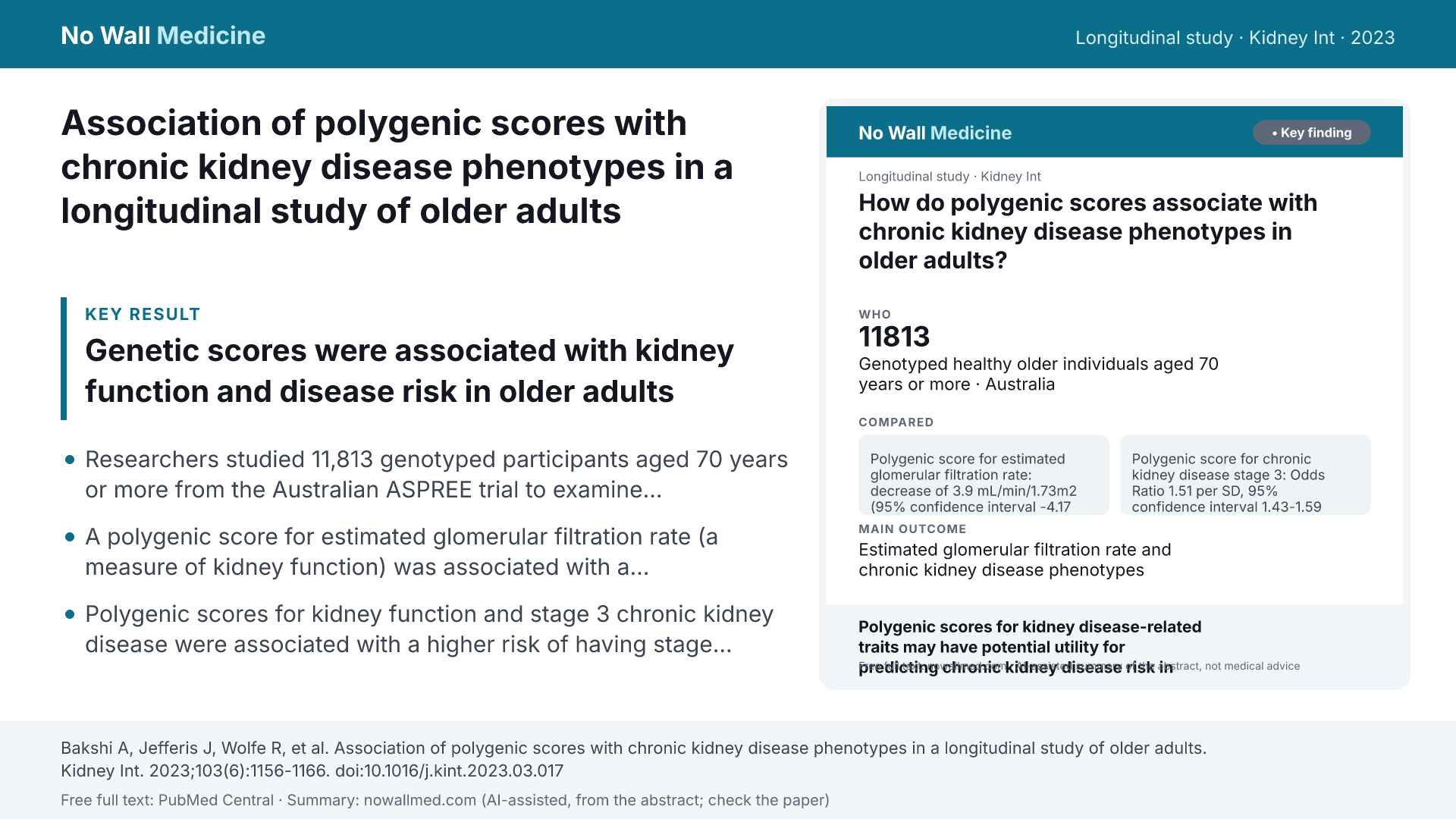
Genetic scores were associated with kidney function and disease risk in older adults
Association of polygenic scores with chronic kidney disease phenotypes in a longitudinal study of older adults
Longitudinal studyKey finding
How do polygenic scores associate with chronic kidney disease phenotypes in older adults?
Who
11813
Genotyped healthy older individuals aged 70 years or more · Australia
Compared
Polygenic score for estimated glomerular filtration rate: decrease of 3.9 mL/min/1.73m2 (95% confidence interval -4.17 to -3.68) per standard deviation increase
Polygenic score for chronic kidney disease stage 3: Odds Ratio 1.51 per SD, 95% confidence interval 1.43-1.59
Main outcome
Estimated glomerular filtration rate and chronic kidney disease phenotypes
Result: Odds Ratio 1.75 per SD, 95% confidence interval 1.66-1.85
Bottom line: Polygenic scores for kidney disease-related traits may have potential utility for predicting chronic kidney disease risk in advanced age.
Kidney Int · 2023-03-29 · Save PNG
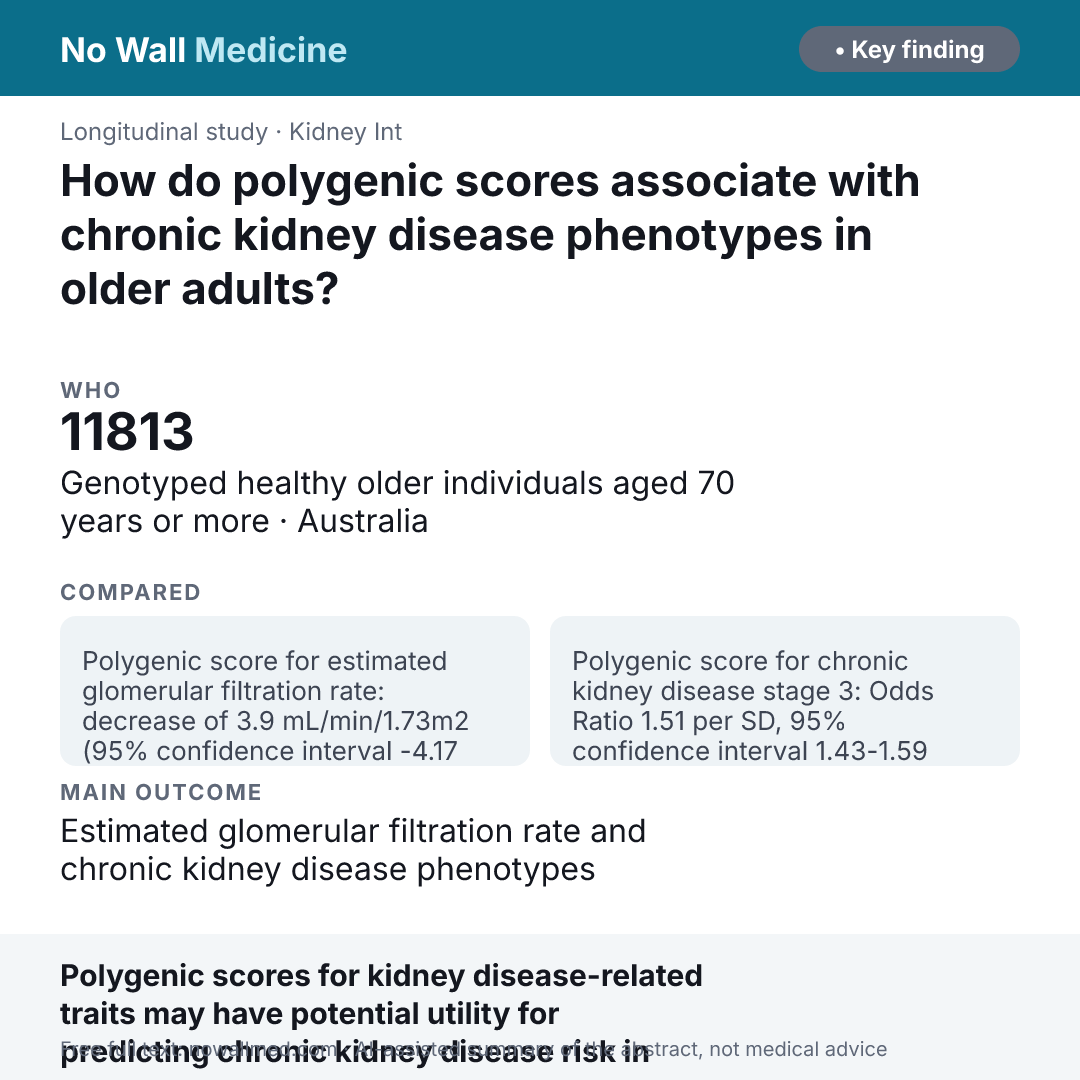
Clinical question: How do polygenic scores associate with chronic kidney disease phenotypes in older adults?
Key points
- Researchers studied 11,813 genotyped participants aged 70 years or more from the Australian ASPREE trial to examine genetic scores and kidney health.
- A polygenic score for estimated glomerular filtration rate (a measure of kidney function) was associated with a 3.9 mL/min/1.73m2 decrease per standard deviation increase.
- Polygenic scores for kidney function and stage 3 chronic kidney disease were associated with a higher risk of having stage 3 disease at baseline.
Headline and key points written with AI from the paper’s abstract, with every number checked against it. Read the paper before relying on them.
Was this summary helpful?
Subject terms
Headline, design, result, key points, caveat and citation as plain text.
Cite this article
Bakshi A, Jefferis J, Wolfe R, et al. Association of polygenic scores with chronic kidney disease phenotypes in a longitudinal study of older adults. Kidney Int. 2023;103(6):1156-1166. doi:10.1016/j.kint.2023.03.017
Spotted a mistake? Suggest a correction