Increased screen time was linked to more behavior problems in children aged 12 or younger
Association of Screen Time With Internalizing and Externalizing Behavior Problems in Children 12 Years or Younger: A Systematic Review and Meta-analysis
Systematic review and meta-analysisHarm found
Does screen time duration associate with externalizing and internalizing behavior problems in children?
Who
159425
Children 12 years or younger
Compared
Externalizing problems: r, 0.11; 95% CI, 0.10-0.12
Internalizing problems: r, 0.07; 95% CI, 0.05-0.08
Main outcome
Externalizing and internalizing behavior problems
Bottom line: Increased screen time duration has small but significant correlations with more externalizing and internalizing behavior problems in children.
JAMA Psychiatry · 2022-03-17Download image
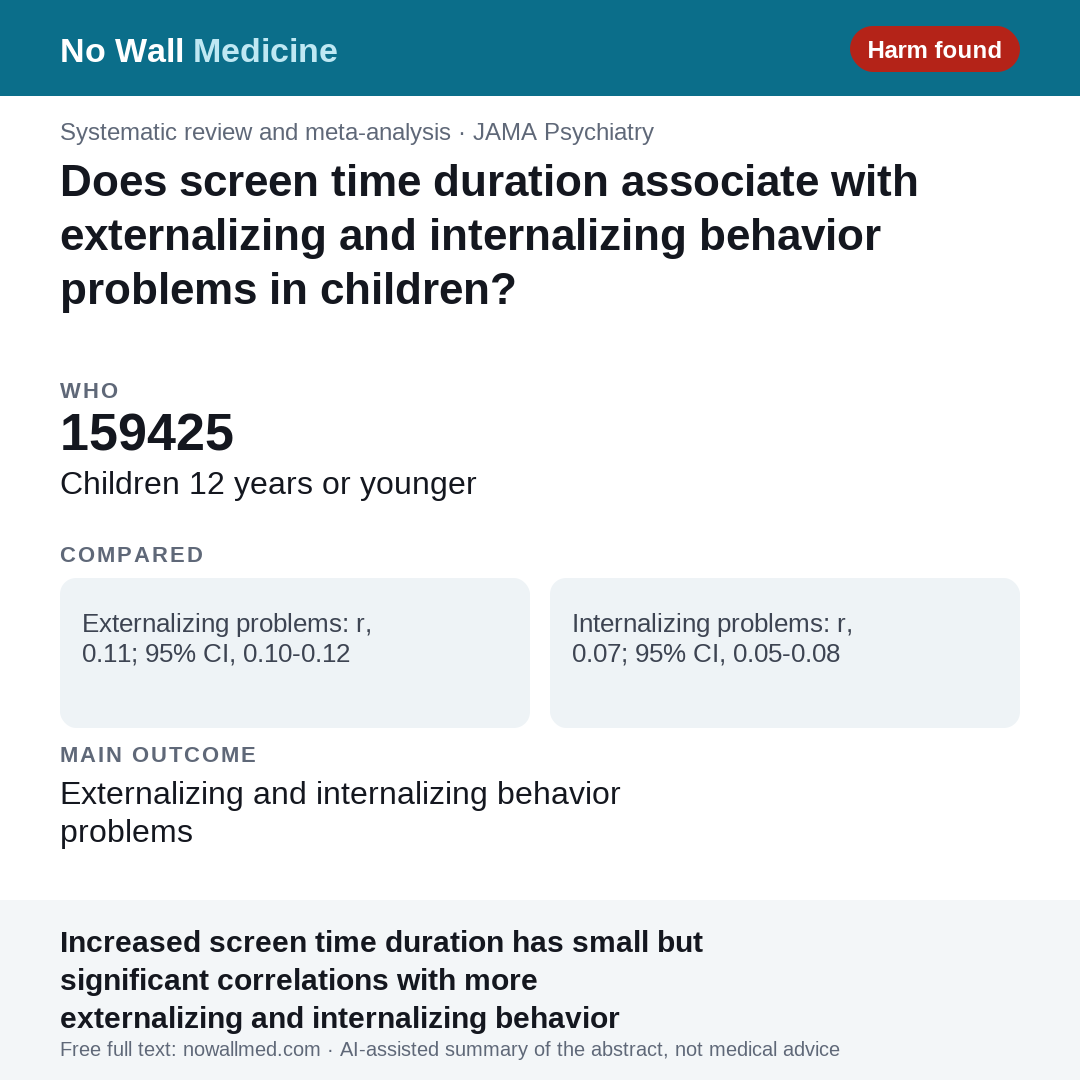
Clinical question: Does screen time duration associate with externalizing and internalizing behavior problems in children?
Why it matters: There is a lack of consensus in existing literature regarding the association between screen time and behavior problems in children.
Key points
- Researchers analyzed 87 studies involving 159,425 participants with a mean age of 6.07 years to examine the link between screen time and behavior.
- More screen time duration was associated with a small correlation to externalizing problems, such as aggression, (r, 0.11; 95% CI, 0.10-0.12).
- Increased screen time was also associated with a small correlation to internalizing problems, such as anxiety or depression, (r, 0.07; 95% CI, 0.05-0.08).
Limitation the authors note: There was significant between-study heterogeneity (I2 = 87.80%) which was likely explained by methodological differences across studies.
Headline and key points written with AI from the paper’s abstract, with every number checked against it. Read the paper before relying on them.
Was this summary helpful?
Subject terms
Cite this article
Eirich R, McArthur BA, Anhorn C, McGuinness C, Christakis DA, Madigan S. Association of Screen Time With Internalizing and Externalizing Behavior Problems in Children 12 Years or Younger: A Systematic Review and Meta-analysis. JAMA Psychiatry. 2022. doi:10.1001/jamapsychiatry.2022.0155
Spotted a mistake? Suggest a correction
Top studies every Monday
The week’s key trials and guidelines in your specialties, plus any topics you follow. By email, free.
Get the weekly digest