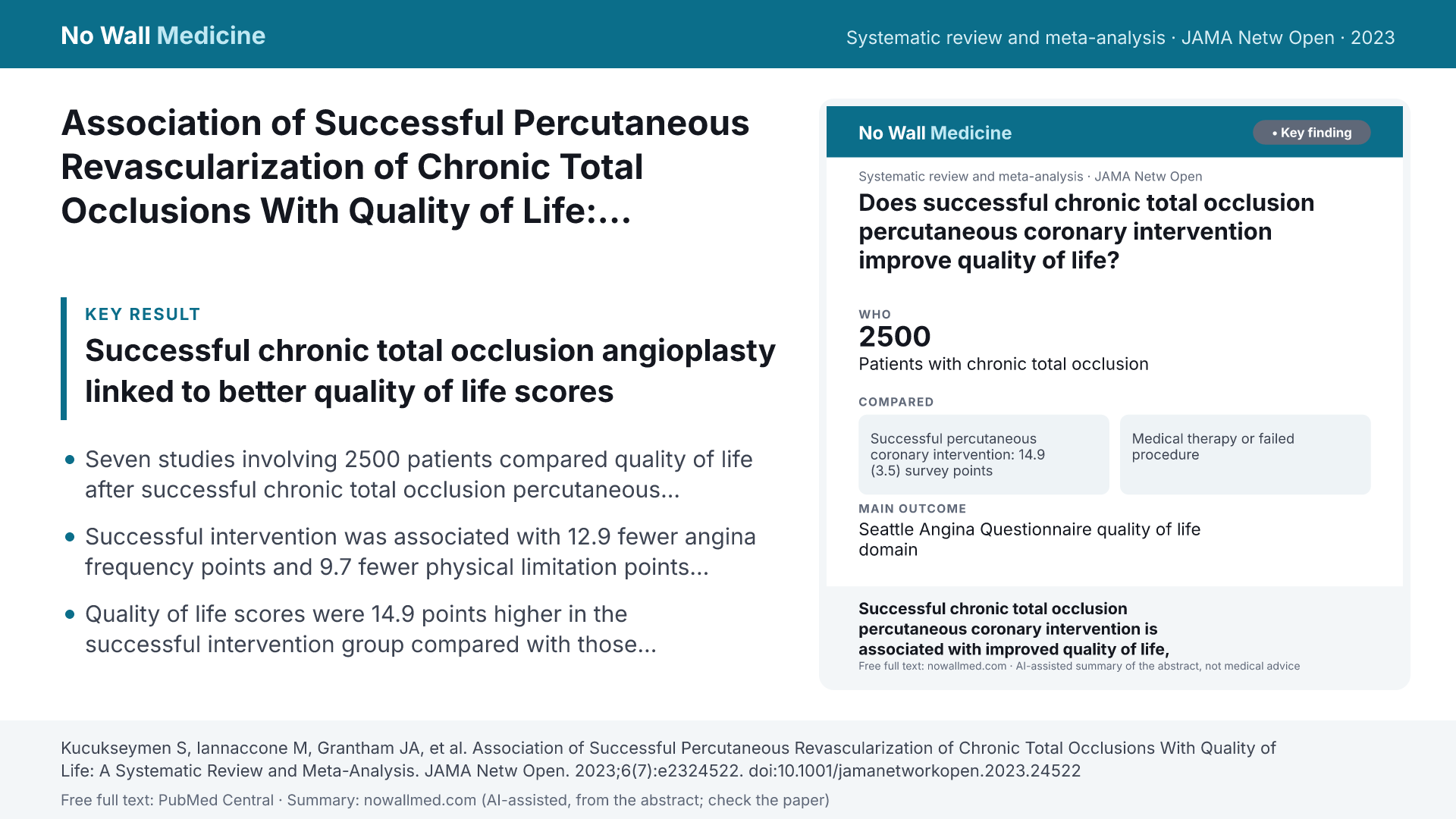
Successful chronic total occlusion angioplasty linked to better quality of life scores
Association of Successful Percutaneous Revascularization of Chronic Total Occlusions With Quality of Life: A Systematic Review and Meta-Analysis
Systematic review and meta-analysisKey finding
Does successful chronic total occlusion percutaneous coronary intervention improve quality of life?
Who
2500
Patients with chronic total occlusion
Compared
Successful percutaneous coronary intervention: 14.9 (3.5) survey points
Medical therapy or failed procedure
Main outcome
Seattle Angina Questionnaire quality of life domain
Result: standardized mean difference 0.41 (95% CI 0.25 to 0.61)
Bottom line: Successful chronic total occlusion percutaneous coronary intervention is associated with improved quality of life, angina frequency, and physical limitation.
JAMA Netw Open · 2023-07-03 · Save PNG
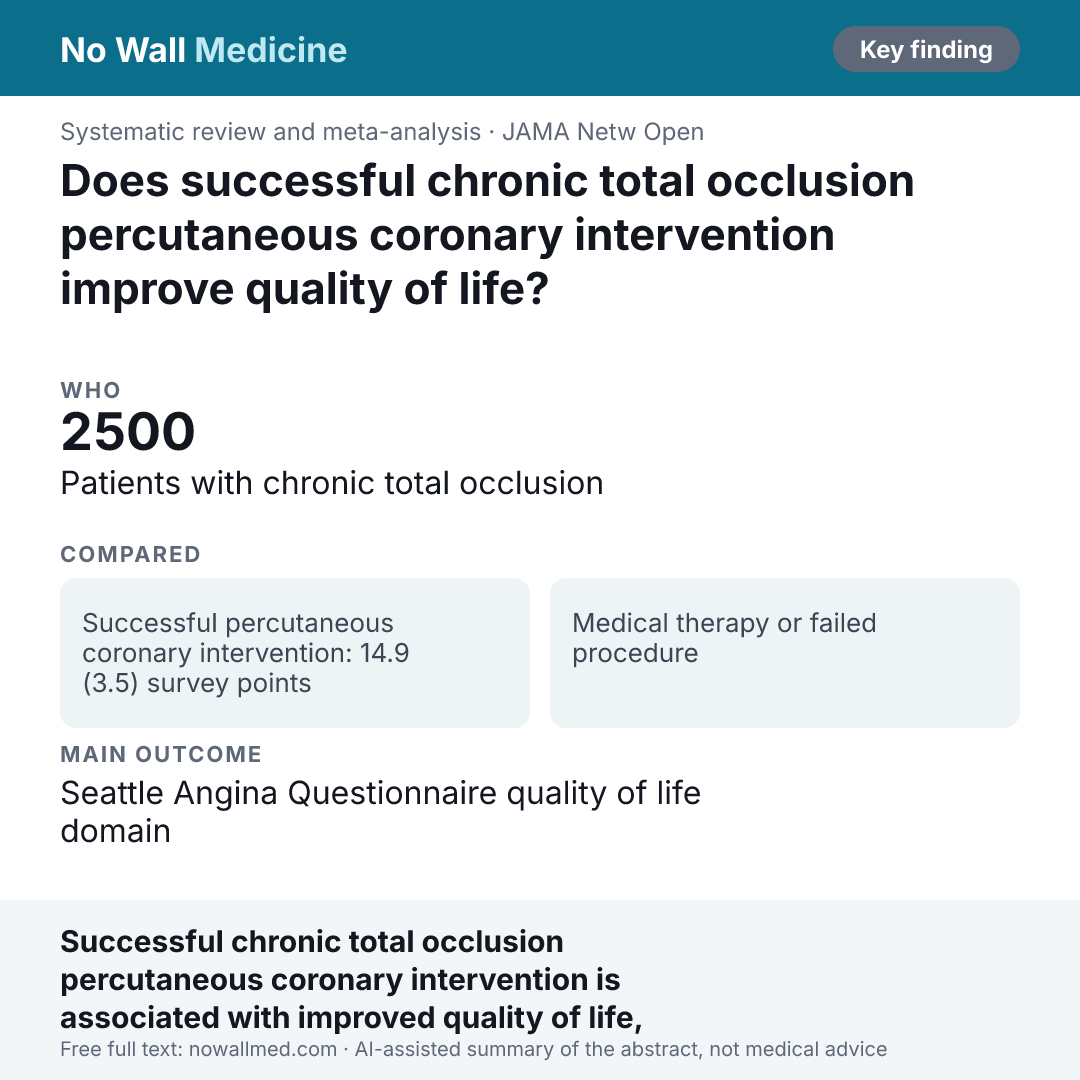
Clinical question: Does successful chronic total occlusion percutaneous coronary intervention improve quality of life?
Why it matters: Clinicians often hesitate to offer chronic total occlusion angioplasty due to uncertainty about whether it improves long-term quality of life.
Key points
- Seven studies involving 2500 patients compared quality of life after successful chronic total occlusion percutaneous coronary intervention to medical therapy or failed procedures.
- Successful intervention was associated with 12.9 fewer angina frequency points and 9.7 fewer physical limitation points on the Seattle Angina Questionnaire.
- Quality of life scores were 14.9 points higher in the successful intervention group compared with those receiving optimal medical therapy or having failed procedures.
Limitation the authors note: The included studies showed high statistical heterogeneity for angina frequency, with an I-squared value of 86.4%.
Headline and key points written with AI from the paper’s abstract, with every number checked against it. Read the paper before relying on them.
Was this summary helpful?
Subject terms
Headline, design, result, key points, caveat and citation as plain text.
Cite this article
Kucukseymen S, Iannaccone M, Grantham JA, et al. Association of Successful Percutaneous Revascularization of Chronic Total Occlusions With Quality of Life: A Systematic Review and Meta-Analysis. JAMA Netw Open. 2023;6(7):e2324522. doi:10.1001/jamanetworkopen.2023.24522
Spotted a mistake? Suggest a correction