Rising ambient temperatures were linked to increased risks for several bacterial enteric infections
Associations between ambient temperature and enteric infections by pathogen: a systematic review and meta-analysis
Systematic review and meta-analysisMixed results
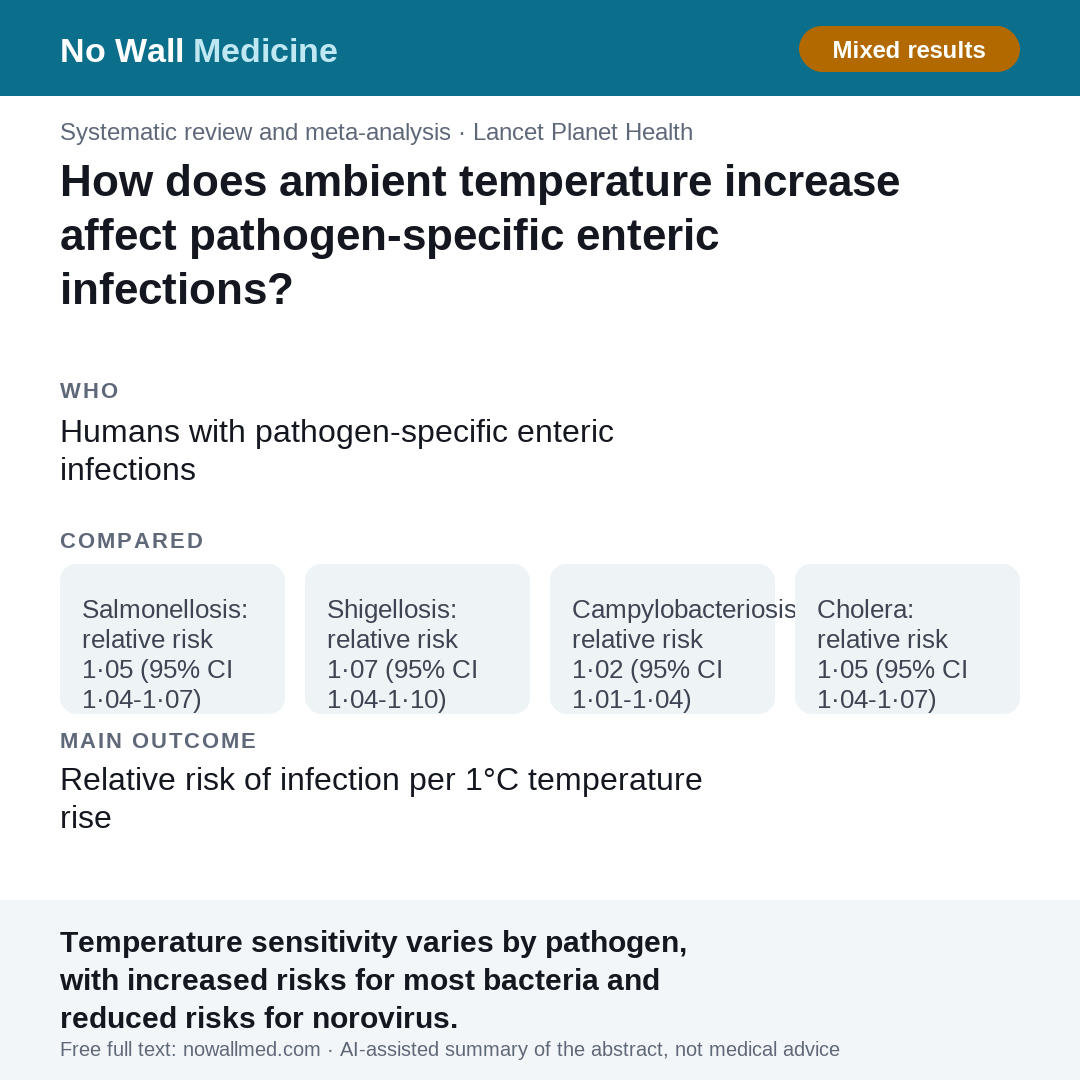
How does ambient temperature increase affect pathogen-specific enteric infections?
Who
Humans with pathogen-specific enteric infections
Compared
Salmonellosis: relative risk 1·05 (95% CI 1·04-1·07)
Shigellosis: relative risk 1·07 (95% CI 1·04-1·10)
Campylobacteriosis: relative risk 1·02 (95% CI 1·01-1·04)
Cholera: relative risk 1·05 (95% CI 1·04-1·07)
Main outcome
Relative risk of infection per 1°C temperature rise
Bottom line: Temperature sensitivity varies by pathogen, with increased risks for most bacteria and reduced risks for norovirus.
Funded by: Japan Society for the Promotion of Science
Lancet Planet Health · 2022-03-12Download image
Clinical question: How does ambient temperature increase affect pathogen-specific enteric infections?
Why it matters: It was unknown if the sensitivity of intestinal infections to temperature changes depends on the specific type of pathogen involved.
Key points
- Researchers analyzed 40 studies from 2981 identified articles to examine how temperature changes relate to specific intestinal infections.
- A 1°C temperature rise was associated with increased relative risks for typhoid at 1.15, shigellosis at 1.07, salmonellosis at 1.05, cholera at 1.05, Escherichia coli enteritis at 1.04, and campylobacteriosis at 1.02.
- Temperature increases were associated with reduced risks for noroviral enteritis at 0.89 and rotaviral enteritis at 0.96.
Headline and key points written with AI from the paper’s abstract, with every number checked against it. Read the paper before relying on them.
Was this summary helpful?
Abstract
Background
Numerous studies have quantified the associations between ambient temperature and enteric infections, particularly all-cause enteric infections. However, the temperature sensitivity of enteric infections might be pathogen dependent. Here, we sought to identify pathogen-specific associations between ambient temperature and enteric infections. Methods
We did a systematic review and meta-analysis by searching PubMed, Web of Science, and Scopus for peer-reviewed research articles published from Jan 1, 2000, to Dec 31, 2019, and also hand searched reference lists of included articles and excluded reviews. We included studies that quantified the effects of ambient temperature increases on common pathogen-specific enteric infections in humans. We excluded studies that expressed ambient temperature as a categorical or diurnal range, or in a standardised format. Two authors screened the search results, one author extracted data from eligible studies, and four authors verified the data. We obtained the overall risks by pooling the relative risks of enteric infection by pathogen for each 1°C temperature rise using random-effects modelling and robust variance estimation for the correlated effect estimates. Between-study heterogeneity was measured using I2, τ2, and Q-statistic. Publication bias was determined using funnel plot asymmetry and the trim-and-fill method. Differences among pathogen-specific pooled estimates were determined using subgroup analysis of taxa-specific meta-analysis. The study protocol was not registered but followed the PRISMA guidelines. Findings
We identified 2981 articles via database searches and 57 articles from scanning reference lists of excluded reviews and included articles, of which 40 were eligible for pathogen-specific meta-analyses. The overall increased risks of incidence per 1°C temperature rise, expressed as relative risks, were 1·05 (95% CI 1·04-1·07; I2 97%) for salmonellosis, 1·07 (1·04-1·10; I2 99%) for shigellosis, 1·02 (1·01-1·04; I2 98%) for campylobacteriosis, 1·05 (1·04-1·07; I2 36%) for cholera, 1·04 (1·01-1·07; I2 98%) for Escherichia coli enteritis, and 1·15 (1·07-1·24; I2 0%) for typhoid. Reduced risks per 1°C temperature increase were 0·96 (95% CI 0·90-1·02; I2 97%) for rotaviral enteritis and 0·89 (0·81-0·99; I2 96%) for noroviral enteritis. There was evidence of between-pathogen differences in risk for bacterial infections but not for viral infections. Interpretation
Temperature sensitivity of enteric infections can vary according to the enteropathogen causing the infection, particularly for bacteria. Thus, we encourage a pathogen-specific health adaptation approach, such as vaccination, given the possibility of increasingly warm temperatures in the future. Funding
Japan Society for the Promotion of Science (Kakenhi) Grant-in-Aid for Scientific Research.
Abstract reproduced under the article’s CC BY licence.
Subject terms
Cite this article
Chua PLC, Ng CFS, Tobias A, Seposo XT, Hashizume M. Associations between ambient temperature and enteric infections by pathogen: a systematic review and meta-analysis. Lancet Planet Health. 2022. doi:10.1016/S2542-5196(22)00003-1
Spotted a mistake? Suggest a correction
Top studies every Monday
The week’s key trials and guidelines in your specialties, plus any topics you follow. By email, free.
Get the weekly digest