Associations between biomarkers and skeletal muscle function in individuals with osteoarthritis: a systematic review and meta-analysis
Systematic review and meta-analysisUnclear result
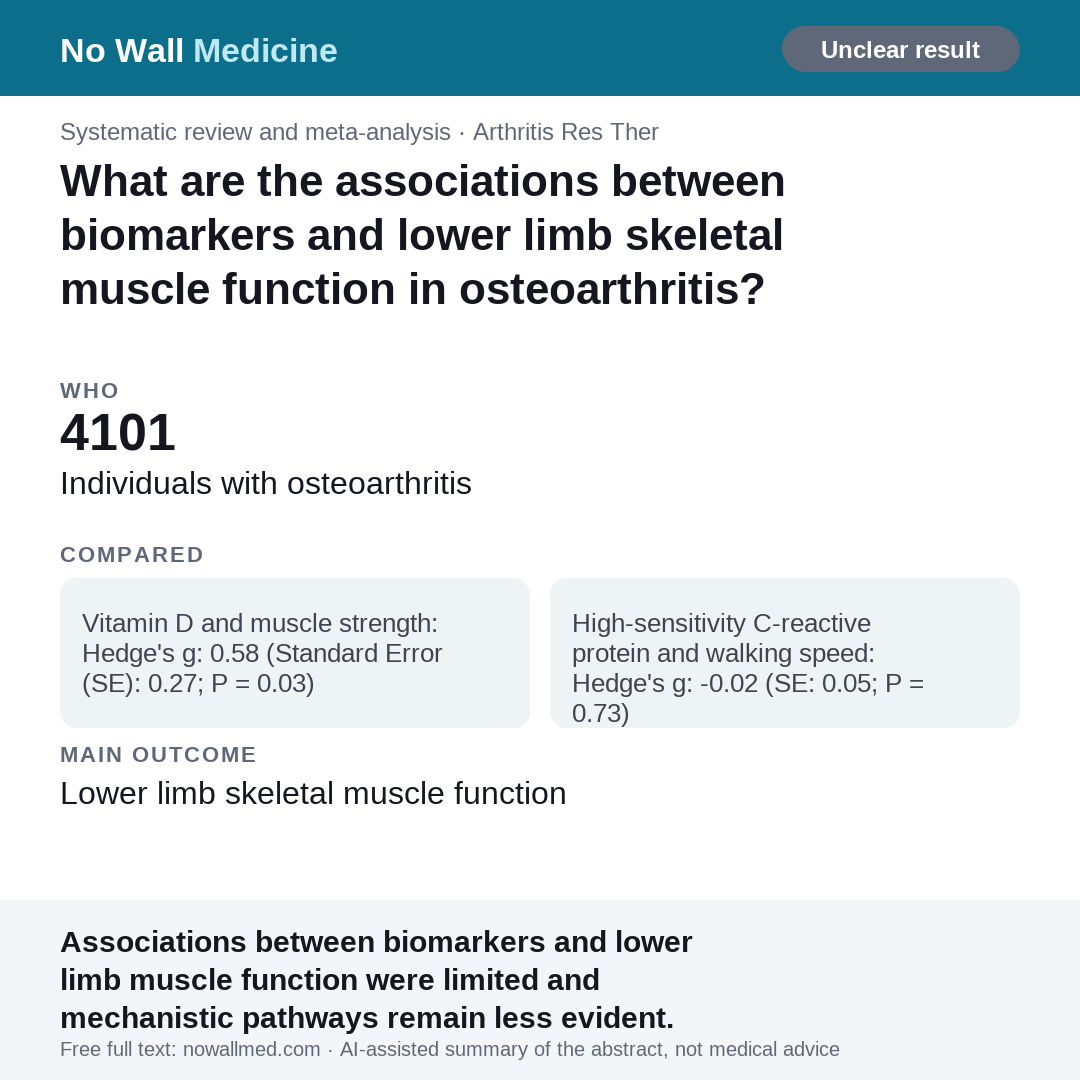
What are the associations between biomarkers and lower limb skeletal muscle function in osteoarthritis?
Who
4101
Individuals with osteoarthritis
Compared
Vitamin D and muscle strength: Hedge's g: 0.58 (Standard Error (SE): 0.27; P = 0.03)
High-sensitivity C-reactive protein and walking speed: Hedge's g: -0.02 (SE: 0.05; P = 0.73)
Main outcome
Lower limb skeletal muscle function
Bottom line: Associations between biomarkers and lower limb muscle function were limited and mechanistic pathways remain less evident.
Limitation: Few studies explored lower limb muscle measures and there was a lack of muscle specific biomarkers.
Arthritis Res Ther · 2024-11-05Download image
Clinical question: What are the associations between biomarkers and lower limb skeletal muscle function in osteoarthritis?
Abstract
Objectives
Skeletal muscle dysfunction is the primary cause of functional limitations in osteoarthritis, associated biomarkers have the potential as targets for early disease identification, diagnosis, and prevention of osteoarthritis disability. This review aimed to identify associations between biomarkers and lower limb skeletal muscle function in individuals with osteoarthritis. Methods
A systematic literature review and meta-analysis conducted in PubMed, MEDLINE, CINAHL, EMBASE, Scopus, SPORTDiscus and Web of Science databases from inception to 8th August 2023. Two independent reviewers performed the title, abstract, full-text screening, data extraction and methodological quality assessment. A meta-analysis was undertaken based on the available data. Results
Twenty-four studies with 4101 participants with osteoarthritis were included (females: 78%; age range; 49 to 71 years). One study reported muscle-specific biomarkers (n = 3), whilst six studies reported osteoarthritis-specific markers (n = 5). Overall, 93 biomarkers were reported, predominately characterised as inflammatory (n = 35), metabolic (n = 15), and hormones (n = 10). Muscle strength and vitamin D reported a significant association (Hedge's g: 0.58 (Standard Error (SE): 0.27; P = 0.03), k = 3 studies). Walking speed and high-sensitivity C-reactive protein reported no significant associations (Hedge's g: -0.02 (SE: 0.05; P = 0.73), k = 3 studies). Conclusion
Associations between biomarkers and lower limb skeletal muscle function in individuals with osteoarthritis was limited, the few studies exploring lower limb muscle measures were mainly secondary outcomes. Furthermore, biomarkers were largely related to overall health, with a lack of muscle specific biomarkers. As such, the mechanistic pathways through which these associations occur are less evident, and difficult to draw clear conclusions on these relationships. Trial registration
Registered on PROSPERO (CRD42022359405).
Topics
Cite this article
Smith SL, Paul L, Steultjens MPM, Jones RL. Associations between biomarkers and skeletal muscle function in individuals with osteoarthritis: a systematic review and meta-analysis. Arthritis Res Ther. 2024. doi:10.1186/s13075-024-03419-1
Spotted a mistake? Suggest a correction
Top studies every Monday
The week’s key trials and guidelines in your specialties, plus any topics you follow. By email, free.
Get the weekly digest