Higher frailty scores were associated with older age, male sex, and poorer lifestyle markers
Associations Between Deficit Accumulation Frailty and Baseline Markers of Lifestyle in the U.S. POINTER Trial
Randomized trial analysisMixed results
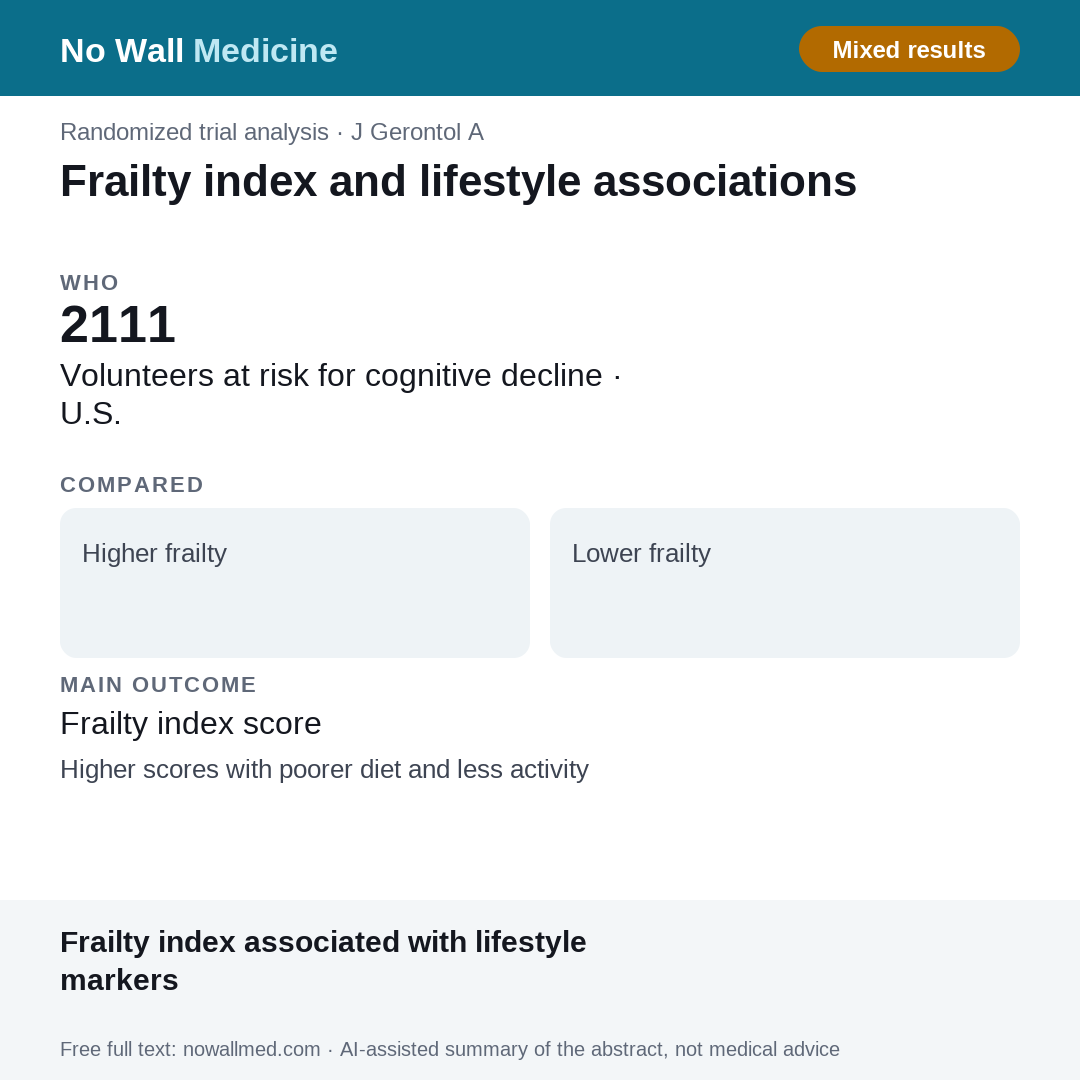
Frailty index and lifestyle associations
Who
2111
Volunteers at risk for cognitive decline · U.S.
Compared
Higher frailty
Lower frailty
Main outcome
Frailty index score
Result: Higher scores with poorer diet and less activity
Bottom line: Frailty index associated with lifestyle markers
J Gerontol A · 2024-11-16Download image
Why it matters: It was unknown how a 49-component frailty index, which measures biological aging through accumulated deficits, relates to sociodemographic factors and lifestyle behaviors.
Key points
- Researchers analyzed baseline data from 2,111 volunteers aged 60-79 years who were at increased risk for cognitive decline.
- Higher frailty index scores were associated with being older, male, living in areas of greater deprivation, having a poorer self-reported diet, and less physical activity.
- The 25th, 50th, and 75th percentiles of the frailty index score distribution were 0.153, 0.189, and 0.235.
Headline and key points written with AI from the paper’s abstract, with every number checked against it. Read the paper before relying on them.
Topics
Cite this article
Espeland MA, Demesie YN, Olson K, Lockhart SN, Farias SET, Cleveland ML. Associations Between Deficit Accumulation Frailty and Baseline Markers of Lifestyle in the U.S. POINTER Trial. J Gerontol A. 2024. doi:10.1093/gerona/glae279
Spotted a mistake? Suggest a correction
Top studies every Monday
The week’s key trials and guidelines in your specialties, by email. Free.
Get the weekly digest