Emotional abuse shows the strongest link to depression compared to other forms of child maltreatment
Associations between five forms of child maltreatment and depression: a multilevel meta-analytic comparison
Multilevel meta-analysisMixed results
How do different forms of child maltreatment associate with depression?
Who
Studies assessing emotional, physical, and sexual abuse
Compared
Emotional abuse: strongest association
Physical abuse
Sexual abuse: weakest
Main outcome
Depression risk and depression severity
Bottom line: Emotional abuse is most strongly linked to depression, followed by physical and then sexual abuse.
Limitation: Incomplete-abuse studies obscured the differences between maltreatment forms.
Psychol Med · 2026-04-06Download image
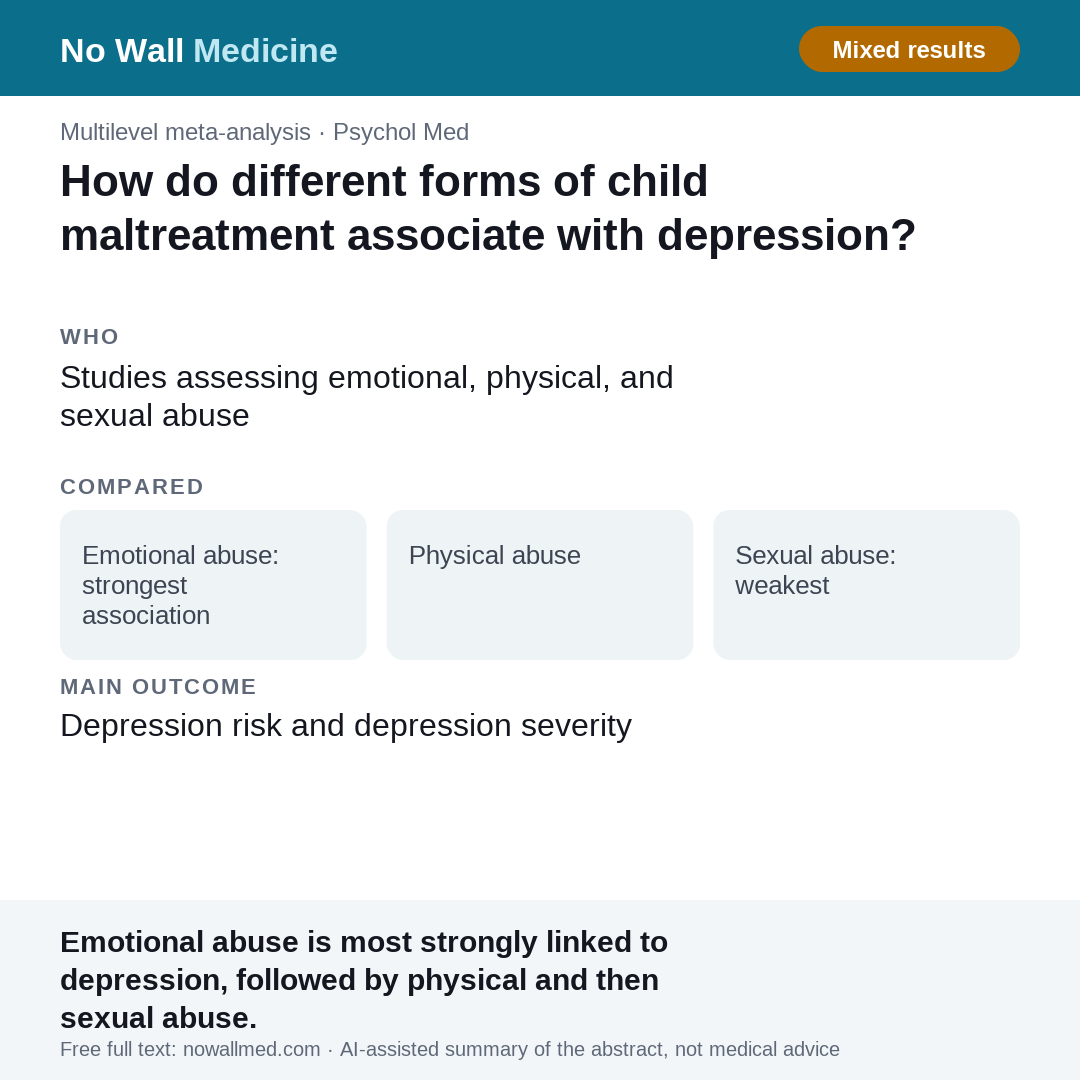
Clinical question: How do different forms of child maltreatment associate with depression?
Why it matters: Previous meta-analyses often used single-level models and combined different subsets of maltreatment, which could distort comparisons between different forms of abuse and neglect.
Key points
- Researchers synthesized data from 12 meta-analytic reviews containing 563 effect sizes from 217 depression risk studies and 501 effect sizes from 157 depression severity studies.
- In the most comparable study designs, emotional abuse had a stronger association with depression than physical abuse or sexual abuse.
- Across all analyses, emotional abuse showed the strongest association with depression while sexual abuse showed the weakest.
Headline and key points written with AI from the paper’s abstract, with every number checked against it. Read the paper before relying on them.
Topics
Cite this article
Rind B, Rieger G. Associations between five forms of child maltreatment and depression: a multilevel meta-analytic comparison. Psychol Med. 2026. doi:10.1017/S003329172610381X
Spotted a mistake? Suggest a correction