Moderate-to-vigorous physical activity was linked to slower increases in p-tau181 blood concentrations
Associations between moderate-to-vigorous physical activity, p-tau181, and cognition in healthy older adults with memory complaints: a secondary analysis from the MAPT
Post-hoc secondary analysis of a randomized trialMixed results
How does moderate-to-vigorous physical activity associate with p-tau181 and cognition?
Who
558
Healthy older adults with memory complaints, low gait speed, or daily living limitations · 13 memory centres in France and Monaco
Compared
Low moderate-to-vigorous physical activity: B = -0·109 (95% CI -0·206 to -0·012)
High moderate-to-vigorous physical activity: B = -0·114 (95% CI -0·208 to -0·020)
Main outcome
p-tau181 concentrations and cognitive composite score
Result: B = -0·114 (95% CI -0·208 to -0·020)
Bottom line: Physical activity is associated with slower p-tau181 increases, but high p-tau181 levels may mitigate cognitive benefits.
Limitation: Verification of these findings in larger population samples will be needed.
Funded by: Toulouse Gérontopôle, French Ministry of Health, and Pierre Fabre Research Institute
Lancet Healthy Longev · 2025-02-24Download image
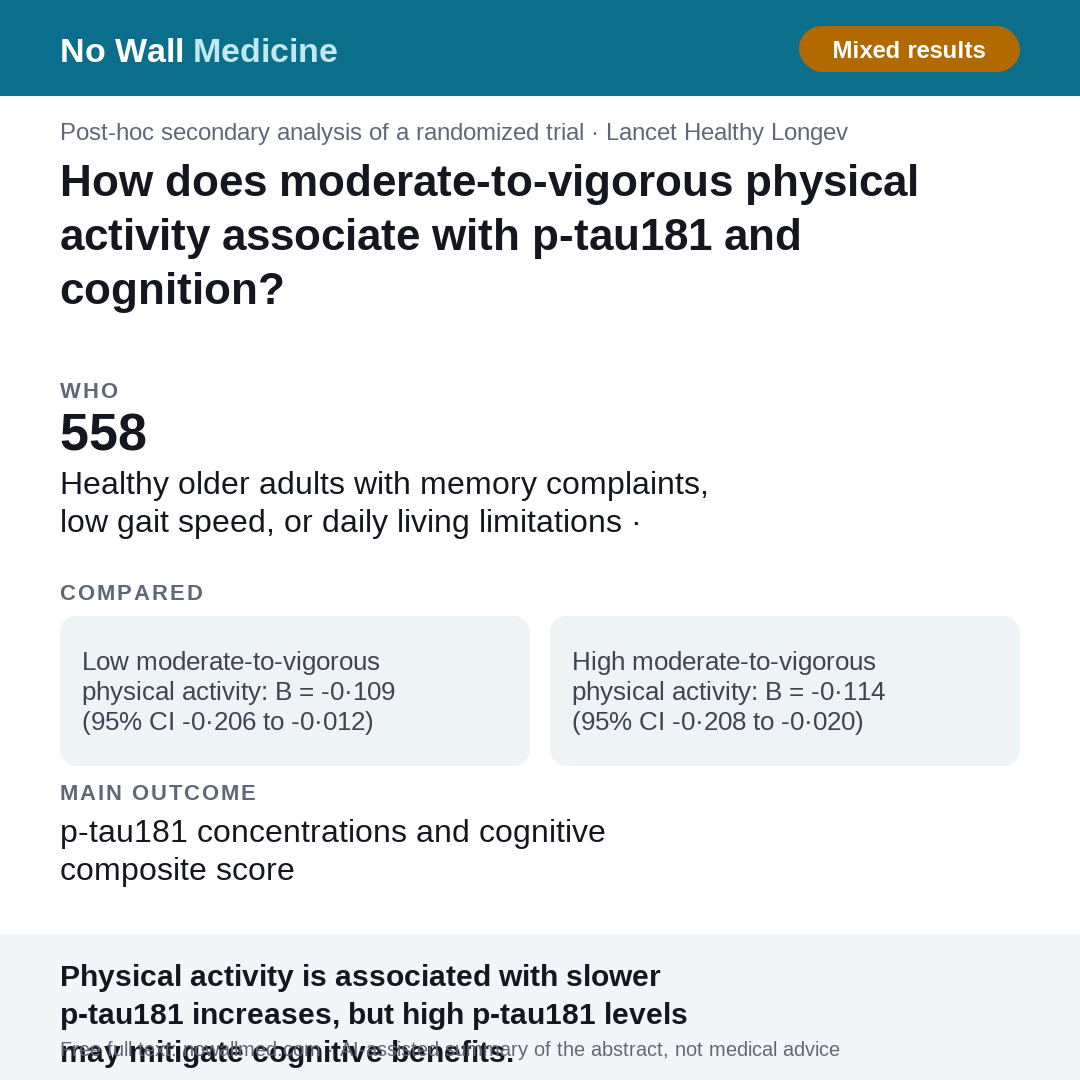
Clinical question: How does moderate-to-vigorous physical activity associate with p-tau181 and cognition?
Why it matters: The associations between moderate-to-vigorous physical activity, p-tau181 blood concentrations, and cognition in healthy older adults with memory complaints are not fully understood.
Key points
- The study analyzed 558 adults aged 70 years or older from the Multidomain Alzheimer's Preventive Trial who had blood measurements of p-tau181, a protein linked to Alzheimer's disease.
- Higher levels of moderate-to-vigorous physical activity were associated with slower increases in p-tau181 concentrations over 3 years compared to inactive individuals.
- The association between physical activity and cognitive scores was no longer favorable when baseline p-tau181 concentrations exceeded 9.36 pg/mL for cross-sectional or 3.5 pg/mL for longitudinal data.
Limitation the authors note: Verification of these findings in larger population samples will be needed.
Headline and key points written with AI from the paper’s abstract, with every number checked against it. Read the paper before relying on them.
Was this summary helpful?
Subject terms
Cite this article
Raffin J, Blennow K, Rolland Y, Cantet C, Guyonnet S, Vellas B. Associations between moderate-to-vigorous physical activity, p-tau181, and cognition in healthy older adults with memory complaints: a secondary analysis from the MAPT. Lancet Healthy Longev. 2025. doi:10.1016/j.lanhl.2024.100678
Spotted a mistake? Suggest a correction
Top studies every Monday
The week’s key trials and guidelines in your specialties, plus any topics you follow. By email, free.
Get the weekly digest