Statins were associated with increased risks of muscle symptoms, liver dysfunction, and eye conditions
Associations between statins and adverse events in primary prevention of cardiovascular disease: systematic review with pairwise, network, and dose-response meta-analyses
Systematic review and meta-analysisBenefit found
Are statins associated with adverse events in primary prevention of cardiovascular disease?
Who
120456
Adults without a history of cardiovascular disease
Compared
Statins: increased risk of self-reported muscle symptoms (odds ratio 1.06 (95% confidence interval 1.01 to 1.13))
Non-statin controls
Main outcome
Common adverse events and cardiovascular disease efficacy
Bottom line: Statins carry a low risk of adverse events that does not outweigh their efficacy in preventing cardiovascular disease.
Limitation: Evidence to support tailoring the type or dosage of statins to account for safety concerns was limited.
BMJ · 2021-07-14Download image
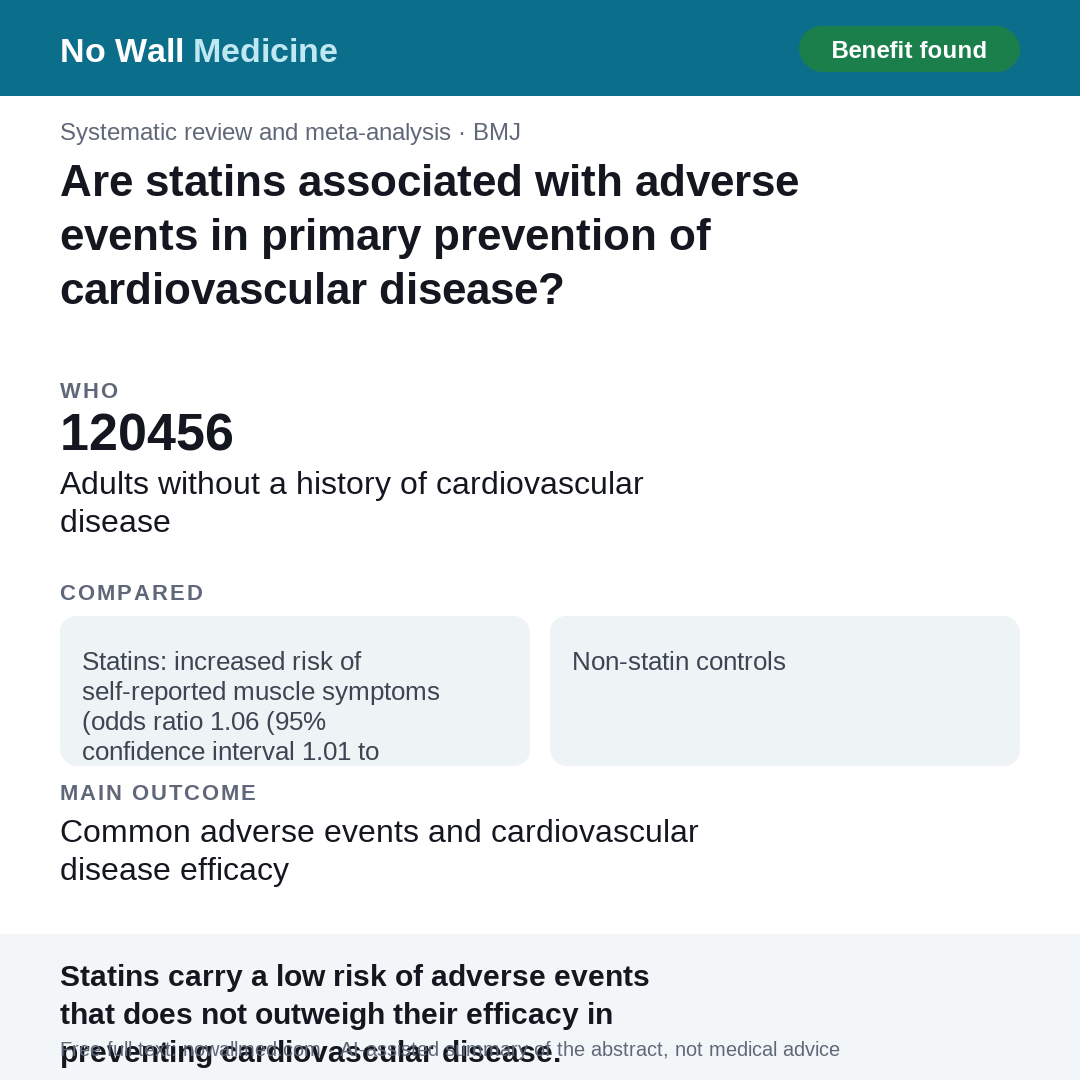
Clinical question: Are statins associated with adverse events in primary prevention of cardiovascular disease?
Why it matters: It was unknown how different types and dosages of statins relate to specific adverse events during primary prevention of cardiovascular disease.
Key points
- Researchers analyzed 62 randomized controlled trials involving 120,456 adults without cardiovascular disease history to compare statins with non-statin controls.
- Statins were associated with increased risks of self-reported muscle symptoms (odds ratio 1.06), liver dysfunction (odds ratio 1.33), renal insufficiency (odds ratio 1.14), and eye conditions (odds ratio 1.23).
- The increased risks of these adverse events were not associated with clinically confirmed muscle disorders or diabetes.
Limitation the authors note: Evidence to support tailoring the type or dosage of statins to account for safety concerns before starting treatment was limited.
Headline and key points written with AI from the paper’s abstract, with every number checked against it. Read the paper before relying on them.
Was this summary helpful?
Abstract
Objective
To assess the associations between statins and adverse events in primary prevention of cardiovascular disease and to examine how the associations vary by type and dosage of statins. Design
Systematic review and meta-analysis. Data sources
Studies were identified from previous systematic reviews and searched in Medline, Embase, and the Cochrane Central Register of Controlled Trials, up to August 2020. Review methods
Randomised controlled trials in adults without a history of cardiovascular disease that compared statins with non-statin controls or compared different types or dosages of statins were included. Main outcome measures
Primary outcomes were common adverse events: self-reported muscle symptoms, clinically confirmed muscle disorders, liver dysfunction, renal insufficiency, diabetes, and eye conditions. Secondary outcomes included myocardial infarction, stroke, and death from cardiovascular disease as measures of efficacy. Data synthesis
A pairwise meta-analysis was conducted to calculate odds ratios and 95% confidence intervals for each outcome between statins and non-statin controls, and the absolute risk difference in the number of events per 10 000 patients treated for a year was estimated. A network meta-analysis was performed to compare the adverse effects of different types of statins. An Emax model based meta-analysis was used to examine the dose-response relationships of the adverse effects of each statin. Results
62 trials were included, with 120 456 participants followed up for an average of 3.9 years. Statins were associated with an increased risk of self-reported muscle symptoms (21 trials, odds ratio 1.06 (95% confidence interval 1.01 to 1.13); absolute risk difference 15 (95% confidence interval 1 to 29)), liver dysfunction (21 trials, odds ratio 1.33 (1.12 to 1.58); absolute risk difference 8 (3 to 14)), renal insufficiency (eight trials, odds ratio 1.14 (1.01 to 1.28); absolute risk difference 12 (1 to 24)), and eye conditions (six trials, odds ratio 1.23 (1.04 to 1.47); absolute risk difference 14 (2 to 29)) but were not associated with clinically confirmed muscle disorders or diabetes. The increased risks did not outweigh the reduction in the risk of major cardiovascular events. Atorvastatin, lovastatin, and rosuvastatin were individually associated with some adverse events, but few significant differences were found between types of statins. An Emax dose-response relationship was identified for the effect of atorvastatin on liver dysfunction, but the dose-response relationships for the other statins and adverse effects were inconclusive. Conclusions
For primary prevention of cardiovascular disease, the risk of adverse events attributable to statins was low and did not outweigh their efficacy in preventing cardiovascular disease, suggesting that the benefit-to-harm balance of statins is generally favourable. Evidence to support tailoring the type or dosage of statins to account for safety concerns before starting treatment was limited. Systematic review registration
PROSPERO CRD42020169955.
Abstract reproduced under the article’s CC BY licence.
Subject terms
Cite this article
Cai T, Abel L, Langford O, Monaghan G, Aronson JK, Stevens RJ. Associations between statins and adverse events in primary prevention of cardiovascular disease: systematic review with pairwise, network, and dose-response meta-analyses. BMJ. 2021. doi:10.1136/bmj.n1537
Spotted a mistake? Suggest a correction
Top studies every Monday
The week’s key trials and guidelines in your specialties, plus any topics you follow. By email, free.
Get the weekly digest