Associations Between Surrogate Markers and Clinical Outcomes for Nononcologic Chronic Disease Treatments
Systematic review and meta-analysisMixed results
How strongly are surrogate markers associated with clinical outcomes in nononcologic chronic diseases?
Who
90056
Surrogate markers used in nononcologic chronic disease clinical trials
Compared
Surrogate markers with reported r or R2: 17% reported high strength
Other reported surrogate marker associations: 54% reported at least 1 r or R2
Main outcome
Association between surrogate markers and clinical outcomes
Bottom line: Most surrogate markers used for drug approval lacked high-strength evidence of association with clinical outcomes.
JAMA · 2024-04-22Download image
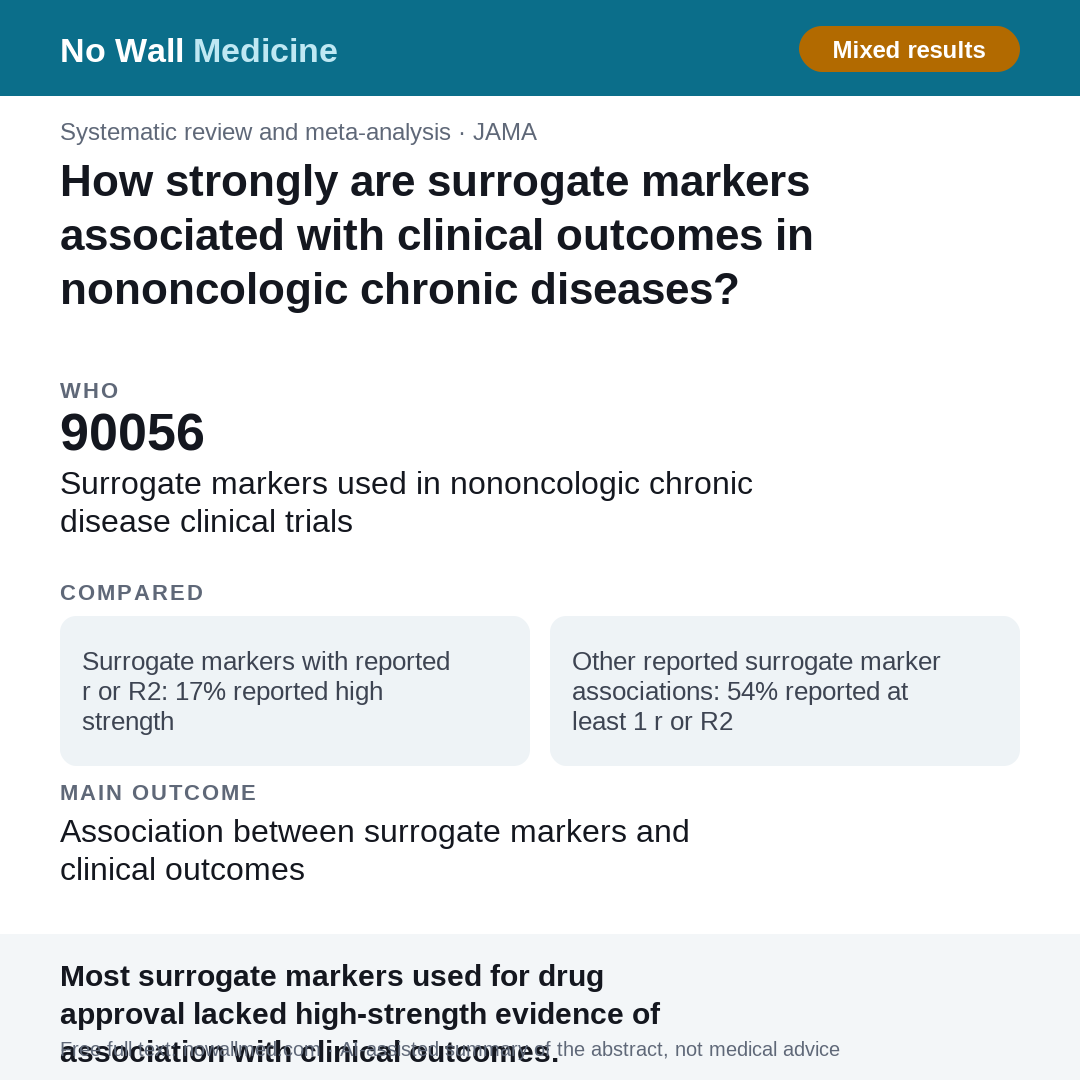
Clinical question: How strongly are surrogate markers associated with clinical outcomes in nononcologic chronic diseases?
Abstract
Importance
Surrogate markers are increasingly used as primary end points in clinical trials supporting drug approvals. Objective
To systematically summarize the evidence from meta-analyses, systematic reviews and meta-analyses, and pooled analyses (hereafter, meta-analyses) of clinical trials examining the strength of association between treatment effects measured using surrogate markers and clinical outcomes in nononcologic chronic diseases. Data sources
The Food and Drug Administration (FDA) Adult Surrogate Endpoint Table and MEDLINE from inception to March 19, 2023. Study selection
Three reviewers selected meta-analyses of clinical trials; meta-analyses of observational studies were excluded. Data extraction and synthesis
Two reviewers extracted correlation coefficients, coefficients of determination, slopes, effect estimates, or results from meta-regression analyses between surrogate markers and clinical outcomes. Main outcomes and measures
Correlation coefficient or coefficient of determination, when reported, was classified as high strength (r ≥ 0.85 or R2 ≥ 0.72); primary findings were otherwise summarized. Results
Thirty-seven surrogate markers listed in FDA's table and used as primary end points in clinical trials across 32 unique nononcologic chronic diseases were included. For 22 (59%) surrogate markers (21 chronic diseases), no eligible meta-analysis was identified. For 15 (41%) surrogate markers (14 chronic diseases), at least 1 meta-analysis was identified, 54 in total (median per surrogate marker, 2.5; IQR, 1.3-6.0); among these, median number of trials and patients meta-analyzed was 18.5 (IQR, 12.0-43.0) and 90 056 (IQR, 20 109-170 014), respectively. The 54 meta-analyses reported 109 unique surrogate marker-clinical outcome pairs: 59 (54%) reported at least 1 r or R2, 10 (17%) of which reported at least 1 classified as high strength, whereas 50 (46%) reported slopes, effect estimates, or results of meta-regression analyses only, 26 (52%) of which reported at least 1 statistically significant result. Conclusions and relevance
Most surrogate markers used as primary end points in clinical trials to support FDA approval of drugs treating nononcologic chronic diseases lacked high-strength evidence of associations with clinical outcomes from published meta-analyses.
Subject terms
Cite this article
Wallach JD, Yoon S, Doernberg H, Glick LR, Ciani O, Taylor RS. Associations Between Surrogate Markers and Clinical Outcomes for Nononcologic Chronic Disease Treatments. JAMA. 2024. doi:10.1001/jama.2024.4175
Spotted a mistake? Suggest a correction
Top studies every Monday
The week’s key trials and guidelines in your specialties, plus any topics you follow. By email, free.
Get the weekly digest