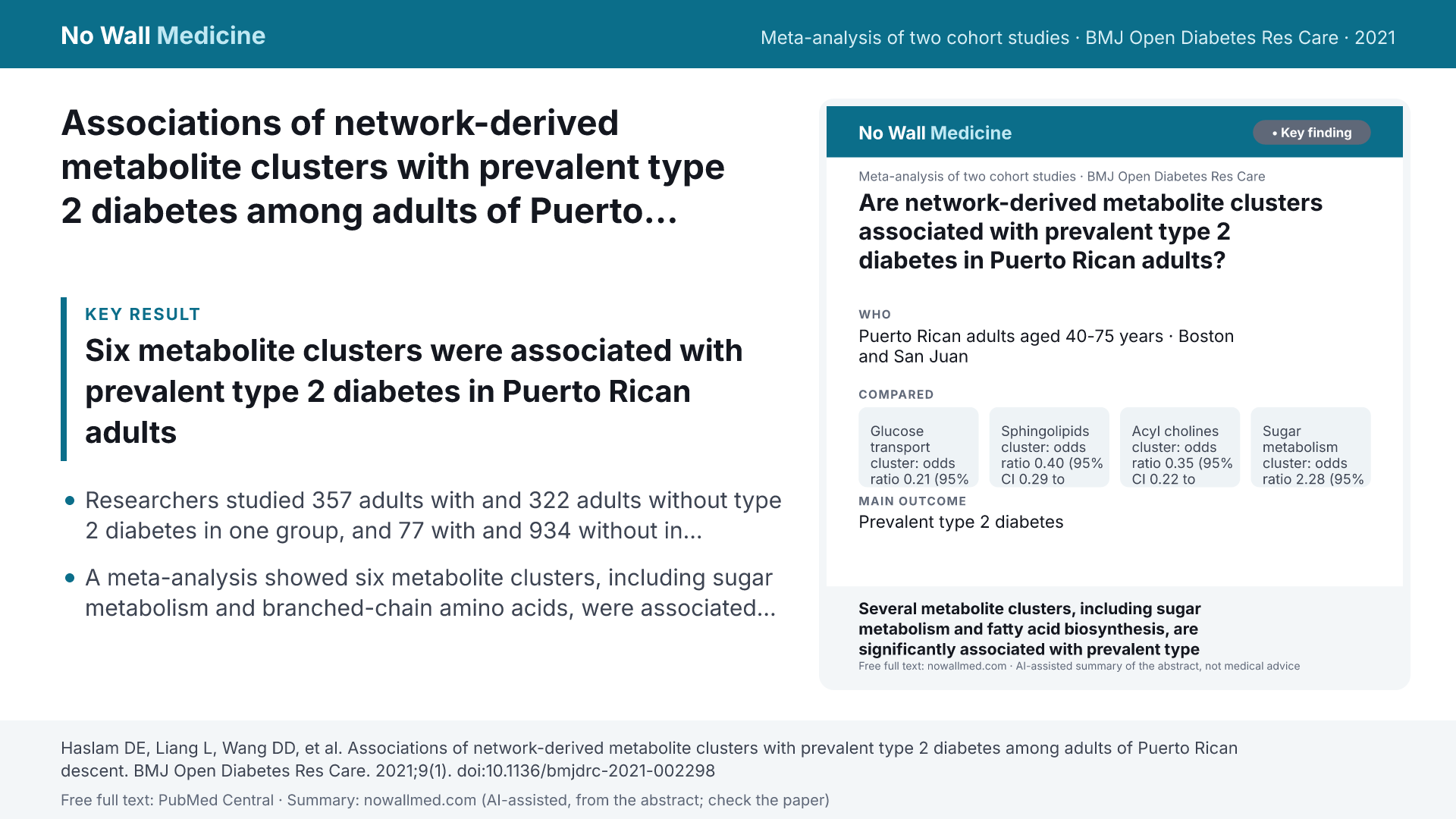
Six metabolite clusters were associated with prevalent type 2 diabetes in Puerto Rican adults
Associations of network-derived metabolite clusters with prevalent type 2 diabetes among adults of Puerto Rican descent
Meta-analysis of two cohort studiesBenefit found
Are network-derived metabolite clusters associated with prevalent type 2 diabetes in Puerto Rican adults?
Who
Puerto Rican adults aged 40-75 years · Boston and San Juan
Compared
Glucose transport cluster: odds ratio 0.21 (95% CI 0.16 to 0.30)
Sphingolipids cluster: odds ratio 0.40 (95% CI 0.29 to 0.53)
Acyl cholines cluster: odds ratio 0.35 (95% CI 0.22 to 0.56)
Sugar metabolism cluster: odds ratio 2.28 (95% CI 1.68 to 3.09)
Main outcome
Prevalent type 2 diabetes
Bottom line: Several metabolite clusters, including sugar metabolism and fatty acid biosynthesis, are significantly associated with prevalent type 2 diabetes in Puerto Rican adults.
BMJ Open Diabetes Res Care · 2021-08-20Download image
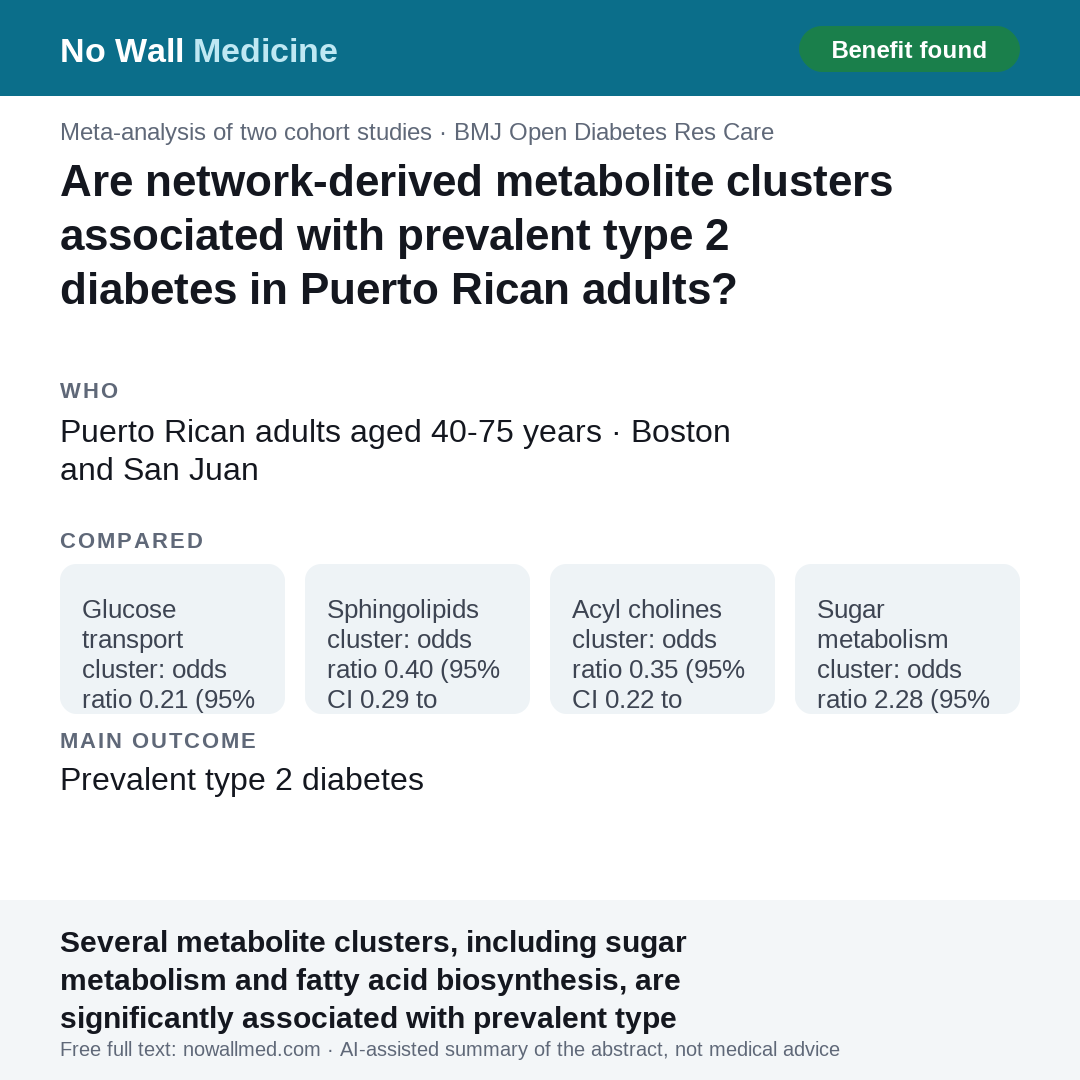
Clinical question: Are network-derived metabolite clusters associated with prevalent type 2 diabetes in Puerto Rican adults?
Why it matters: It was unknown if network analysis could identify specific groups of coregulated metabolites associated with type 2 diabetes in adults of Puerto Rican descent.
Key points
- Researchers studied 357 adults with and 322 adults without type 2 diabetes in one group, and 77 with and 934 without in a second group.
- A meta-analysis showed six metabolite clusters, including sugar metabolism and branched-chain amino acids, were associated with prevalent type 2 diabetes.
- The sugar metabolism cluster had an odds ratio of 2.28 (95% CI 1.68 to 3.09) and the branched-chain and aromatic amino acids cluster had an odds ratio of 2.22 (95% CI 1.60 to 3.08).
Headline and key points written with AI from the paper’s abstract, with every number checked against it. Read the paper before relying on them.
Was this summary helpful?
Abstract
Introduction
We investigated whether network analysis revealed clusters of coregulated metabolites associated with prevalent type 2 diabetes (T2D) among Puerto Rican adults. Research design and methods
We used liquid chromatography-mass spectrometry to measure fasting plasma metabolites (>600) among participants aged 40-75 years in the Boston Puerto Rican Health Study (BPRHS; discovery) and San Juan Overweight Adult Longitudinal Study (SOALS; replication), with (n=357; n=77) and without (n=322; n=934) T2D, respectively. Among BPRHS participants, we used unsupervised partial correlation network-based methods to identify and calculate metabolite cluster scores. Logistic regression was used to assess cross-sectional associations between metabolite clusters and prevalent T2D at the baseline blood draw in the BPRHS, and significant associations were replicated in SOALS. Inverse-variance weighted random-effect meta-analysis was used to combine cohort-specific estimates. Results
Six metabolite clusters were significantly associated with prevalent T2D in the BPRHS and replicated in SOALS (false discovery rate (FDR) <0.05). In a meta-analysis of the two cohorts, the OR and 95% CI (per 1 SD increase in cluster score) for prevalent T2D were as follows for clusters characterized primarily by glucose transport (0.21 (0.16 to 0.30); FDR <0.0001), sphingolipids (0.40 (0.29 to 0.53); FDR <0.0001), acyl cholines (0.35 (0.22 to 0.56); FDR <0.0001), sugar metabolism (2.28 (1.68 to 3.09); FDR <0.0001), branched-chain and aromatic amino acids (2.22 (1.60 to 3.08); FDR <0.0001), and fatty acid biosynthesis (1.54 (1.29 to 1.85); FDR <0.0001). Three additional clusters characterized by amino acid metabolism, cell membrane components, and aromatic amino acid metabolism displayed significant associations with prevalent T2D in the BPRHS, but these associations were not replicated in SOALS. Conclusions
Among Puerto Rican adults, we identified several known and novel metabolite clusters that associated with prevalent T2D.
Abstract reproduced under the article’s CC BY NC licence.
Subject terms
Cite this article
Haslam DE, Liang L, Wang DD, Kelly RS, Wittenbecher C, Pérez CM. Associations of network-derived metabolite clusters with prevalent type 2 diabetes among adults of Puerto Rican descent. BMJ Open Diabetes Res Care. 2021. doi:10.1136/bmjdrc-2021-002298
Spotted a mistake? Suggest a correction
Top studies every Monday
The week’s key trials and guidelines in your specialties, plus any topics you follow. By email, free.
Get the weekly digest