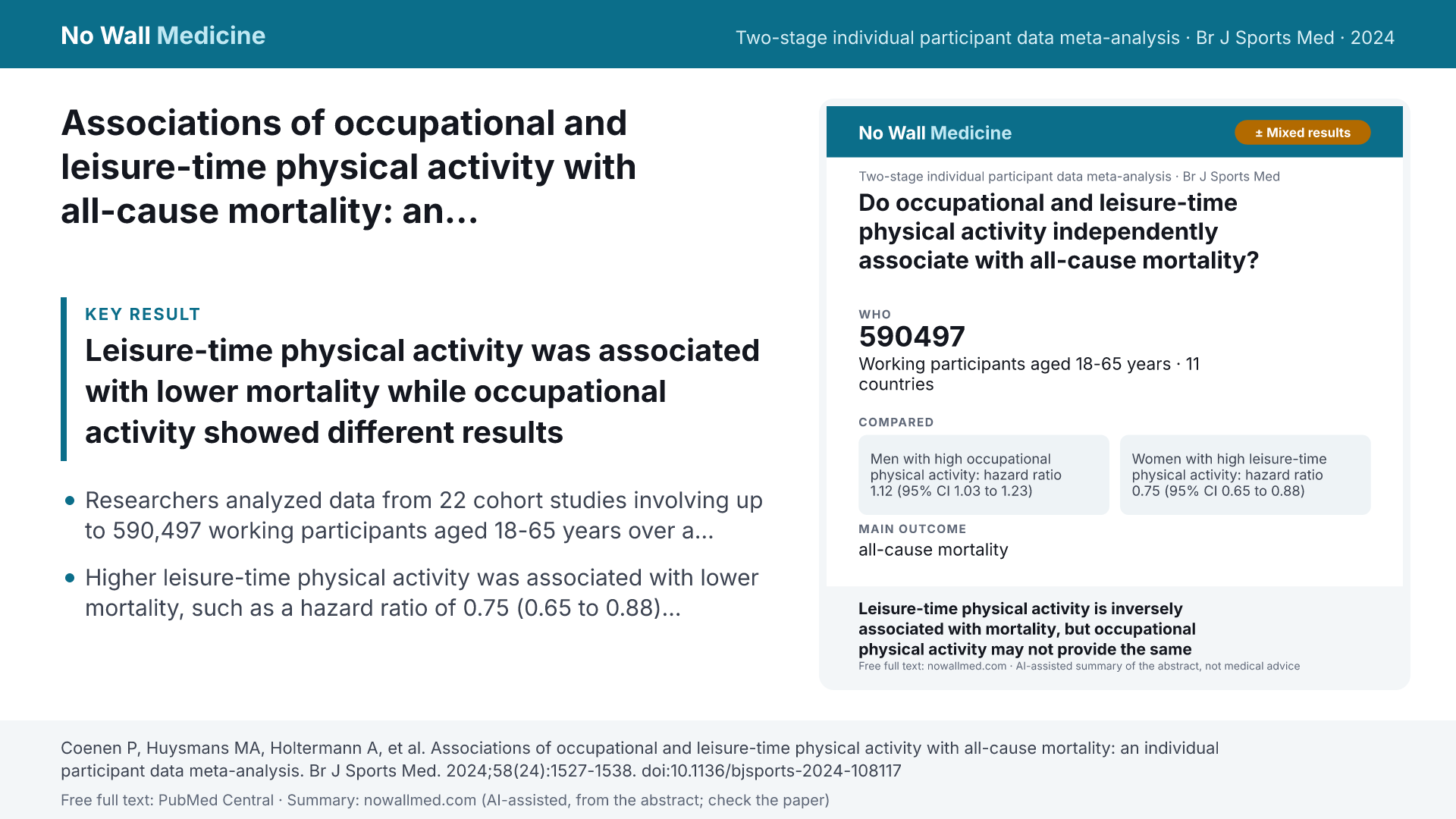
Leisure-time physical activity was associated with lower mortality while occupational activity showed different results
Associations of occupational and leisure-time physical activity with all-cause mortality: an individual participant data meta-analysis
Two-stage individual participant data meta-analysisMixed results
Do occupational and leisure-time physical activity independently associate with all-cause mortality?
Who
590497
Working participants aged 18-65 years · 11 countries
Compared
Men with high occupational physical activity: hazard ratio 1.12 (95% CI 1.03 to 1.23)
Women with high leisure-time physical activity: hazard ratio 0.75 (95% CI 0.65 to 0.88)
Main outcome
all-cause mortality
Bottom line: Leisure-time physical activity is inversely associated with mortality, but occupational physical activity may not provide the same benefits.
Br J Sports Med · 2024-12-18 · Save PNG
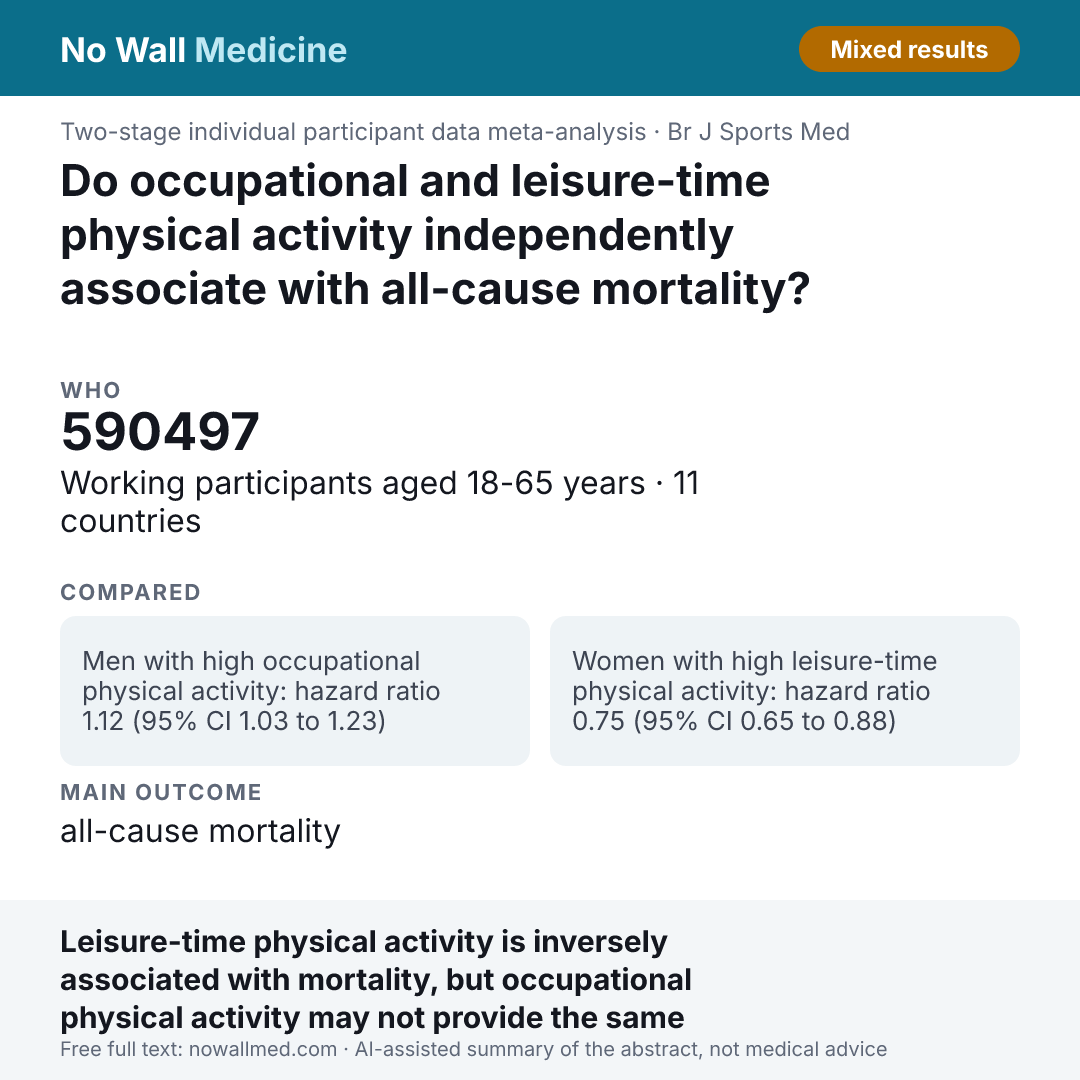
Clinical question: Do occupational and leisure-time physical activity independently associate with all-cause mortality?
Key points
- Researchers analyzed data from 22 cohort studies involving up to 590,497 working participants aged 18-65 years over a mean follow-up of 23.1 years.
- Higher leisure-time physical activity was associated with lower mortality, such as a hazard ratio of 0.75 (0.65 to 0.88) for high activity in women.
- For men, high occupational physical activity was associated with a hazard ratio of 1.12 (1.03 to 1.23) for all-cause mortality.
Headline and key points written with AI from the paper’s abstract, with every number checked against it. Read the paper before relying on them.
Was this summary helpful?
Abstract
Objective
Health effects of different physical activity domains (ie, during leisure time, work and transport) are generally considered positive. Using Active Worker consortium data, we assessed independent associations of occupational and leisure-time physical activity (OPA and LTPA) with all-cause mortality. Design
Two-stage individual participant data meta-analysis. Data source
Published and unpublished cohort study data. Eligibility criteria
Working participants aged 18-65 years. Methods
After data harmonisation, we assessed associations of OPA and LTPA with all-cause mortality. In stage 1, we analysed data from each study separately using Cox survival regression, and in stage 2, we pooled individual study findings with random-effects modelling. Results
In 22 studies with up to 590 497 participants from 11 countries, during a mean follow-up of 23.1 (SD: 6.8) years, 99 743 (16%) participants died. Adjusted for LTPA, body mass index, age, smoking and education level, summary (ie, stage 2) hazard ration (HRs) and 95% confidence interval (95% CI) for low, moderate and high OPA among men (n=2 96 134) were 1.01 (0.99 to 1.03), 1.05 (1.01 to 1.10) and 1.12 (1.03 to 1.23), respectively. For women (n=2 94 364), HRs (95% CI) were 0.98 (0.92 to 1.04), 0.96 (0.92 to 1.00) and 0.97 (0.86 to 1.10), respectively. In contrast, higher levels of LTPA were inversely associated with mortality for both genders. For example, for women HR for low, moderate and high compared with sedentary LTPA were 0.85 (0.81 to 0.89), 0.78 (0.74 to 0.81) and 0.75 (0.65 to 0.88), respectively. Effects were attenuated when adjusting for income (although data on income were available from only 9 and 6 studies, for men and women, respectively). Conclusion
Our findings indicate that OPA may not result in the same beneficial health effects as LTPA.
Abstract reproduced under the article’s CC BY NC licence.
Subject terms
Headline, design, result, key points, caveat and citation as plain text.
Cite this article
Coenen P, Huysmans MA, Holtermann A, et al. Associations of occupational and leisure-time physical activity with all-cause mortality: an individual participant data meta-analysis. Br J Sports Med. 2024;58(24):1527-1538. doi:10.1136/bjsports-2024-108117
Spotted a mistake? Suggest a correction