Triglyceride-glucose based obesity indices are associated with increased cardiovascular disease and mortality risk
Associations of triglyceride-glucose-related composite obesity indices with cardiovascular diseases and mortality: a systematic review and meta-analysis
Systematic review and meta-analysisKey finding
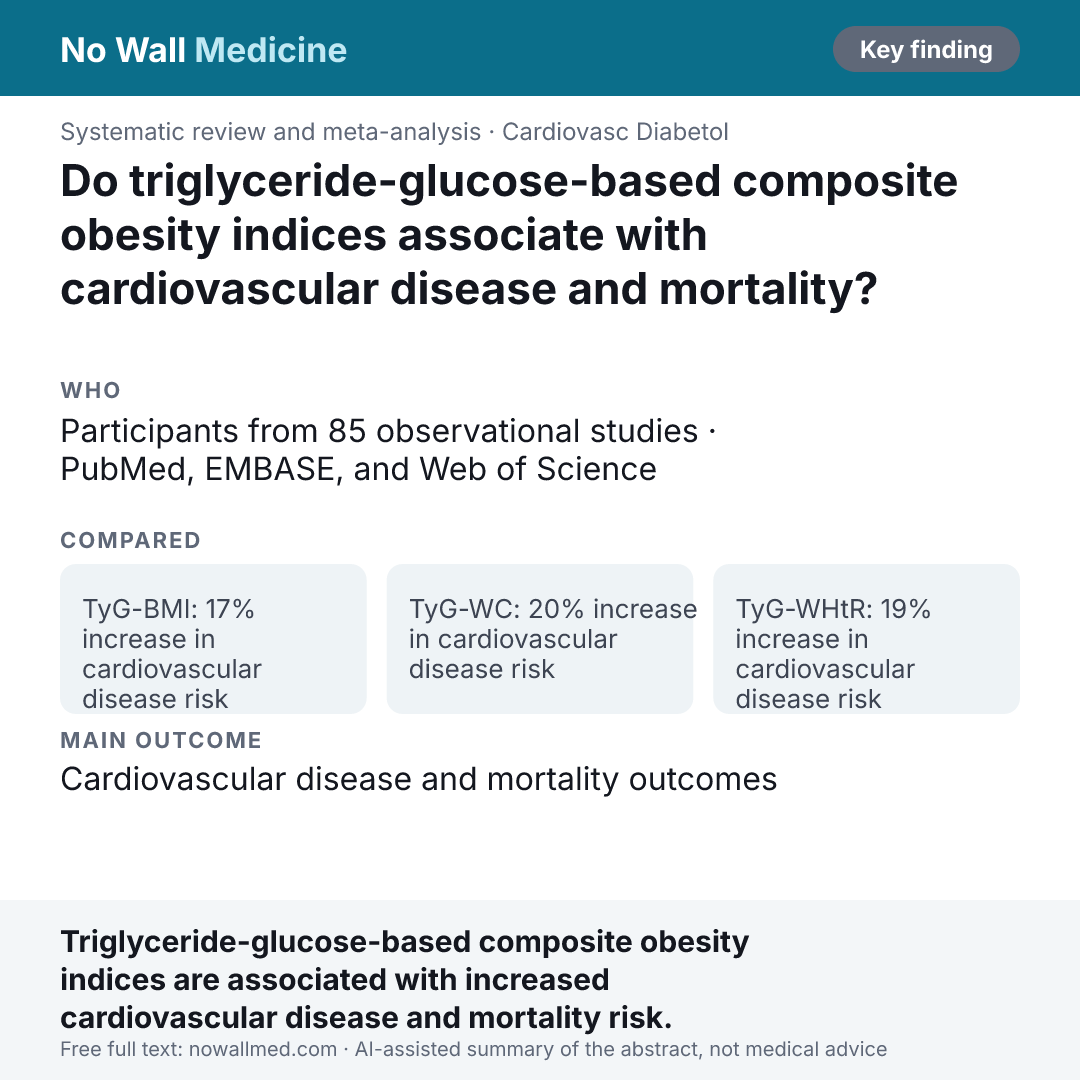
Do triglyceride-glucose-based composite obesity indices associate with cardiovascular disease and mortality?
Who
Participants from 85 observational studies · PubMed, EMBASE, and Web of Science
Compared
TyG-BMI: 17% increase in cardiovascular disease risk
TyG-WC: 20% increase in cardiovascular disease risk
TyG-WHtR: 19% increase in cardiovascular disease risk
Main outcome
Cardiovascular disease and mortality outcomes
Bottom line: Triglyceride-glucose-based composite obesity indices are associated with increased cardiovascular disease and mortality risk.
Limitation: Future multicenter prospective studies are needed to validate causal associations and generalizability.
Cardiovasc Diabetol · 2026-03-26 · Save PNG
Clinical question: Do triglyceride-glucose-based composite obesity indices associate with cardiovascular disease and mortality?
Why it matters: Evidence has not been systematically synthesized regarding how different triglyceride-glucose based obesity indices relate to cardiovascular risk and dose-response relationships.
Key points
- Researchers analyzed 85 studies, including 70 cohort studies, to evaluate how different triglyceride-glucose based obesity indices relate to cardiovascular outcomes.
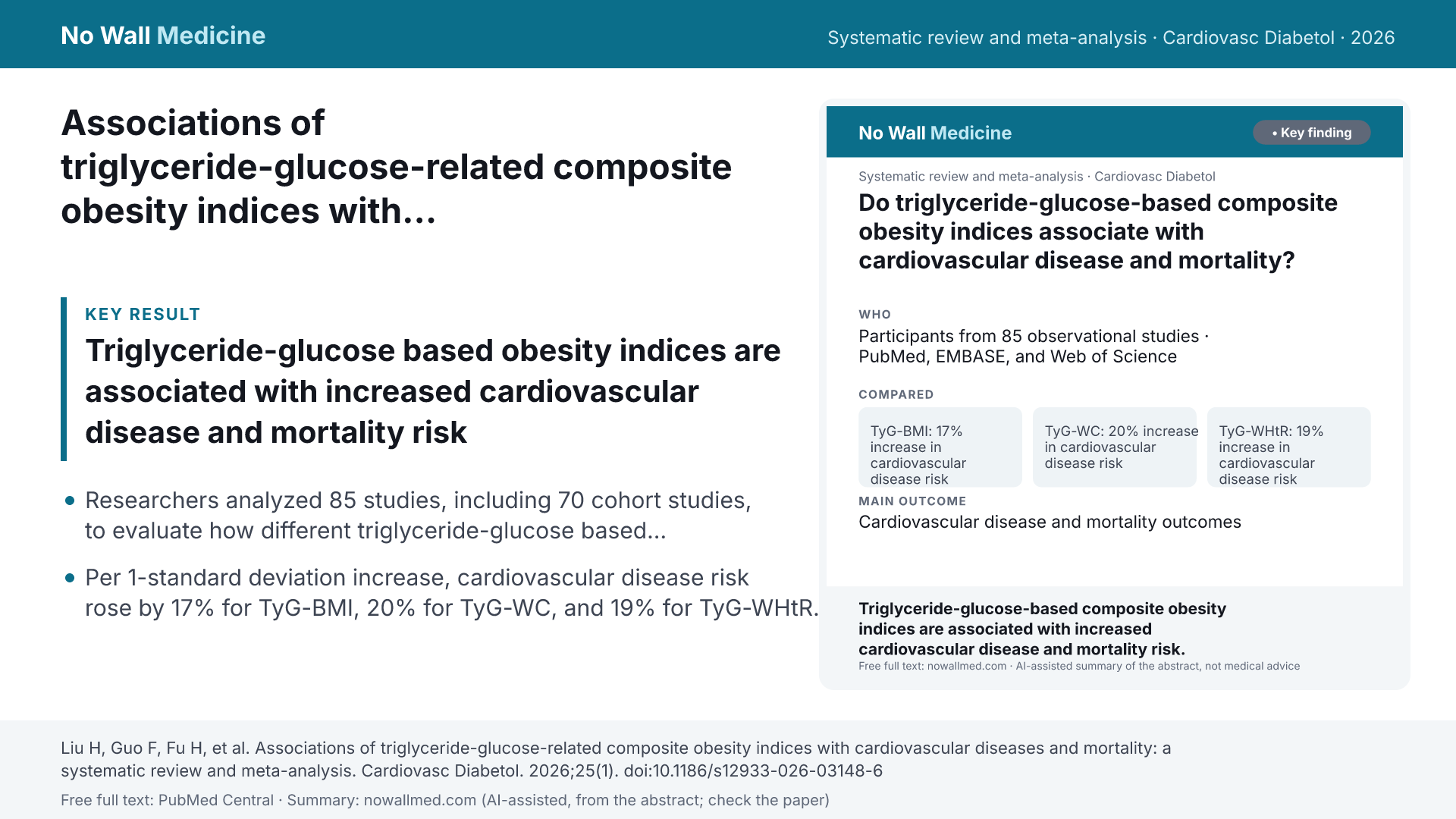
- Per 1-standard deviation increase, cardiovascular disease risk rose by 17% for TyG-BMI, 20% for TyG-WC, and 19% for TyG-WHtR.
- Cardiovascular mortality risk increased by 22%, 24%, 32%, and 31% for TyG-BMI, TyG-WC, TyG-WHtR, and TyG-ABSI, respectively.
Limitation the authors note: Future multicenter prospective studies are needed to validate causal associations and generalizability across diverse populations.
Headline and key points written with AI from the paper’s abstract, with every number checked against it. Read the paper before relying on them.
Was this summary helpful?
Subject terms
Headline, design, result, key points, caveat and citation as plain text.
Cite this article
Liu H, Guo F, Fu H, et al. Associations of triglyceride-glucose-related composite obesity indices with cardiovascular diseases and mortality: a systematic review and meta-analysis. Cardiovasc Diabetol. 2026;25(1). doi:10.1186/s12933-026-03148-6
Spotted a mistake? Suggest a correction