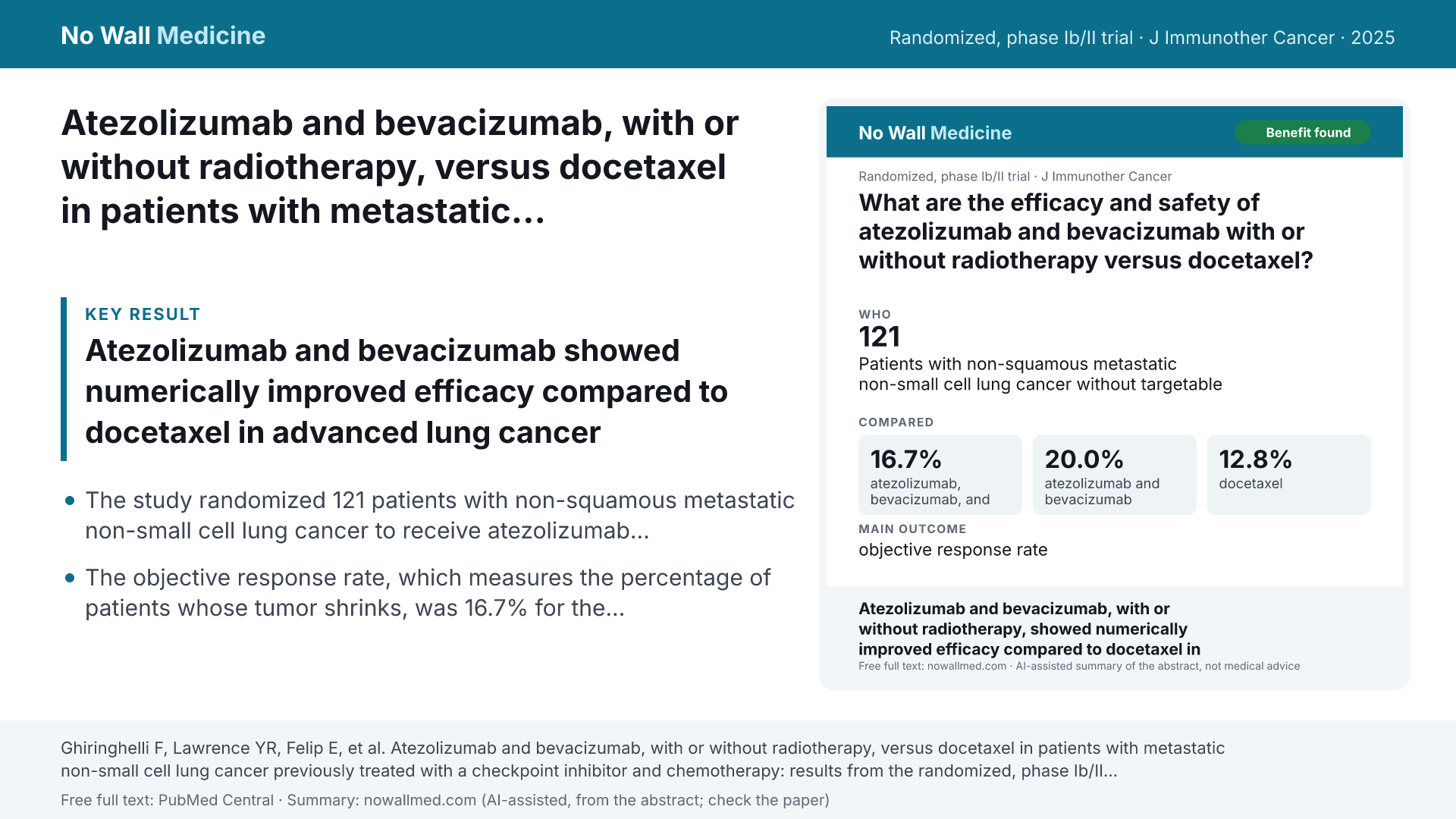
Atezolizumab and bevacizumab showed numerically improved efficacy compared to docetaxel in advanced lung cancer
Atezolizumab and bevacizumab, with or without radiotherapy, versus docetaxel in patients with metastatic non-small cell lung cancer previously treated with a checkpoint inhibitor and chemotherapy: results from the randomized, phase Ib/II MORPHEUS-Lung study
Randomized, phase Ib/II trialBenefit found
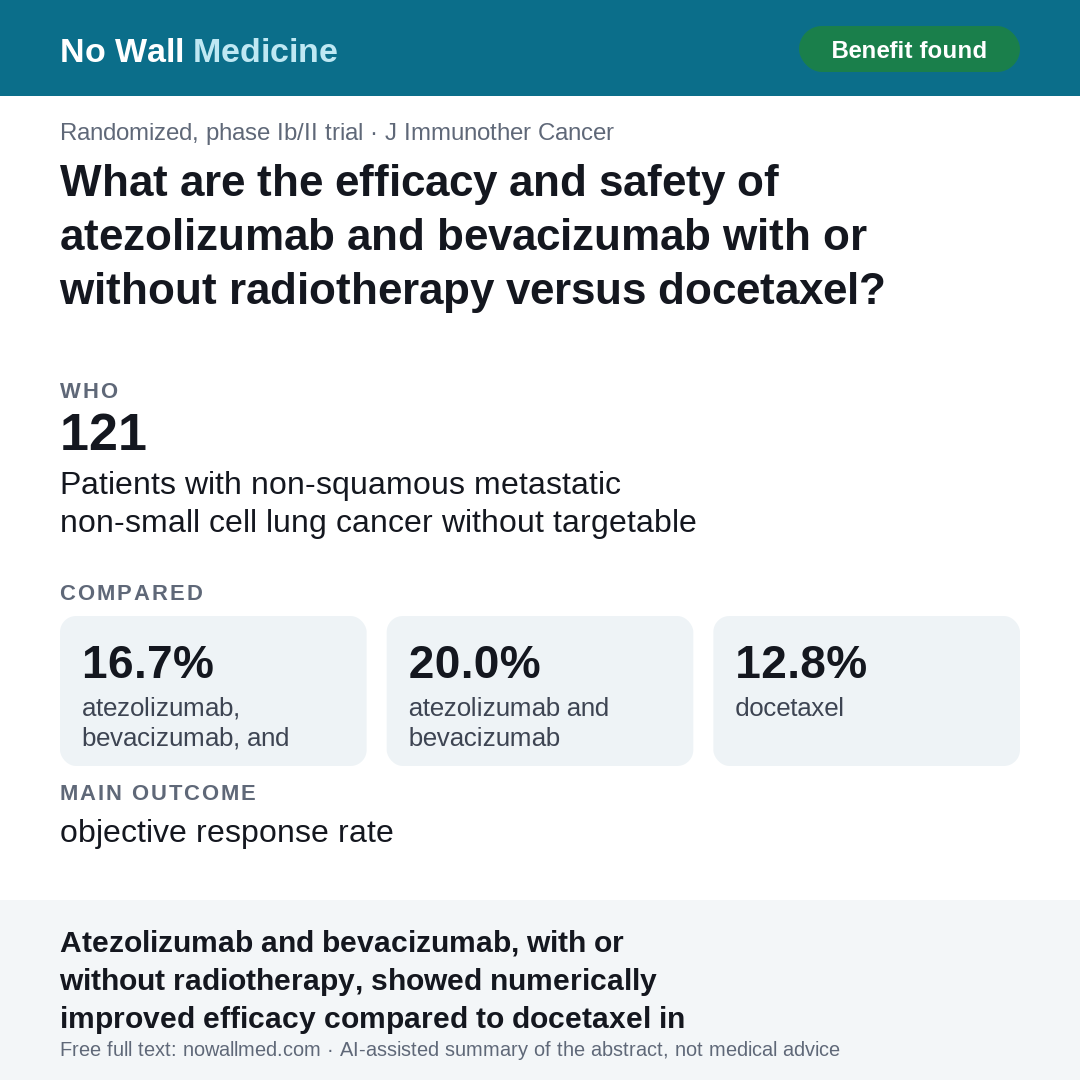
What are the efficacy and safety of atezolizumab and bevacizumab with or without radiotherapy versus docetaxel?
Who
121
Patients with non-squamous metastatic non-small cell lung cancer without targetable mutations
Compared
16.7%atezolizumab, bevacizumab, and stereotactic body radiotherapy (6/36)
20.0%atezolizumab and bevacizumab (8/40)
12.8%docetaxel (5/39)
Main outcome
objective response rate
Bottom line: Atezolizumab and bevacizumab, with or without radiotherapy, showed numerically improved efficacy compared to docetaxel in this interim analysis.
Limitation: This report presents interim analysis results.
J Immunother Cancer · 2025-08-04Download image
Clinical question: What are the efficacy and safety of atezolizumab and bevacizumab with or without radiotherapy versus docetaxel?
Why it matters: Treatment options are limited for patients with metastatic non-small cell lung cancer who have already progressed after receiving chemotherapy and immune checkpoint inhibitors.
Key points
- The study randomized 121 patients with non-squamous metastatic non-small cell lung cancer to receive atezolizumab plus bevacizumab with or without stereotactic body radiotherapy or docetaxel.
- The objective response rate, which measures the percentage of patients whose tumor shrinks, was 16.7% for the triple combination, 20.0% for the double combination, and 12.8% for docetaxel.
- Grade 3 or higher adverse events occurred in 47.6% of the triple combination group, 45.0% of the double combination group, and 64.1% of the docetaxel group.
Headline and key points written with AI from the paper’s abstract, with every number checked against it. Read the paper before relying on them.
Was this summary helpful?
Abstract
Background
Options remain limited for patients requiring later lines of therapy for metastatic non-small cell lung cancer (mNSCLC) due to poor prognosis and potential toxicities. Therefore, trials of novel combinations of existing therapeutic candidates are warranted. Here, we report robust interim analysis results from the MORPHEUS-Lung study in immune checkpoint inhibitor (CPI)-exposed patients with non-squamous mNSCLC and without targetable gene mutations. Methods
MORPHEUS-Lung enrolled patients with disease progression during or following treatment with a platinum-containing regimen and a PD-L1/PD-1 immune CPI, given in combination as one line or as two separate lines of therapy, regardless of PD-L1 expression. The primary efficacy endpoint was objective response rate (ORR). Secondary efficacy endpoints included progression-free survival, duration of response, disease control rate, overall survival, and safety; exploratory endpoints included biomarkers. Patients were randomized to the atezolizumab+bevacizumab+non-ablative stereotactic body radiotherapy (SBRT), atezolizumab+bevacizumab, or docetaxel (control) arms and included in this analysis. Results
At data cut-off (August 28, 2024), 121 patients were randomized and treated: atezolizumab+bevacizumab+SBRT (n=42), atezolizumab+bevacizumab (n=40), and docetaxel (n=39). Confirmed ORR was 16.7% (6/36), 20.0% (8/40), and 12.8% (5/39) in the atezolizumab+bevacizumab+SBRT, atezolizumab+bevacizumab, and docetaxel (control) arms, respectively; one patient (2.5%) in the atezolizumab+bevacizumab arm had a complete response. Grade≥3 adverse events (AEs) occurred in 47.6% (20/42) of patients receiving atezolizumab+bevacizumab+SBRT, 45.0% (18/40) receiving atezolizumab+bevacizumab, and 64.1% (25/39) receiving docetaxel. AEs leading to discontinuation of any treatment occurred in 14.3% of patients in the atezolizumab+bevacizumab+SBRT arm, 7.5% in the atezolizumab+bevacizumab arm, and 15.4% in the docetaxel (control) arm. There were no clear correlations of response or survival benefit with PD-L1 expression or immune phenotype. Conclusions
Results from this interim analysis suggest that atezolizumab+bevacizumab, with or without SBRT, showed evidence of numerically improved efficacy outcomes compared with docetaxel, with a trend toward a benefit in both the primary and secondary resistance settings. Safety was consistent with the known profiles of the individual drugs, with increased toxicity observed when SBRT was added to atezolizumab+bevacizumab.
Abstract reproduced under the article’s CC BY NC licence.
Subject terms
Cite this article
Ghiringhelli F, Lawrence YR, Felip E, et al. Atezolizumab and bevacizumab, with or without radiotherapy, versus docetaxel in patients with metastatic non-small cell lung cancer previously treated with a checkpoint inhibitor and chemotherapy: results from the randomized, phase Ib/II MORPHEUS-Lung study. J Immunother Cancer. 2025. doi:10.1136/jitc-2025-011892
Spotted a mistake? Suggest a correction