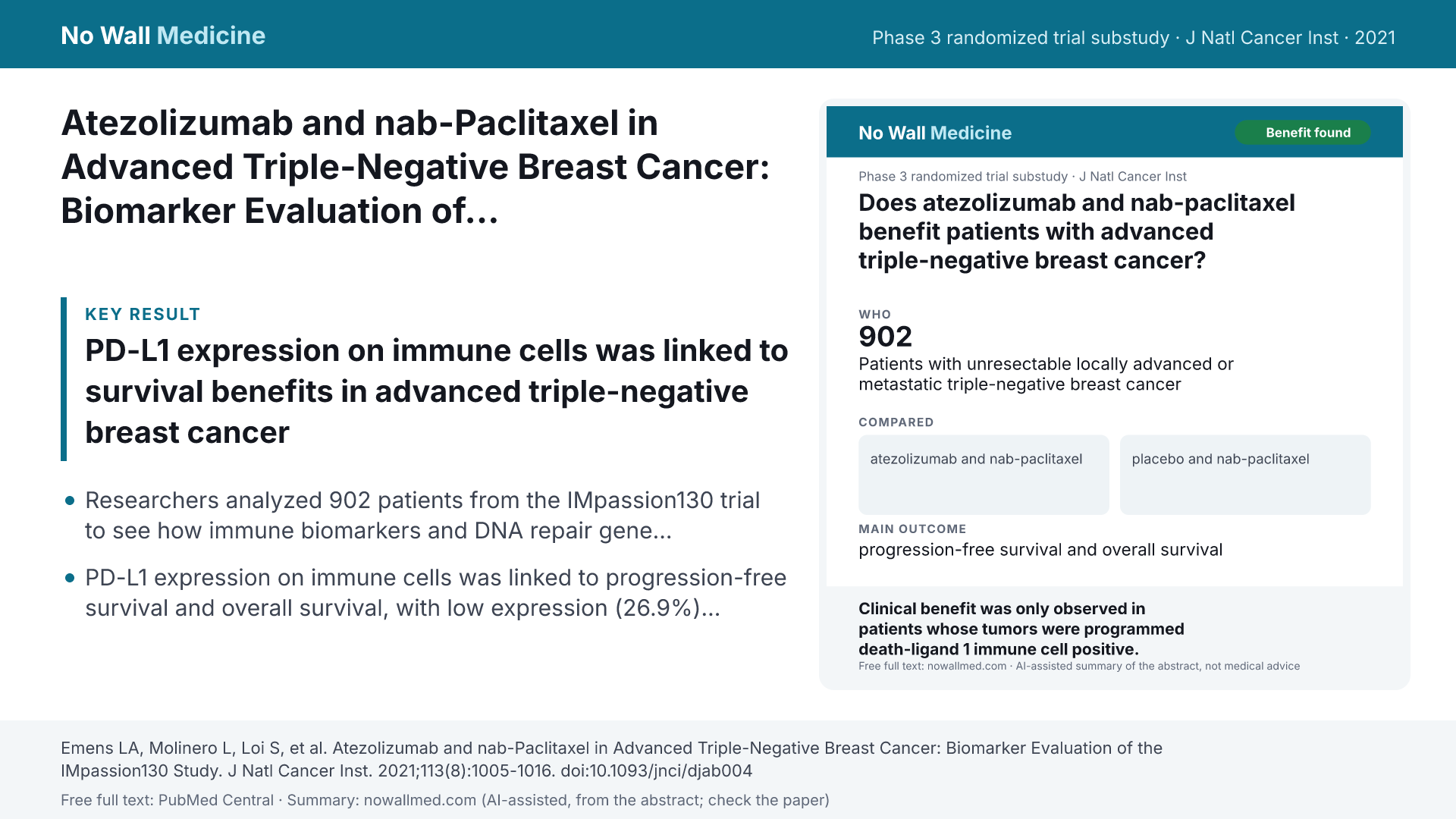
PD-L1 expression on immune cells was linked to survival benefits in advanced triple-negative breast cancer
Atezolizumab and nab-Paclitaxel in Advanced Triple-Negative Breast Cancer: Biomarker Evaluation of the IMpassion130 Study
Phase 3 randomized trial substudyBenefit found
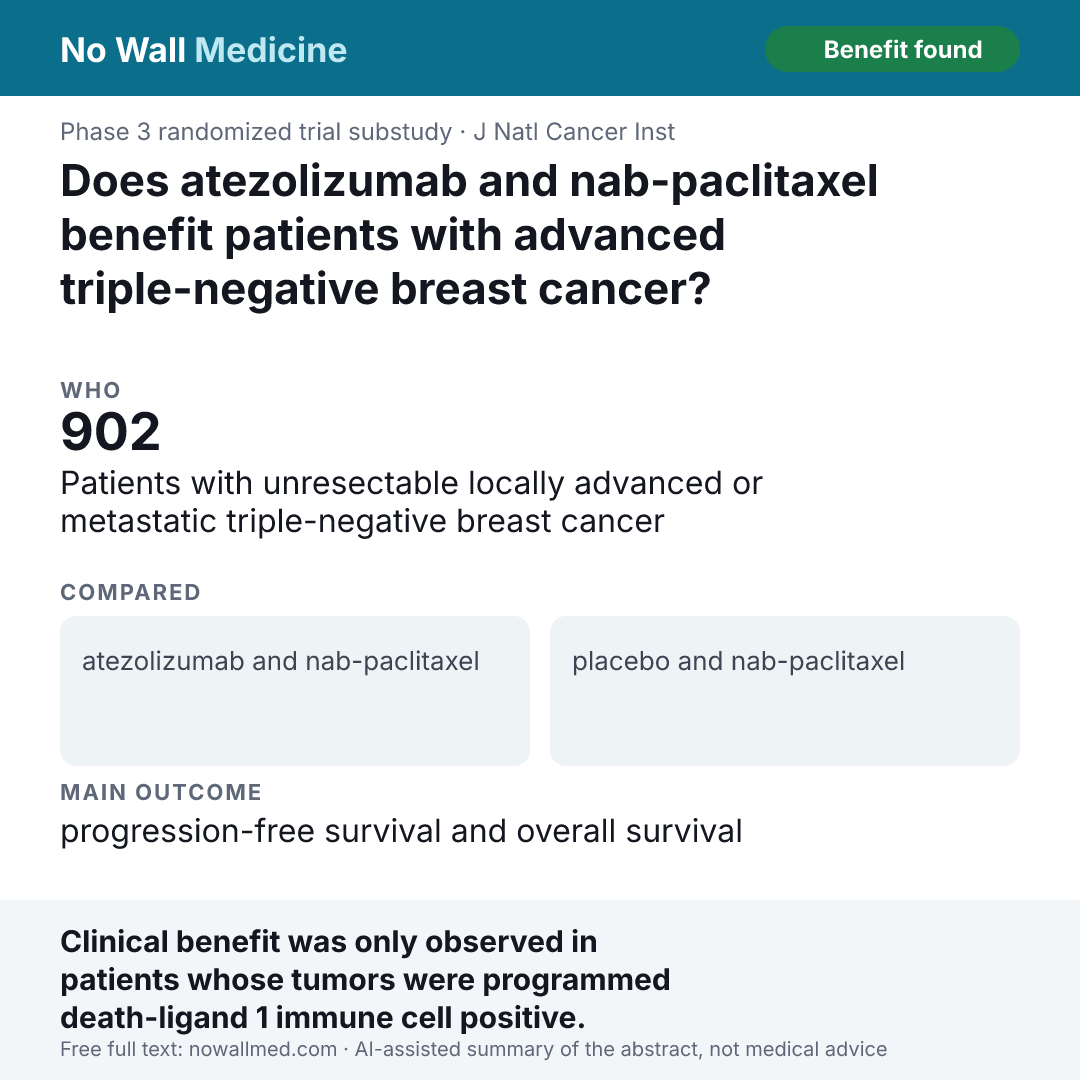
Does atezolizumab and nab-paclitaxel benefit patients with advanced triple-negative breast cancer?
Who
902
Patients with unresectable locally advanced or metastatic triple-negative breast cancer
Compared
atezolizumab and nab-paclitaxel
placebo and nab-paclitaxel
Main outcome
progression-free survival and overall survival
Bottom line: Clinical benefit was only observed in patients whose tumors were programmed death-ligand 1 immune cell positive.
J Natl Cancer Inst · 2021-02-02 · Save PNG
Clinical question: Does atezolizumab and nab-paclitaxel benefit patients with advanced triple-negative breast cancer?
Key points
- Researchers analyzed 902 patients from the IMpassion130 trial to see how immune biomarkers and DNA repair gene mutations related to treatment with atezolizumab and nab-paclitaxel.
- PD-L1 expression on immune cells was linked to progression-free survival and overall survival, with low expression (26.9%) and high expression (13.9%) showing comparable outcomes.
- Clinical benefit was only observed in patients with PD-L1 expression on immune cells, regardless of whether BRCA1/2 mutations were present in 14.5% of patients.
Headline and key points written with AI from the paper’s abstract, with every number checked against it. Read the paper before relying on them.
Was this summary helpful?
Subject terms
Headline, design, result, key points, caveat and citation as plain text.
Cite this article
Emens LA, Molinero L, Loi S, et al. Atezolizumab and nab-Paclitaxel in Advanced Triple-Negative Breast Cancer: Biomarker Evaluation of the IMpassion130 Study. J Natl Cancer Inst. 2021;113(8):1005-1016. doi:10.1093/jnci/djab004
Spotted a mistake? Suggest a correction