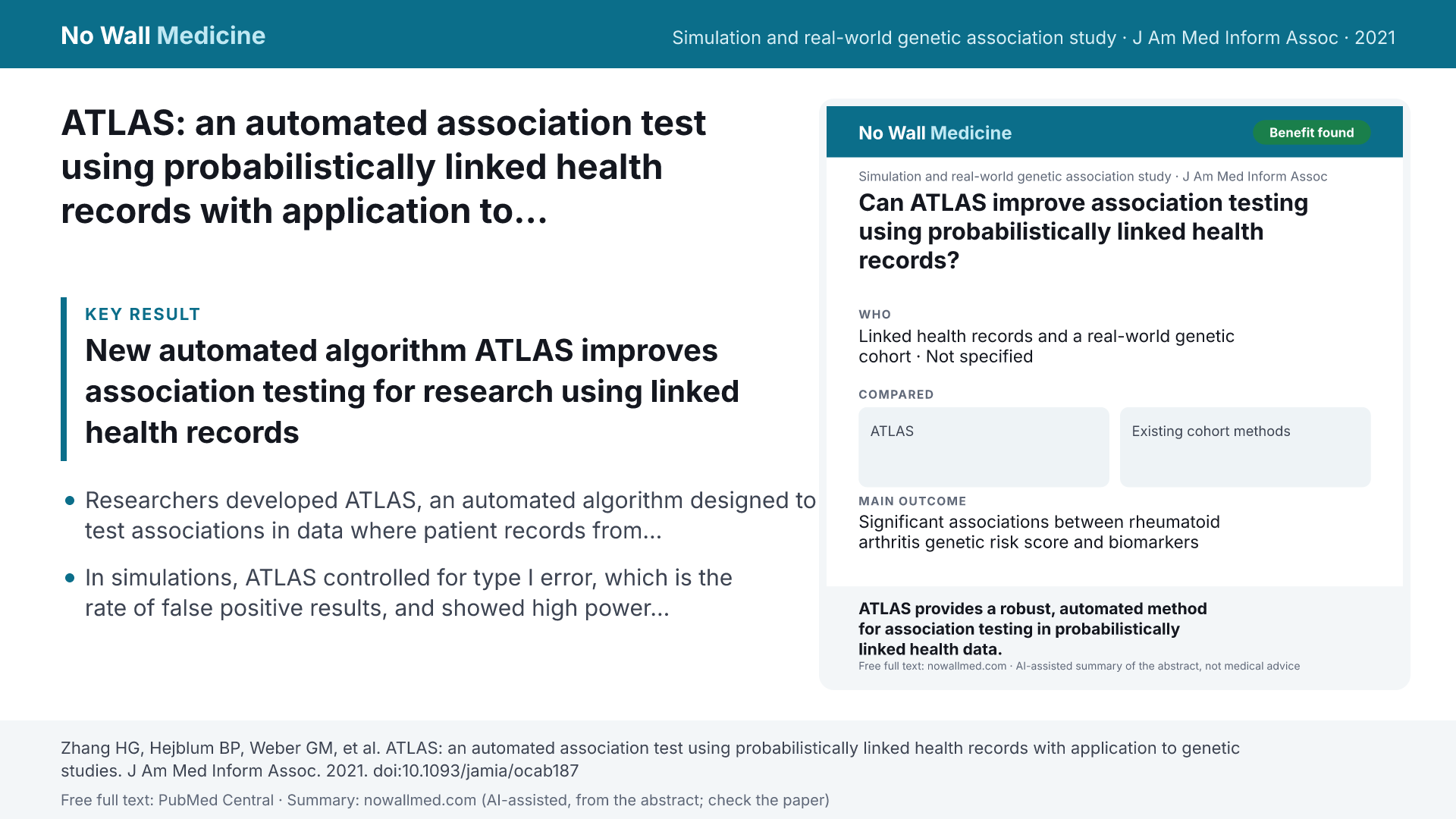
New automated algorithm ATLAS improves association testing for research using linked health records
ATLAS: an automated association test using probabilistically linked health records with application to genetic studies
Simulation and real-world genetic association studyBenefit found
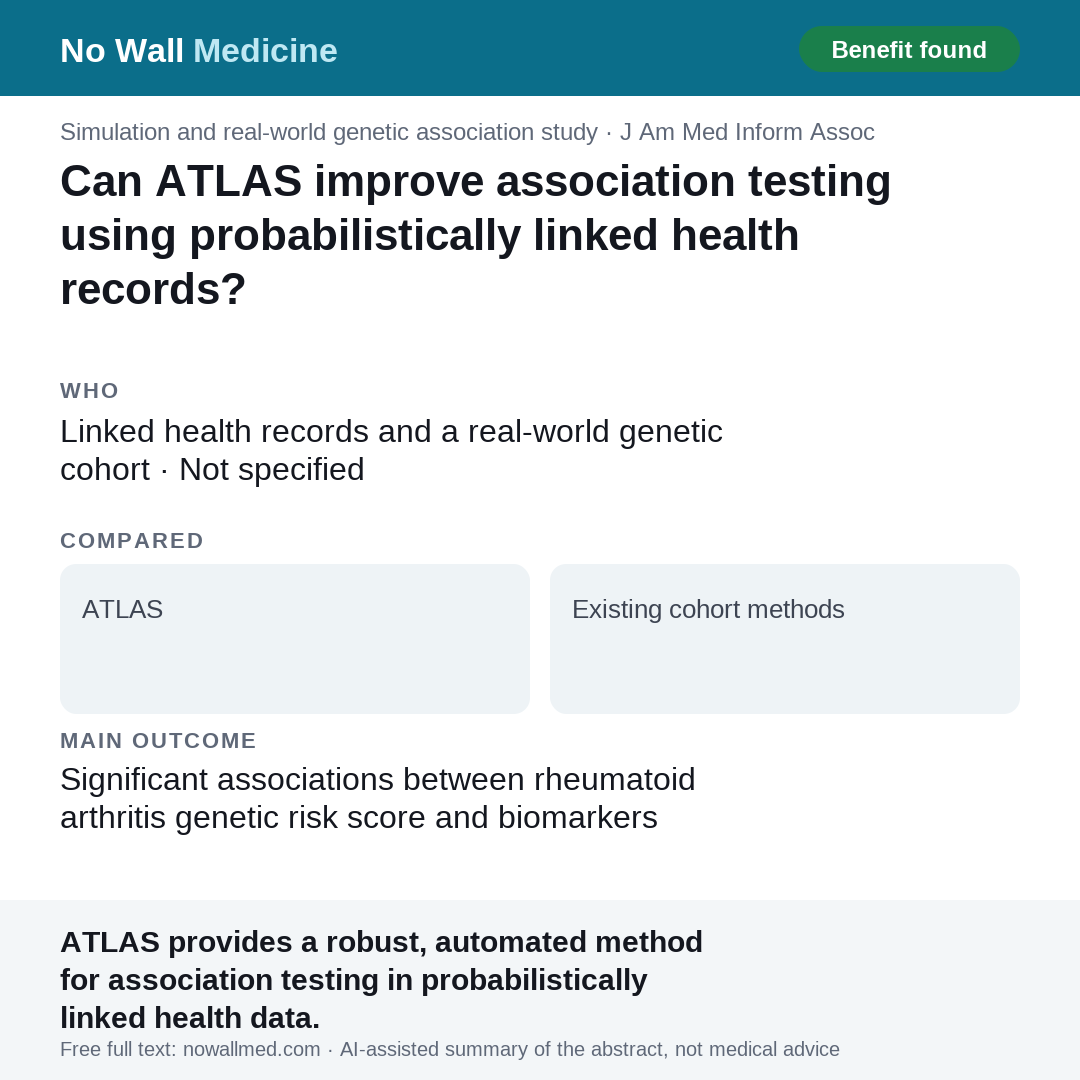
Can ATLAS improve association testing using probabilistically linked health records?
Who
Linked health records and a real-world genetic cohort · Not specified
Compared
ATLAS
Existing cohort methods
Main outcome
Significant associations between rheumatoid arthritis genetic risk score and biomarkers
Bottom line: ATLAS provides a robust, automated method for association testing in probabilistically linked health data.
J Am Med Inform Assoc · 2021-10-06Download image
Clinical question: Can ATLAS improve association testing using probabilistically linked health records?
Why it matters: Researchers lack methods to analyze linked health records that can handle uncertainty and avoid the low power or bias caused by choosing a single threshold for matching patients.
Key points
- Researchers developed ATLAS, an automated algorithm designed to test associations in data where patient records from different databases are linked using probability rather than exact matches.
- In simulations, ATLAS controlled for type I error, which is the rate of false positive results, and showed high power compared to previous methods.
- In a real-world genetic study, ATLAS was associated with finding additional significant links between rheumatoid arthritis genetic risk scores and laboratory biomarkers.
Headline and key points written with AI from the paper’s abstract, with every number checked against it. Read the paper before relying on them.
Was this summary helpful?
Subject terms
Cite this article
Zhang HG, Hejblum BP, Weber GM, et al. ATLAS: an automated association test using probabilistically linked health records with application to genetic studies. J Am Med Inform Assoc. 2021. doi:10.1093/jamia/ocab187
Spotted a mistake? Suggest a correction