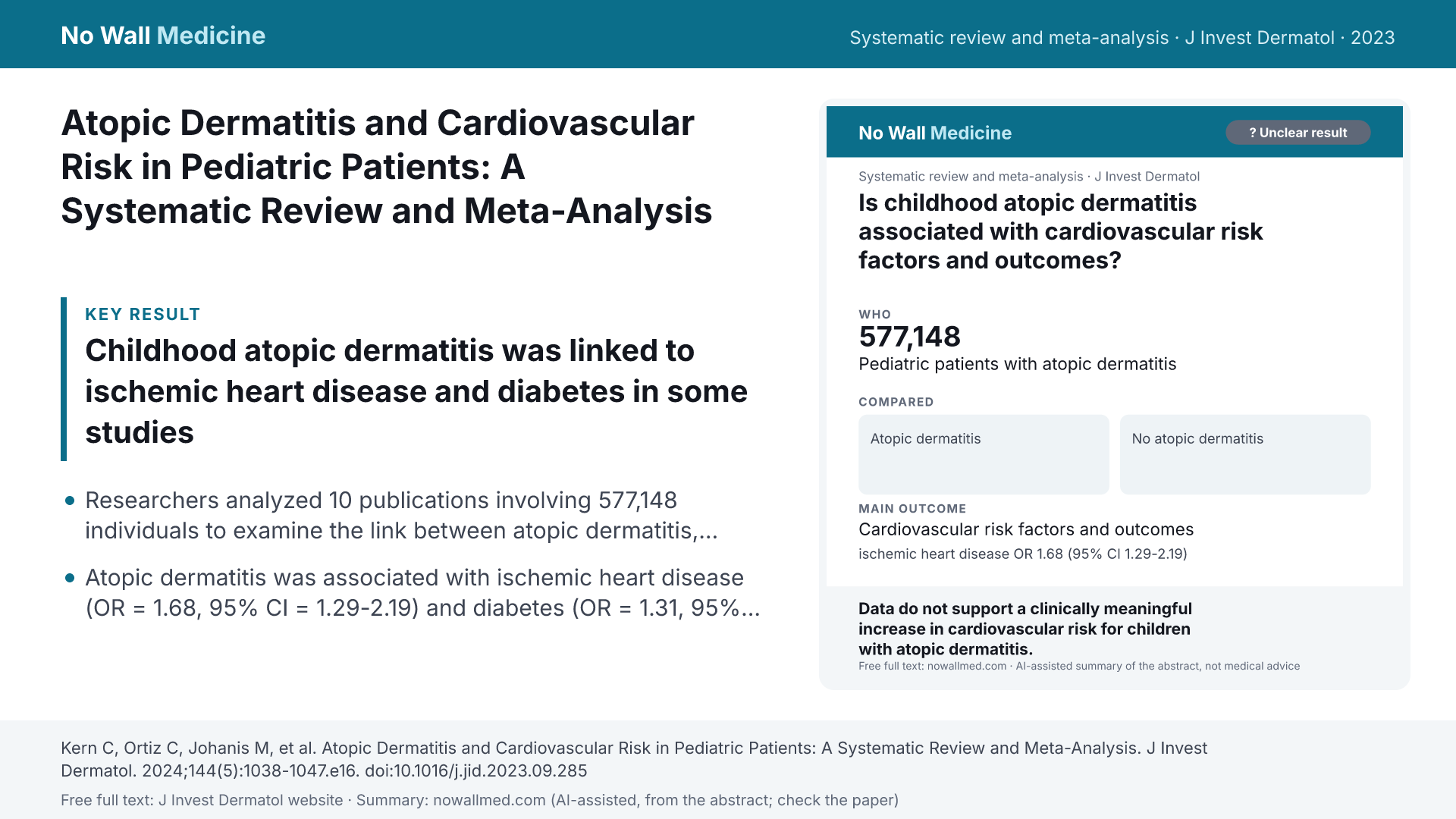
Childhood atopic dermatitis was linked to ischemic heart disease and diabetes in some studies
Atopic Dermatitis and Cardiovascular Risk in Pediatric Patients: A Systematic Review and Meta-Analysis
Systematic review and meta-analysisUnclear result
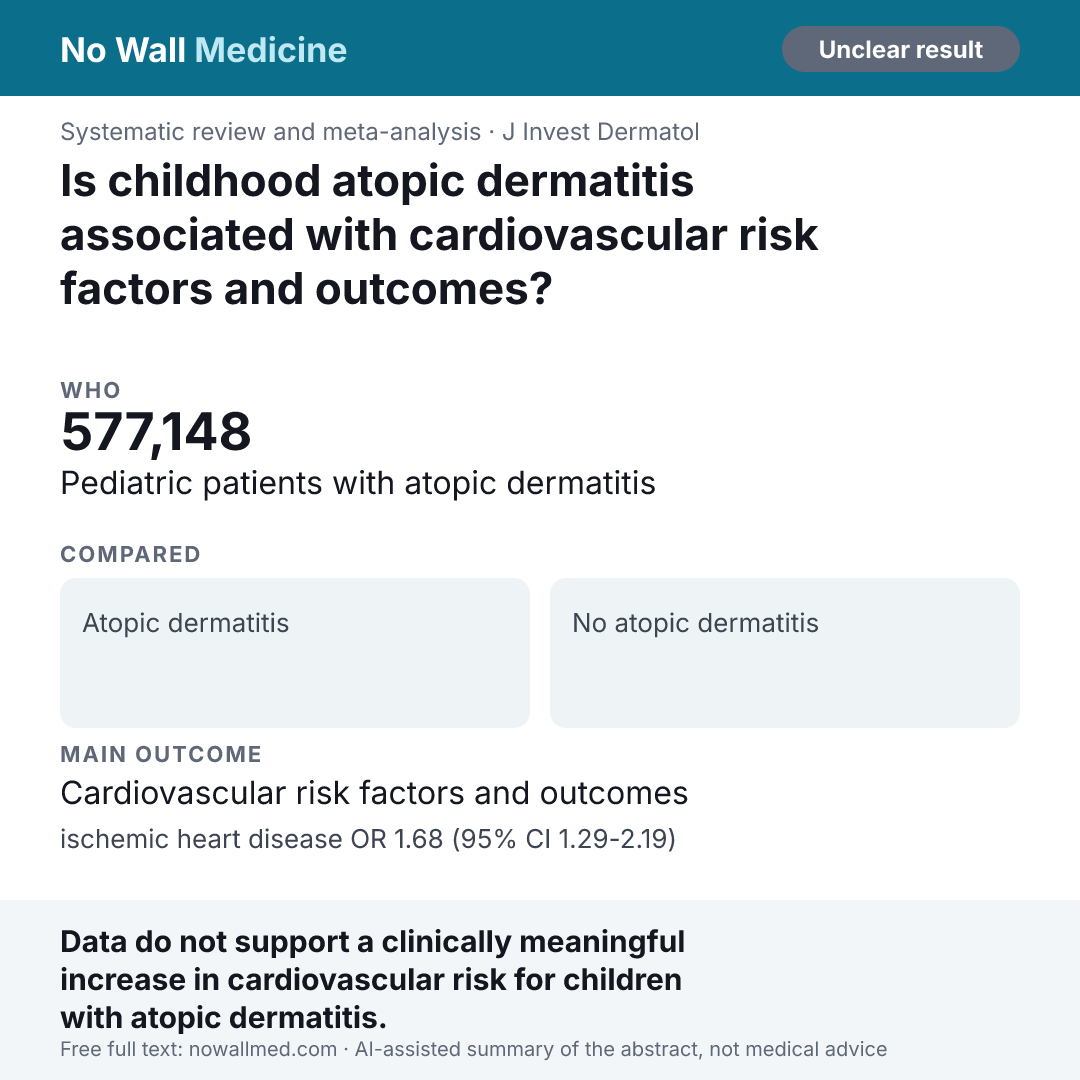
Is childhood atopic dermatitis associated with cardiovascular risk factors and outcomes?
Who
577,148
Pediatric patients with atopic dermatitis
Compared
Atopic dermatitis
No atopic dermatitis
Main outcome
Cardiovascular risk factors and outcomes
Result: ischemic heart disease OR 1.68 (95% CI 1.29-2.19)
Bottom line: Data do not support a clinically meaningful increase in cardiovascular risk for children with atopic dermatitis.
Limitation: Studies lacked detail on disease severity and confounders like body mass index; certainty of evidence was very low.
J Invest Dermatol · 2023-11-14 · Save PNG
Clinical question: Is childhood atopic dermatitis associated with cardiovascular risk factors and outcomes?
Why it matters: While atopic dermatitis is linked to cardiovascular risk in adults, data regarding the risk for children are limited.
Key points
- Researchers analyzed 10 publications involving 577,148 individuals to examine the link between atopic dermatitis, a chronic skin inflammation, and cardiovascular risks.
- Atopic dermatitis was associated with ischemic heart disease (OR = 1.68, 95% CI = 1.29-2.19) and diabetes (OR = 1.31, 95% CI = 1.12-1.53).
- The association with ischemic heart disease and diabetes did not persist in studies that adjusted for potential confounding factors (OR = 0.98, 95% CI = 0.35-2.75).
Limitation the authors note: Studies lacked detail on skin disease severity and important confounding factors like body mass index, and the certainty of evidence was very low to low.
Headline and key points written with AI from the paper’s abstract, with every number checked against it. Read the paper before relying on them.
Was this summary helpful?
Abstract
Cardiovascular guidelines recommend early screening and preventative treatment for children with chronic inflammatory diseases. Atopic dermatitis (AD) is associated with cardiovascular risk in adults, but data in children are limited. We systematically searched for studies that examined the association between childhood AD and cardiovascular risk factors and outcomes. Data from 10 publications, including 577,148 individuals, revealed an association between AD and ischemic heart disease (n = 3, OR = 1.68, 95% confidence interval [CI] = 1.29-2.19) and diabetes (n = 4, OR = 1.31, 95% CI = 1.12-1.53), but this did not persist among studies that adjusted for potential confounders (n = 2, OR = 0.98, 95% CI = 0.35-2.75). Similarly, there was an association with lipid disorders but not across the entire population distribution (n = 7, OR = 1.24, 95% CI = 1.13-1.36, 95% prediction interval = 0.95-1.61). AD was not associated with hypertension (n = 5, OR = 1.15, 95% CI = 0.98-1.34, 95% prediction interval = 0.81-1.62) or stroke (n = 2, OR = 1.24, 95% CI = 0.94-1.62). Studies lacked detail on AD severity and important confounders such as body mass index, and the certainty of evidence was very low to low on the basis of GRADE (Grading of Recommendations, Assessment, Development and Evaluation) assessments. Currently, data do not support a clinically meaningful increase in cardiovascular risk for children with AD.
Abstract reproduced under the article’s CC BY licence.
Subject terms
Headline, design, result, key points, caveat and citation as plain text.
Cite this article
Kern C, Ortiz C, Johanis M, et al. Atopic Dermatitis and Cardiovascular Risk in Pediatric Patients: A Systematic Review and Meta-Analysis. J Invest Dermatol. 2024;144(5):1038-1047.e16. doi:10.1016/j.jid.2023.09.285
Spotted a mistake? Suggest a correction