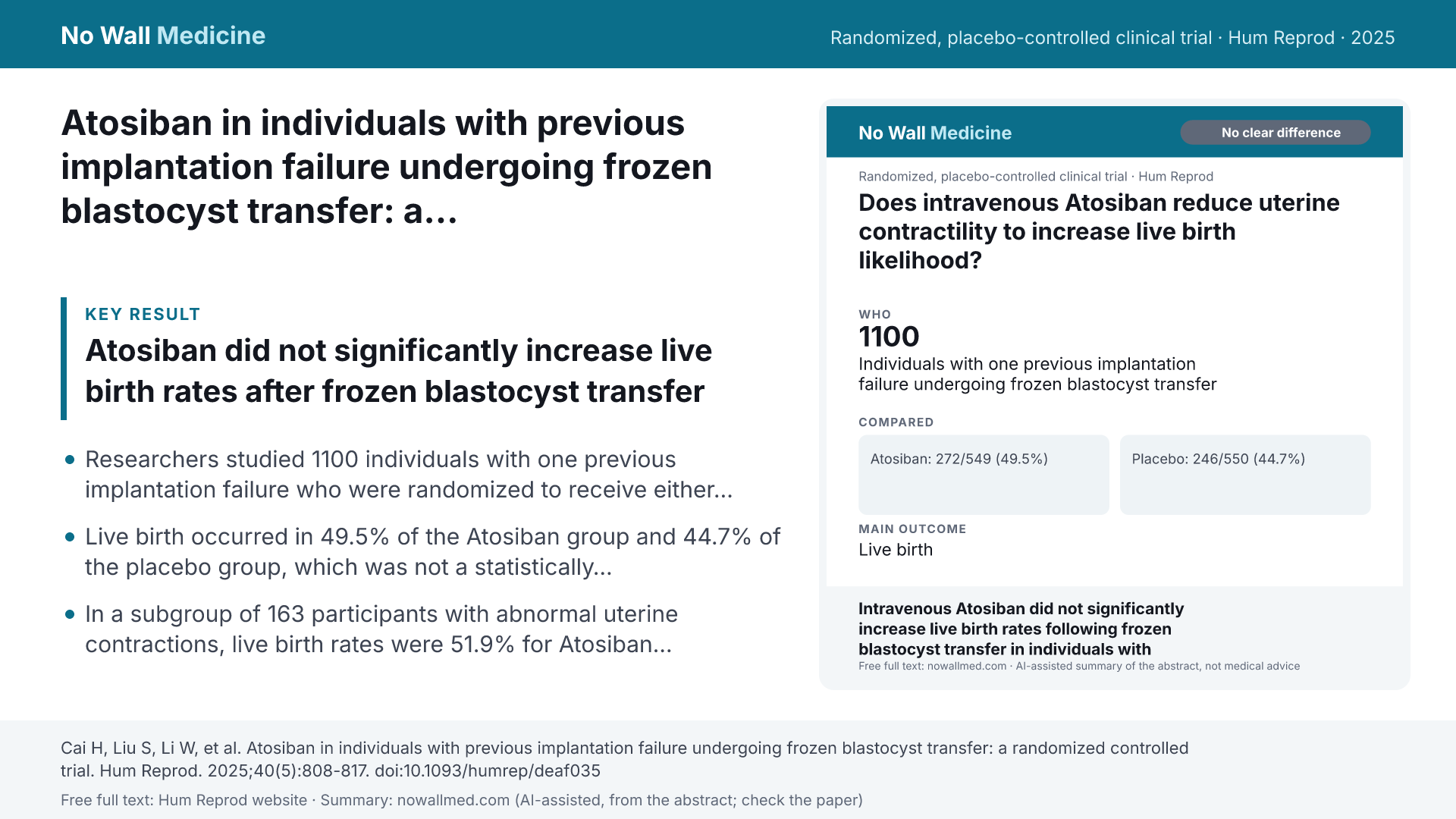
Atosiban did not significantly increase live birth rates after frozen blastocyst transfer
Atosiban in individuals with previous implantation failure undergoing frozen blastocyst transfer: a randomized controlled trial
Randomized, placebo-controlled clinical trialNo clear difference
Does intravenous Atosiban reduce uterine contractility to increase live birth likelihood?
Who
1100
Individuals with one previous implantation failure undergoing frozen blastocyst transfer · Single-center
Compared
Atosiban: 272/549 (49.5%)
Placebo: 246/550 (44.7%)
Main outcome
Live birth
Result: risk ratio 1.11 (95% CI 0.98 to 1.26)
Bottom line: Intravenous Atosiban did not significantly increase live birth rates following frozen blastocyst transfer in individuals with previous implantation failure.
Limitation: Single-center design, subjective video assessments, and limited examination of uterine contractions in only 65% of participants.
Funded by: Science and Technology Department of Shaanxi Province, China
Hum Reprod · 2025-03-04Download image
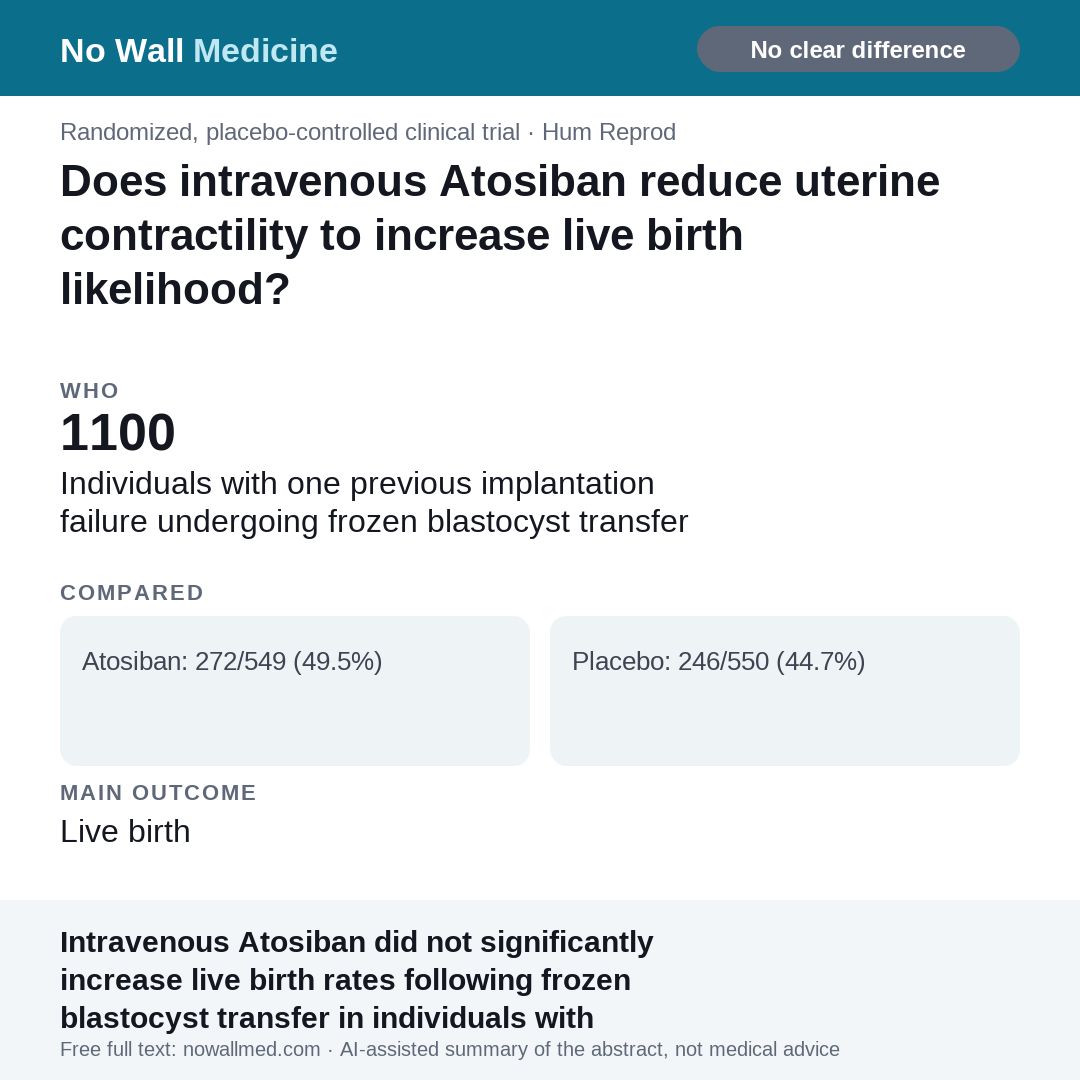
Clinical question: Does intravenous Atosiban reduce uterine contractility to increase live birth likelihood?
Why it matters: It was unknown if using Atosiban, an oxytocin receptor antagonist to reduce uterine contractions, could increase live birth rates in individuals with a history of implantation failure.
Key points
- Researchers studied 1100 individuals with one previous implantation failure who were randomized to receive either 37.5 mg of Atosiban or a placebo before embryo transfer.
- Live birth occurred in 49.5% of the Atosiban group and 44.7% of the placebo group, which was not a statistically significant difference.
- In a subgroup of 163 participants with abnormal uterine contractions, live birth rates were 51.9% for Atosiban and 39.3% for placebo, but this result was also not statistically significant.
Limitation the authors note: The study's findings may not be widely applicable due to its single-center design, subjective video assessments, and the fact that uterine contractions were only evaluated in 65% of participants.
Headline and key points written with AI from the paper’s abstract, with every number checked against it. Read the paper before relying on them.
Was this summary helpful?
Subject terms
Cite this article
Cai H, Liu S, Li W, et al. Atosiban in individuals with previous implantation failure undergoing frozen blastocyst transfer: a randomized controlled trial. Hum Reprod. 2025. doi:10.1093/humrep/deaf035
Spotted a mistake? Suggest a correction