Catheter ablation for atrial fibrillation is associated with fewer heart failure events in reduced ejection fraction patients
Atrial Fibrillation Ablation in Heart Failure With Reduced vs Preserved Ejection Fraction: A Systematic Review and Meta-Analysis
Systematic review and meta-analysis of 12 randomized clinical trialsMixed results
Does catheter ablation reduce heart failure outcomes based on ejection fraction phenotype?
Who
2465
Patients with heart failure and paroxysmal or persistent atrial fibrillation
Compared
Heart failure with reduced ejection fraction: risk ratio 0.59 (95% CI, 0.48-0.72)
Heart failure with preserved ejection fraction: risk ratio 0.93 (95% CI, 0.65-1.32)
Main outcome
heart failure events
Result: risk ratio 0.59 (95% CI, 0.48-0.72) in HFrEF vs 0.93 (95% CI, 0.65-1.32) in HFpEF
Bottom line: Catheter ablation reduces heart failure events in reduced ejection fraction patients but shows no benefit in preserved ejection fraction patients.
Limitation: Results from ongoing trials may further elucidate the role of catheter ablation in preserved ejection fraction.
JAMA Cardiol · 2024-04-24Download image
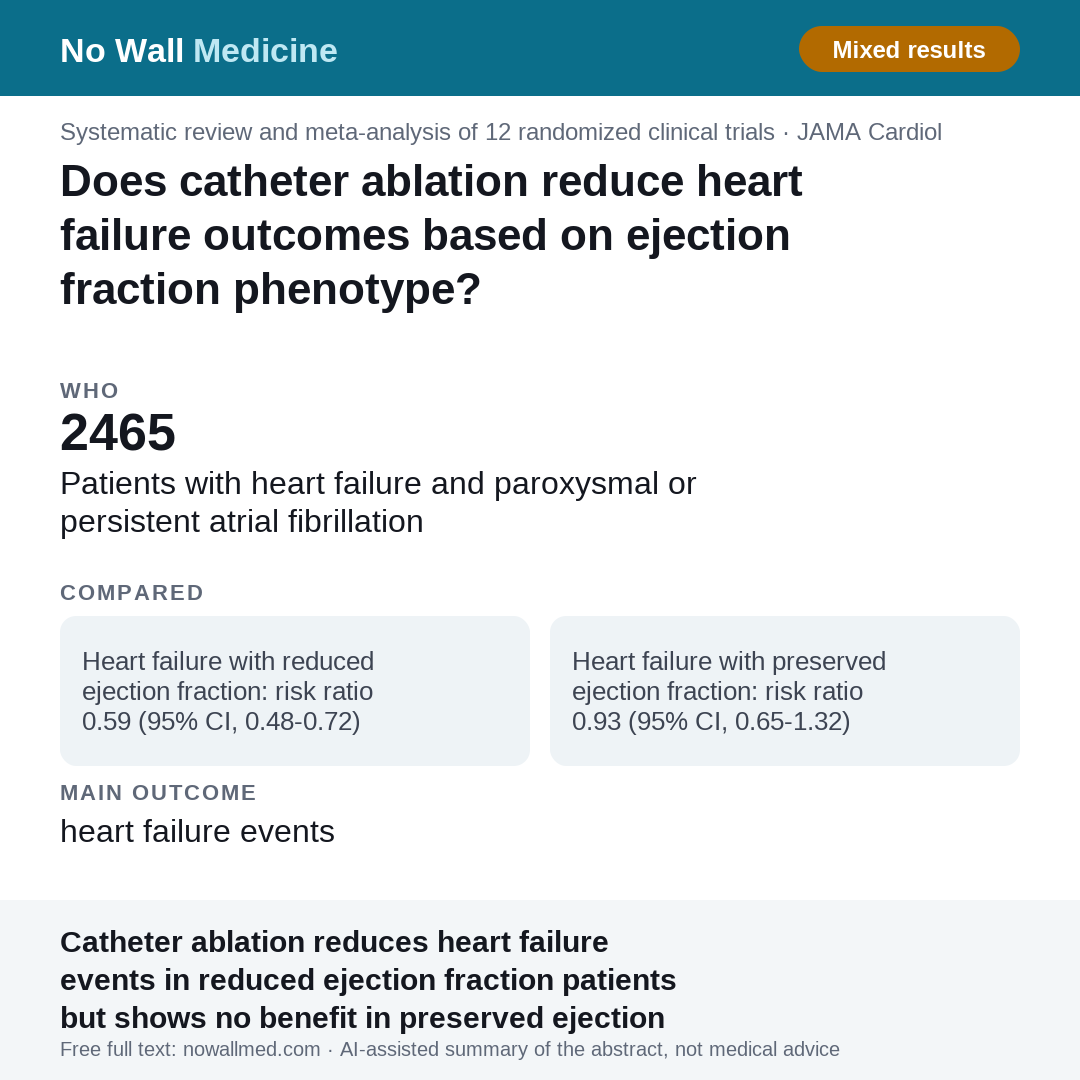
Clinical question: Does catheter ablation reduce heart failure outcomes based on ejection fraction phenotype?
Why it matters: It is uncertain if catheter ablation for atrial fibrillation provides benefits for heart failure patients with preserved ejection fraction compared to those with reduced ejection fraction.
Key points
- Researchers analyzed 12 randomized clinical trials involving 2465 participants with atrial fibrillation and heart failure.
- In patients with heart failure with reduced ejection fraction, catheter ablation was associated with a lower risk of heart failure events (risk ratio, 0.59) and cardiovascular death (risk ratio, 0.49).
- For patients with heart failure with preserved ejection fraction, catheter ablation was not associated with a reduced risk of heart failure events (risk ratio, 0.93) or cardiovascular death (risk ratio, 0.91).
Headline and key points written with AI from the paper’s abstract, with every number checked against it. Read the paper before relying on them.
Was this summary helpful?
Subject terms
Cite this article
Oraii A, McIntyre WF, Parkash R, Kowalik K, Razeghi G, Benz AP. Atrial Fibrillation Ablation in Heart Failure With Reduced vs Preserved Ejection Fraction: A Systematic Review and Meta-Analysis. JAMA Cardiol. 2024. doi:10.1001/jamacardio.2024.0675
Spotted a mistake? Suggest a correction
Top studies every Monday
The week’s key trials and guidelines in your specialties, plus any topics you follow. By email, free.
Get the weekly digest