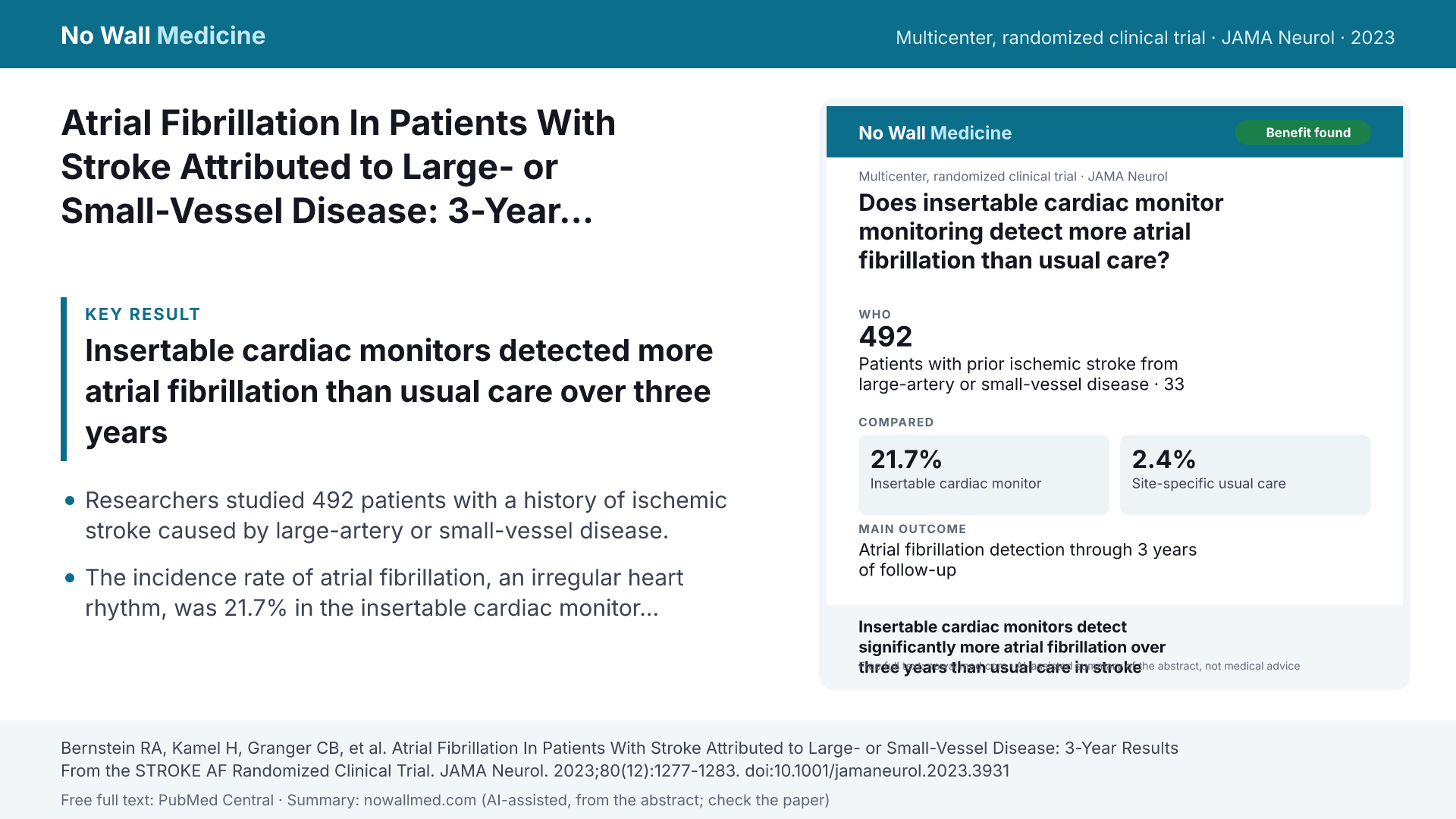
Insertable cardiac monitors detected more atrial fibrillation than usual care over three years
Atrial Fibrillation In Patients With Stroke Attributed to Large- or Small-Vessel Disease: 3-Year Results From the STROKE AF Randomized Clinical Trial
Multicenter, randomized clinical trialBenefit found
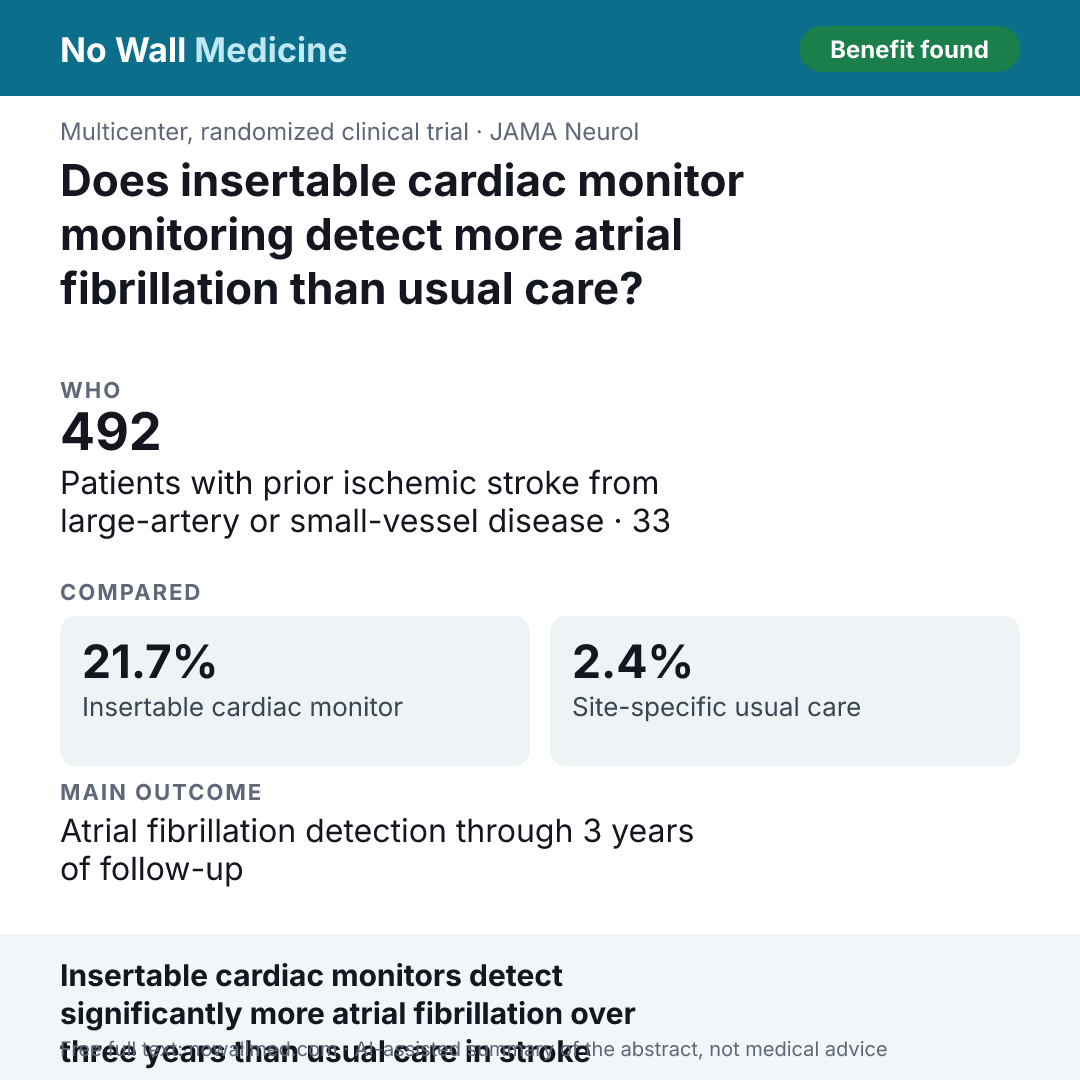
Does insertable cardiac monitor monitoring detect more atrial fibrillation than usual care?
Who
492
Patients with prior ischemic stroke from large-artery or small-vessel disease · 33 sites in the United States
Compared
21.7%Insertable cardiac monitor (46 patients)
2.4%Site-specific usual care (5 patients)
Main outcome
Atrial fibrillation detection through 3 years of follow-up
Result: hazard ratio 10.0 (95% CI 4.0-25.2)
Bottom line: Insertable cardiac monitors detect significantly more atrial fibrillation over three years than usual care in stroke patients.
JAMA Neurol · 2023-10-30 · Save PNG
Same trial (NCT02700945)
Papers we list that report this registered trial, oldest first. Read a secondary analysis alongside the main results.
- Main results Benefit found
Long-term continuous cardiac monitoring detected more atrial fibrillation than usual care after certain strokes JAMA 2021-06 - Secondary analysis Key finding
Congestive heart failure and left atrial enlargement were linked to poststroke atrial fibrillation detection JAMA Neurol 2022-11 - Longer follow-up Benefit found
This paper JAMA Neurol 2023-10
Clinical question: Does insertable cardiac monitor monitoring detect more atrial fibrillation than usual care?
Key points
- Researchers studied 492 patients with a history of ischemic stroke caused by large-artery or small-vessel disease.
- The incidence rate of atrial fibrillation, an irregular heart rhythm, was 21.7% in the insertable cardiac monitor group compared to 2.4% in the usual care group.
- Of the participants enrolled, 314 patients completed the 3-year follow-up period.
Headline and key points written with AI from the paper’s abstract, with every number checked against it. Read the paper before relying on them.
Was this summary helpful?
Subject terms
Headline, design, result, key points, caveat and citation as plain text.
Cite this article
Bernstein RA, Kamel H, Granger CB, et al. Atrial Fibrillation In Patients With Stroke Attributed to Large- or Small-Vessel Disease: 3-Year Results From the STROKE AF Randomized Clinical Trial. JAMA Neurol. 2023;80(12):1277-1283. doi:10.1001/jamaneurol.2023.3931
Spotted a mistake? Suggest a correction