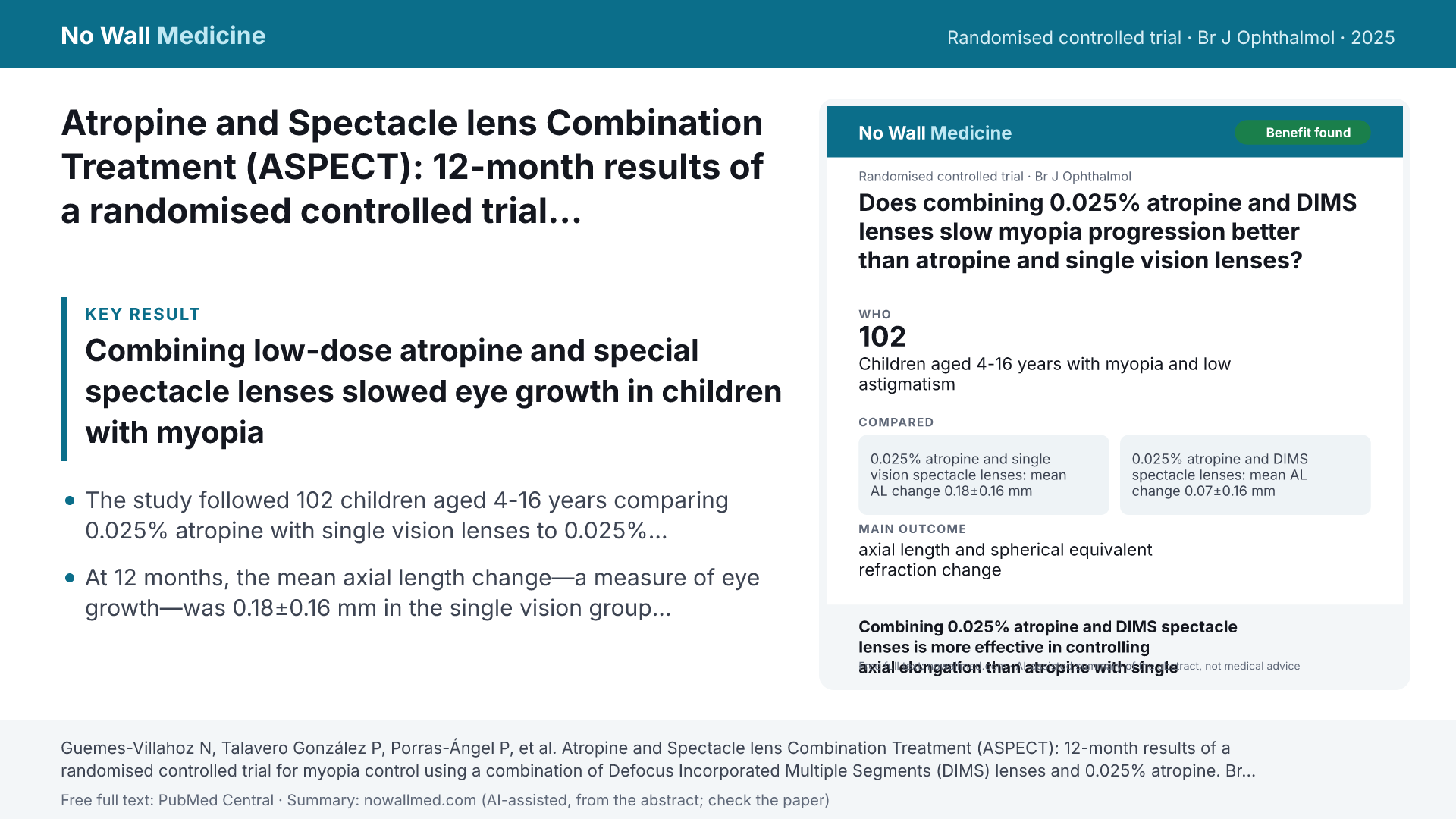
Combining low-dose atropine and special spectacle lenses slowed eye growth in children with myopia
Atropine and Spectacle lens Combination Treatment (ASPECT): 12-month results of a randomised controlled trial for myopia control using a combination of Defocus Incorporated Multiple Segments (DIMS) lenses and 0.025% atropine
Randomised controlled trialBenefit found
Does combining 0.025% atropine and DIMS lenses slow myopia progression better than atropine and single vision lenses?
Who
102
Children aged 4-16 years with myopia and low astigmatism
Compared
0.025% atropine and single vision spectacle lenses: mean AL change 0.18±0.16 mm
0.025% atropine and DIMS spectacle lenses: mean AL change 0.07±0.16 mm
Main outcome
axial length and spherical equivalent refraction change
Result: mean difference 0.11, 95% CI 0.05 to 0.17
Bottom line: Combining 0.025% atropine and DIMS spectacle lenses is more effective in controlling axial elongation than atropine with single vision lenses.
Br J Ophthalmol · 2025-08-20 · Save PNG
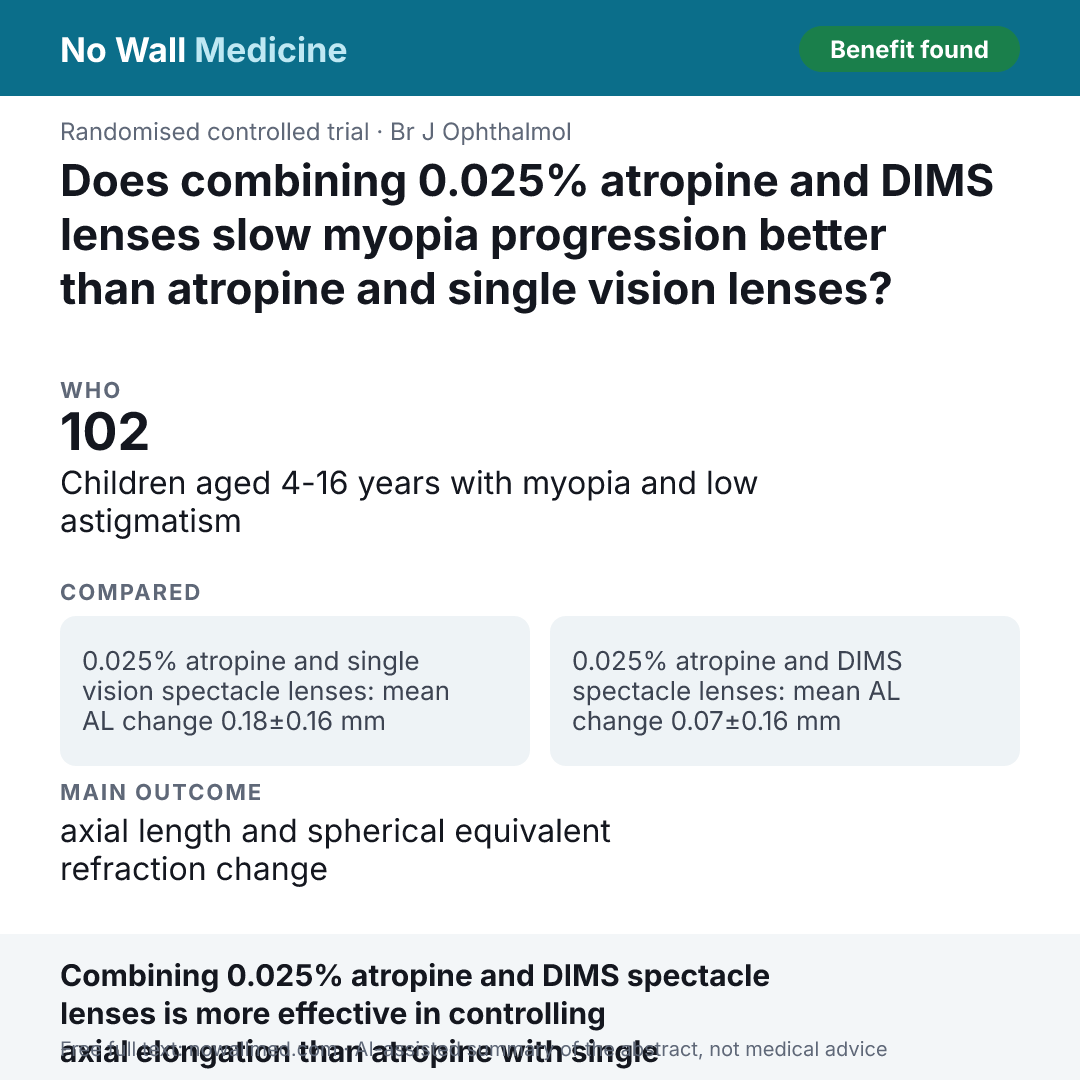
Clinical question: Does combining 0.025% atropine and DIMS lenses slow myopia progression better than atropine and single vision lenses?
Key points
- The study followed 102 children aged 4-16 years comparing 0.025% atropine with single vision lenses to 0.025% atropine with Defocus Incorporated Multiple Segments lenses.
- At 12 months, the mean axial length change—a measure of eye growth—was 0.18±0.16 mm in the single vision group and 0.07±0.16 mm in the special lens group.
- While eye growth was slower in the special lens group, the difference in spherical equivalent refraction, a measure of nearsightedness progression, was not statistically significant.
Headline and key points written with AI from the paper’s abstract, with every number checked against it. Read the paper before relying on them.
Was this summary helpful?
Abstract
Aim
To evaluate and compare the efficacy of combination treatment using 0.025% atropine and Defocus Incorporated Multiple Segments (DIMS) spectacle lenses to 0.025% atropine and single vision (SV) spectacle lenses in slowing myopia progression in children with myopia. Methods
Randomised controlled trial conducted on children aged 4-16 years with myopia between -1.00D and -6.00D and astigmatism ≤2.00D. Children were randomly allocated into two groups: 0.025% atropine and SV spectacle lenses treatment group (group A), and 0.025% atropine and DIMS spectacle lenses treatment group (group B). Cycloplegic spherical equivalent refraction (SER) and axial length were measured at baseline, 6 and 12 months. Results
102 patients completed the 12-month follow-up: n=49 in group A, mean age 9.50±2.78 years and n=53 in group B, mean age 9.90±2.47 years. At 12 months, the mean AL±SD change was 0.18±0.16 mm in group A and 0.07±0.16 mm in group B (mean difference: 0.11, 95% CI: 0.05 to 0.17; p≤0.001). Mean SER±SD progression at 12 months was -0.19±0.42D and -0.09±0.35D in groups A and B, respectively (p=0.13). 39.6% of children in group B had no axial elongation over 12 months compared with 12.2% of the children in group A (p=0.002). Conclusions
Combination treatment with 0.025% atropine and DIMS spectacle lenses is more effective in controlling axial elongation than 0.025% atropine with SV lenses. Although not significant, SER differences between groups were lower in group B. These findings support a potential additive effect of the two treatments.
Abstract reproduced under the article’s CC BY NC licence.
Subject terms
Headline, design, result, key points, caveat and citation as plain text.
Cite this article
Guemes-Villahoz N, Talavero González P, Porras-Ángel P, et al. Atropine and Spectacle lens Combination Treatment (ASPECT): 12-month results of a randomised controlled trial for myopia control using a combination of Defocus Incorporated Multiple Segments (DIMS) lenses and 0.025% atropine. Br J Ophthalmol. 2025;109(9):1074-1080. doi:10.1136/bjo-2024-326852
Spotted a mistake? Suggest a correction