Augmented feedback for manual wheelchair propulsion technique training in a virtual reality simulator
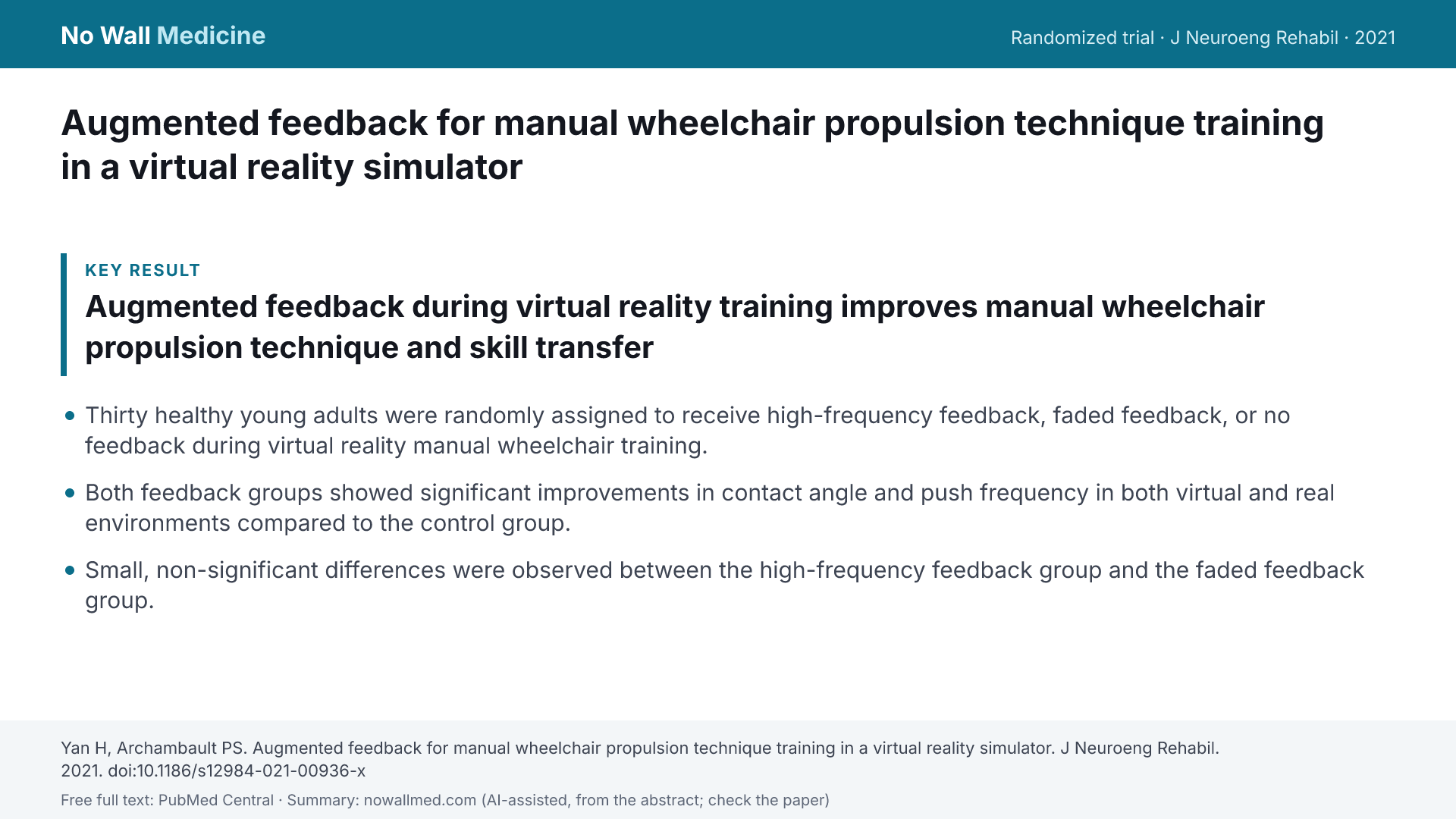
Key result: Augmented feedback during virtual reality training improves manual wheelchair propulsion technique and skill transfer
Key points
- Thirty healthy young adults were randomly assigned to receive high-frequency feedback, faded feedback, or no feedback during virtual reality manual wheelchair training.
- Both feedback groups showed significant improvements in contact angle and push frequency in both virtual and real environments compared to the control group.
- Small, non-significant differences were observed between the high-frequency feedback group and the faded feedback group.
Why it matters: It is unknown how different schedules of augmented feedback, which provides information about movement performance, affect motor learning and the transfer of wheelchair skills to real-world environments.
Discussion prompts
- Would these patients look like yours? Who was left out?
- Is the main outcome one that matters to patients?
- Is the difference large enough to change what you do?
Cite: Yan H, Archambault PS. Augmented feedback for manual wheelchair propulsion technique training in a virtual reality simulator. J Neuroeng Rehabil. 2021. doi:10.1186/s12984-021-00936-x
Free full text: PubMed Central · Summary and visual abstract: nowallmed.com/a/augmented-feedback-for-manual-wheelchair-propulsion-technique-1g2908c/ (AI-assisted from the abstract; check the paper before relying on it).