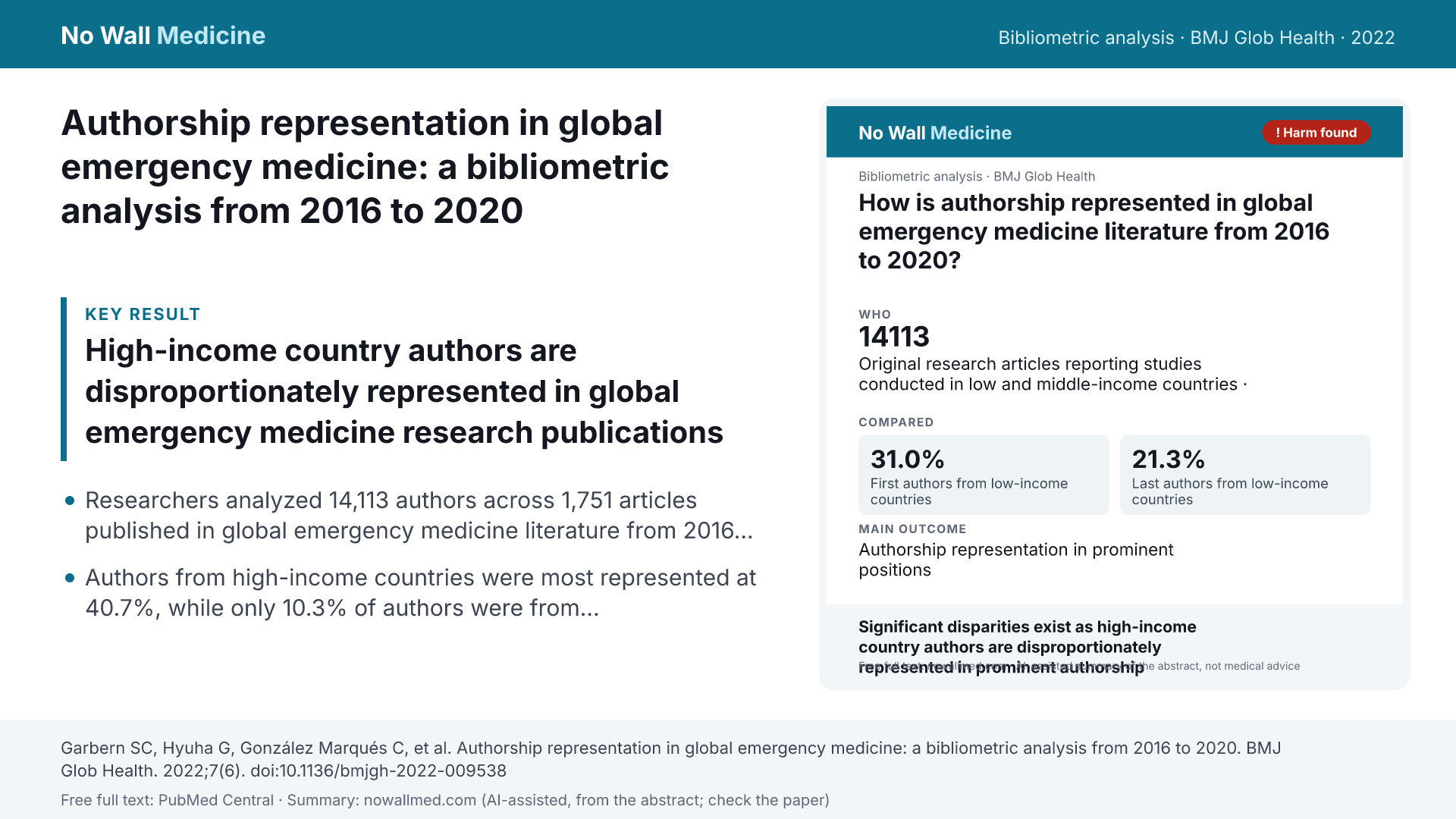
High-income country authors are disproportionately represented in global emergency medicine research publications
Authorship representation in global emergency medicine: a bibliometric analysis from 2016 to 2020
Bibliometric analysisHarm found
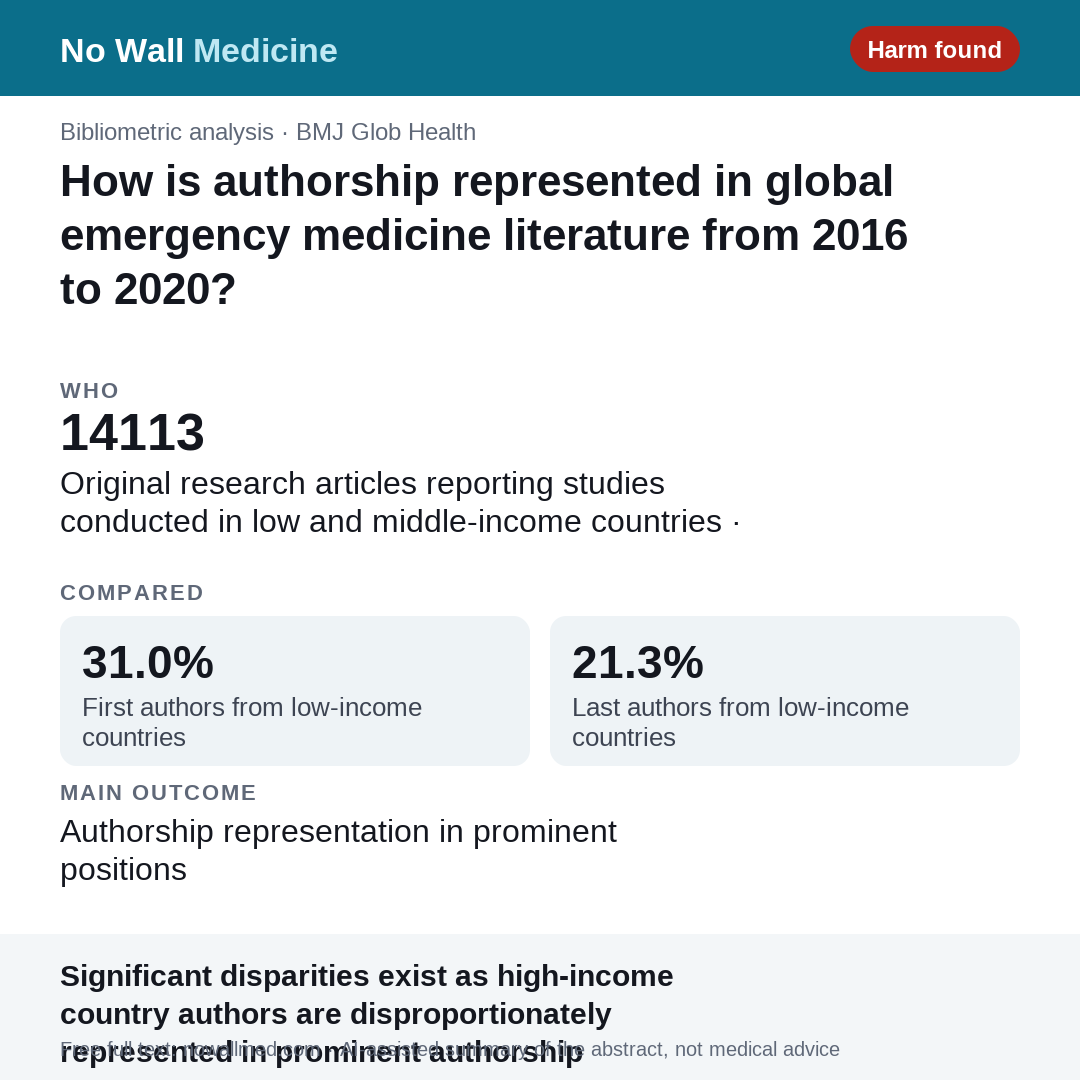
How is authorship represented in global emergency medicine literature from 2016 to 2020?
Who
14113
Original research articles reporting studies conducted in low and middle-income countries · Global emergency medicine literature
Compared
31.0%First authors from low-income countries
21.3%Last authors from low-income countries
Main outcome
Authorship representation in prominent positions
Bottom line: Significant disparities exist as high-income country authors are disproportionately represented in prominent authorship positions.
BMJ Glob Health · 2022-06-27Download image
Clinical question: How is authorship represented in global emergency medicine literature from 2016 to 2020?
Why it matters: The level of authorship representation for researchers in low and middle-income countries within the field of global emergency medicine was unknown.
Key points
- Researchers analyzed 14,113 authors across 1,751 articles published in global emergency medicine literature from 2016 to 2020.
- Authors from high-income countries were most represented at 40.7%, while only 10.3% of authors were from low-income countries.
- Only 31.0% of first authors and 21.3% of last authors were affiliated with the low-income countries where the studies were conducted.
Headline and key points written with AI from the paper’s abstract, with every number checked against it. Read the paper before relying on them.
Was this summary helpful?
Abstract
Introduction
High-income country (HIC) authors are disproportionately represented in authorship bylines compared with those affiliated with low and middle-income countries (LMICs) in global health research. An assessment of authorship representation in the global emergency medicine (GEM) literature is lacking but may inform equitable academic collaborations in this relatively new field. Methods
We conducted a bibliometric analysis of original research articles reporting studies conducted in LMICs from the annual GEM Literature Review from 2016 to 2020. Data extracted included study topic, journal, study country(s) and region, country income classification, author order, country(s) of authors' affiliations and funding sources. We compared the proportion of authors affiliated with each income bracket using Χ2 analysis. We conducted logistic regression to identify factors associated with first or last authorship affiliated with the study country. Results
There were 14 113 authors in 1751 articles. Nearly half (45.5%) of the articles reported work conducted in lower middle-income countries (MICs), 23.6% in upper MICs, 22.5% in low-income countries (LICs). Authors affiliated with HICs were most represented (40.7%); 26.4% were affiliated with lower MICs, 17.4% with upper MICs, 10.3% with LICs and 5.1% with mixed affiliations. Among single-country studies, those without any local authors (8.7%) were most common among those conducted in LICs (14.4%). Only 31.0% of first authors and 21.3% of last authors were affiliated with LIC study countries. Studies in upper MICs (adjusted OR (aOR) 3.6, 95% CI 2.46 to 5.26) and those funded by the study country (aOR 2.94, 95% CI 2.05 to 4.20) had greater odds of having a local first author. Conclusions
There were significant disparities in authorship representation. Authors affiliated with HICs more commonly occupied the most prominent authorship positions. Recognising and addressing power imbalances in international, collaborative emergency medicine (EM) research is warranted. Innovative methods are needed to increase funding opportunities and other support for EM researchers in LMICs, particularly in LICs.
Abstract reproduced under the article’s CC BY NC licence.
Subject terms
Cite this article
Garbern SC, Hyuha G, González Marqués C, Baig N, Chan JL, Dutta S. Authorship representation in global emergency medicine: a bibliometric analysis from 2016 to 2020. BMJ Glob Health. 2022. doi:10.1136/bmjgh-2022-009538
Spotted a mistake? Suggest a correction
Top studies every Monday
The week’s key trials and guidelines in your specialties, plus any topics you follow. By email, free.
Get the weekly digest