Autoantibodies were associated with obsessive-compulsive disorder in case reports and cross-sectional studies
Autoantibodies in patients with obsessive-compulsive disorder: a systematic review
Systematic literature reviewMixed results
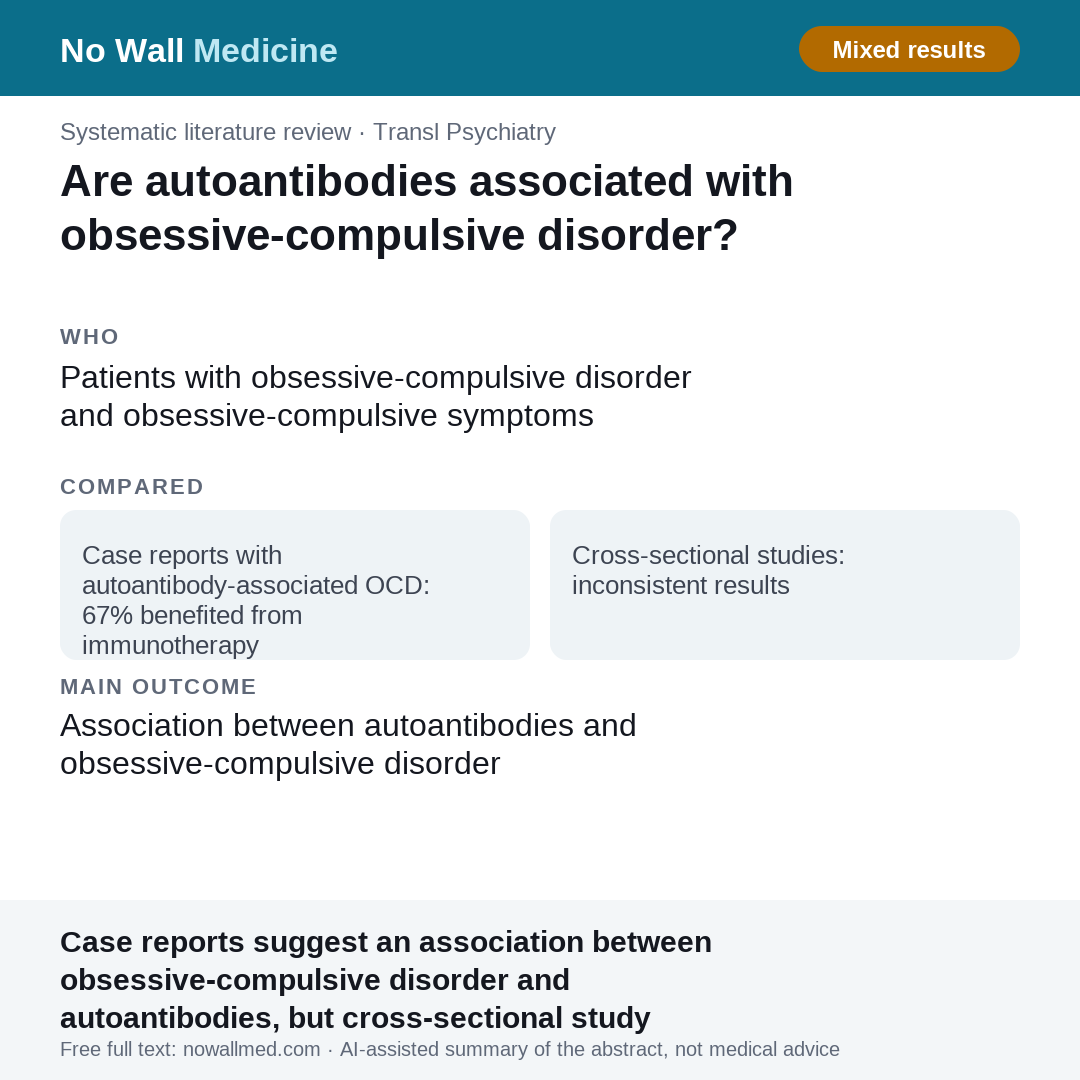
Are autoantibodies associated with obsessive-compulsive disorder?
Who
Patients with obsessive-compulsive disorder and obsessive-compulsive symptoms
Compared
Case reports with autoantibody-associated OCD: 67% benefited from immunotherapy
Cross-sectional studies: inconsistent results
Main outcome
Association between autoantibodies and obsessive-compulsive disorder
Bottom line: Case reports suggest an association between obsessive-compulsive disorder and autoantibodies, but cross-sectional study results are inconsistent.
Limitation: Scientific data is still very limited.
Transl Psychiatry · 2023-07-03Download image
Clinical question: Are autoantibodies associated with obsessive-compulsive disorder?
Why it matters: It is unknown if autoimmune processes are linked to obsessive-compulsive disorder or why many patients do not respond to standard treatments.
Key points
- Researchers reviewed case reports and cross-sectional studies investigating the link between autoantibodies, which are proteins the immune system mistakenly makes against itself, and obsessive-compulsive disorder.
- In nine case reports, six patients (67%) benefited from immunotherapy, and six of eleven cross-sectional studies suggested an association between autoantibodies and obsessive-compulsive symptoms.
- The review identified five patients with anti-neuronal autoantibodies and four patients with autoantibodies associated with systemic autoimmune diseases.
Limitation the authors note: The available scientific data regarding autoantibodies in patients with obsessive-compulsive disorder is still very limited.
Headline and key points written with AI from the paper’s abstract, with every number checked against it. Read the paper before relying on them.
Was this summary helpful?
Subject terms
Cite this article
Denzel D, Runge K, Feige B, Pankratz B, Pitsch K, Schlump A. Autoantibodies in patients with obsessive-compulsive disorder: a systematic review. Transl Psychiatry. 2023. doi:10.1038/s41398-023-02545-9
Spotted a mistake? Suggest a correction
Top studies every Monday
The week’s key trials and guidelines in your specialties, plus any topics you follow. By email, free.
Get the weekly digest