Autologous nerve coverage in revision surgery for recurrent or persistent carpal tunnel syndrome: A systematic review and meta-analysis
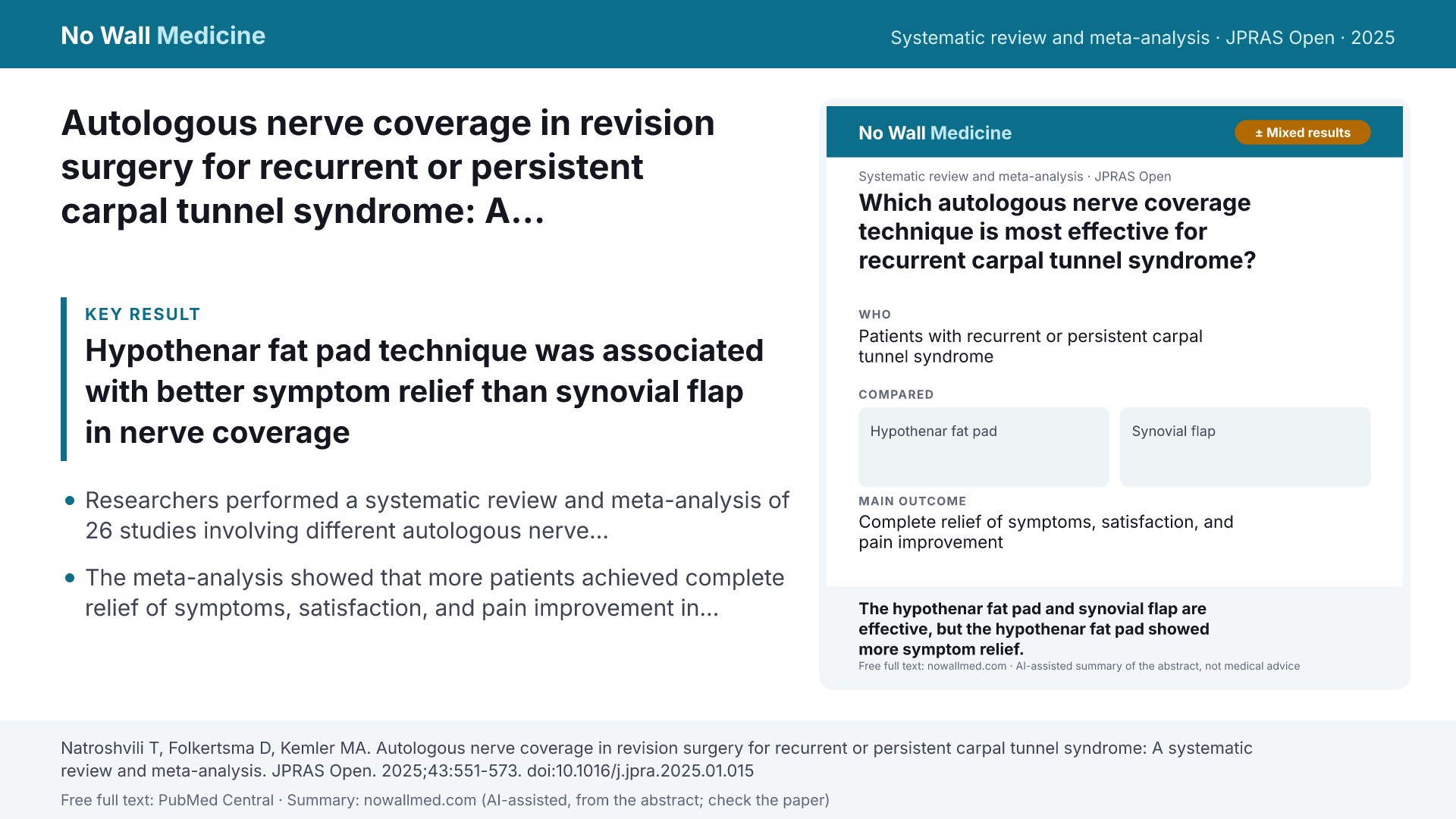
Key result: Hypothenar fat pad technique was associated with better symptom relief than synovial flap in nerve coverage
Systematic review and meta-analysisMixed results
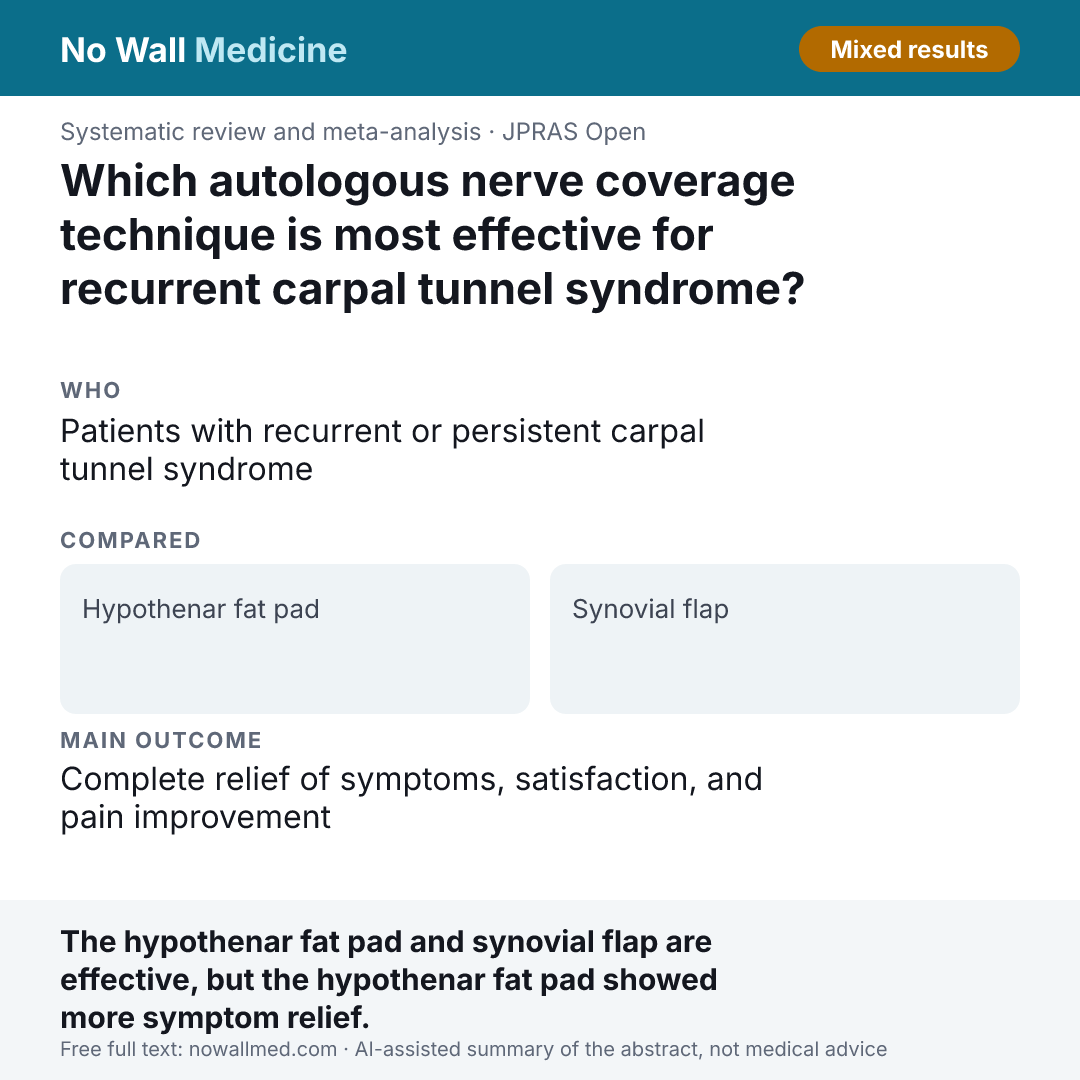
Which autologous nerve coverage technique is most effective for recurrent carpal tunnel syndrome?
Who
Patients with recurrent or persistent carpal tunnel syndrome
Compared
Hypothenar fat pad
Synovial flap
Main outcome
Complete relief of symptoms, satisfaction, and pain improvement
Bottom line: The hypothenar fat pad and synovial flap are effective, but the hypothenar fat pad showed more symptom relief.
JPRAS Open · 2025-01-25 · Save PNG
Key points
- Researchers performed a systematic review and meta-analysis of 26 studies involving different autologous nerve coverage techniques for recurrent or persistent carpal tunnel syndrome.
- The meta-analysis showed that more patients achieved complete relief of symptoms, satisfaction, and pain improvement in the hypothenar fat pad group compared to the synovial flap group.
- Initial carpal tunnel surgery fails in about 5% to 10% of cases, with revision rates ranging from 0.3% to 7%.
Discussion prompts
- Would these patients look like yours? Who was left out?
- Is the main outcome one that matters to patients?
- Is the difference large enough to change what you do?
Cite: Natroshvili T, Folkertsma D, Kemler MA. Autologous nerve coverage in revision surgery for recurrent or persistent carpal tunnel syndrome: A systematic review and meta-analysis. JPRAS Open. 2025;43:551-573. doi:10.1016/j.jpra.2025.01.015
Free full text: PubMed Central · Summary and visual abstract: nowallmed.com/a/autologous-nerve-coverage-in-revision-surgery-for-recurrent-or-1t6sxxw/ (AI-assisted from the abstract; check the paper before relying on it).