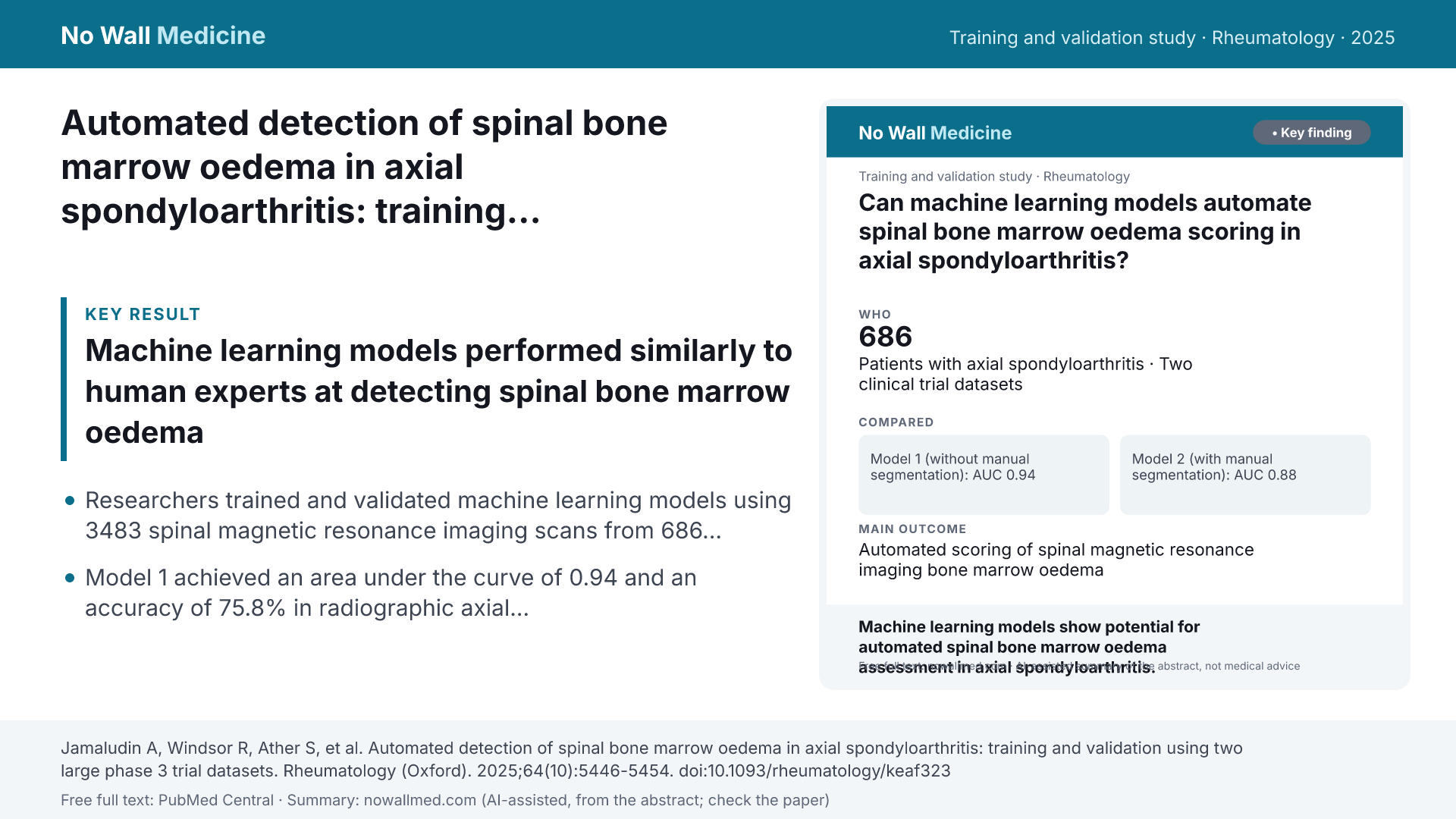
Machine learning models performed similarly to human experts at detecting spinal bone marrow oedema
Automated detection of spinal bone marrow oedema in axial spondyloarthritis: training and validation using two large phase 3 trial datasets
Training and validation studyKey finding
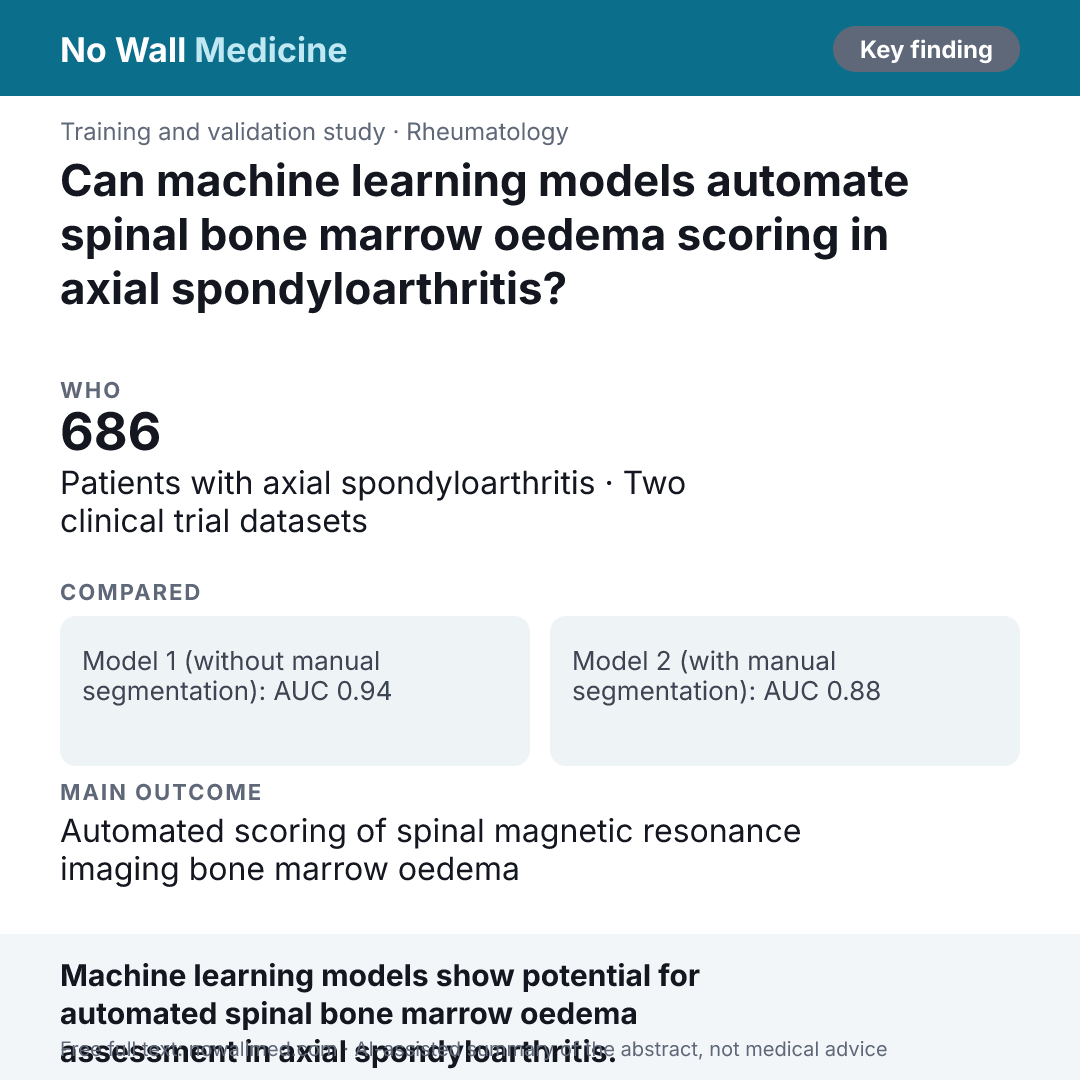
Can machine learning models automate spinal bone marrow oedema scoring in axial spondyloarthritis?
Who
686
Patients with axial spondyloarthritis · Two clinical trial datasets
Compared
Model 1 (without manual segmentation): AUC 0.94
Model 2 (with manual segmentation): AUC 0.88
Main outcome
Automated scoring of spinal magnetic resonance imaging bone marrow oedema
Bottom line: Machine learning models show potential for automated spinal bone marrow oedema assessment in axial spondyloarthritis.
Rheumatology · 2025-06-09 · Save PNG
Same trial (NCT01358175, NCT02696031)
Papers we list that report this registered trial, oldest first. Read a secondary analysis alongside the main results.
- Design and baseline Benefit found
Secukinumab efficacy in non-radiographic axial spondyloarthritis varies by sex, genetics, and inflammation markers Arthritis Res Ther 2021-09 - Main results No clear difference
Secukinumab showed minimal radiographic changes in patients with non-radiographic axial spondyloarthritis over two years Arthritis Res Ther 2023-05 - Related analysis Key finding
This paper Rheumatology 2025-06 - Secondary analysis
Age did not significantly change how patients responded to secukinumab for axial spondyloarthritis Arthritis Res Ther 2026-04
Clinical question: Can machine learning models automate spinal bone marrow oedema scoring in axial spondyloarthritis?
Why it matters: Automated scoring of spinal magnetic resonance imaging bone marrow oedema is needed to improve consistency and reduce labor costs in axial spondyloarthritis assessment.
Key points
- Researchers trained and validated machine learning models using 3483 spinal magnetic resonance imaging scans from 686 patients with axial spondyloarthritis.
- Model 1 achieved an area under the curve of 0.94 and an accuracy of 75.8% in radiographic axial spondyloarthritis datasets.
- In non-radiographic axial spondyloarthritis datasets, Model 1 reached an area under the curve of 0.97 and an accuracy of 74.6%.
Headline and key points written with AI from the paper’s abstract, with every number checked against it. Read the paper before relying on them.
Was this summary helpful?
Subject terms
Headline, design, result, key points, caveat and citation as plain text.
Cite this article
Jamaludin A, Windsor R, Ather S, et al. Automated detection of spinal bone marrow oedema in axial spondyloarthritis: training and validation using two large phase 3 trial datasets. Rheumatology (Oxford). 2025;64(10):5446-5454. doi:10.1093/rheumatology/keaf323
Spotted a mistake? Suggest a correction