Automated insulin delivery increased time in target glucose range during the first 6 months postpartum
Automated insulin delivery during the first 6 months postpartum (AiDAPT): a prespecified extension study
Randomized controlled trial extensionBenefit found
Is hybrid closed loop therapy effective during the first 6 months postpartum?
Who
57
Pregnant women with type 1 diabetes · Nine United Kingdom sites
Compared
Hybrid closed loop therapy: 72% [SD 12%]
Standard insulin therapy with continuous glucose monitoring: 54% [17%]
Main outcome
Percentage time in range 3.9-10.0 mmol/L
Result: adjusted treatment difference of 15% (95% CI 7 to 22)
Bottom line: Hybrid closed loop therapy increased time in range compared to standard care during the first 6 months postpartum.
Lancet Diabetes Endocrinol · 2025-01-27Download image
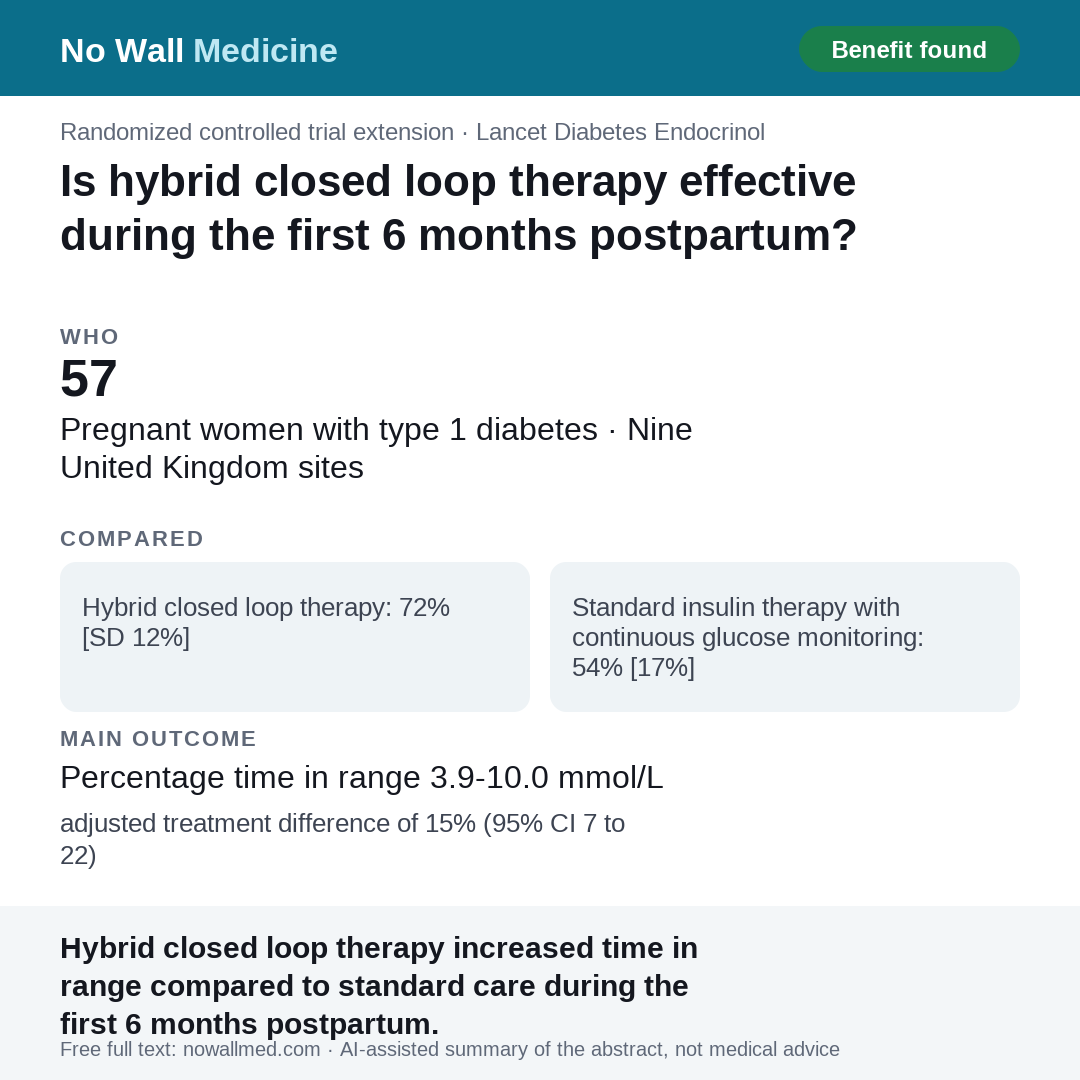
Clinical question: Is hybrid closed loop therapy effective during the first 6 months postpartum?
Why it matters: Clinical guidelines do not specifically address the use of hybrid closed loop systems during the postpartum period when newborn care demands are high.
Key points
- The study followed 57 women with type 1 diabetes who were randomized to receive either hybrid closed loop therapy or standard insulin therapy with continuous glucose monitoring.
- During the 6 months postpartum, the hybrid closed loop group had a mean time in range of 72% compared to 54% for the standard care group.
- The hybrid closed loop group also showed lower rates of high blood sugar and lower mean glucose levels, while hypoglycemia rates were similar between groups at 2.4% and 2.6%.
Headline and key points written with AI from the paper’s abstract, with every number checked against it. Read the paper before relying on them.
Was this summary helpful?
Abstract
Background
Clinical guidelines in the UK and elsewhere do not specifically address hybrid closed loop (HCL) use in the postpartum period when the demands of caring for a newborn are paramount. Our aim was to evaluate the safety and efficacy of HCL use during the first 6 months postpartum compared with standard care. Methods
In this prespecified extension to a multicentre, randomised controlled trial, pregnant women with type 1 diabetes at nine UK sites were followed up for 6 months postpartum. Eligible participants (AiDAPT participants recruited after the implementation of the postpartum protocol amendment approval, those still pregnant or within six months of delivery at the time of amendment implementation and still using HCL or continuous glucose monitoring [CGM] therapy) continued their randomly assigned treatment, either standard insulin therapy with CGM or HCL therapy (CamAPS FX system version 0.3.1, CamDiab, Cambridge, UK). Participants were randomised in a 1:1 ratio with stratification by clinical site using randomly permuted block sizes of 2 or 4. The primary outcome was the between-group difference in percentage time in range ([TIR] 3·9-10·0 mmol/L [70-180mg/dL]), measured during the periods of month 0 up to 3, months 3 to 6, and over 6 months postpartum. The study is registered at ClinicalTrials.gov (ISRCTN56898625) and is complete. Findings
Of the 124 AiDAPT trial participants, 66 (53%) were ineligible for inclusion in the postpartum extension, and 57 participants consented to continue their treatment per original random allocation. The mean age was 31 years (SD 4), and all participants had early pregnancy HbA1c 59·4 mmol/mol (SD 10·5 [7·6% SD 1·0%]). In the 6 months postpartum, mean time with glucose levels within the target range was higher in the HCL group compared with the standard care group (72% [SD 12%] vs 54% [17%]), with an adjusted treatment difference of 15% (95% CI 7 to 22). Results for hyperglycaemia (>10·0 mmol/L) and mean CGM glucose also favoured HCL (-14% [95% CI -23% to -6%] and -1·3 mmol/L [-2·3 to -0·3], respectively). Hypoglycaemia rates were low, with no between-group differences (2·4% vs 2·6%). There were no treatment effect changes depending on postpartum period (0 up to 3 months vs 3 to 6 months) and no unanticipated safety problems. Interpretation
Participants in the HCL group maintained 70% TIR during the first 6 months postpartum, supporting continued use of HCL rather than standard insulin therapy for people with diabetes once they have given birth. Funding
National Institute for Health Research, Juvenile Diabetes Research Foundation, and Diabetes Research & Wellness Foundation. CGM devices were provided by Dexcom at a discounted price.
Abstract reproduced under the article’s CC BY licence.
Subject terms
Cite this article
Lee TTM, Collett C, Bergford S, Hartnell S, Scott EM, Lindsay RS. Automated insulin delivery during the first 6 months postpartum (AiDAPT): a prespecified extension study. Lancet Diabetes Endocrinol. 2025. doi:10.1016/S2213-8587(24)00340-1
Spotted a mistake? Suggest a correction
Top studies every Monday
The week’s key trials and guidelines in your specialties, plus any topics you follow. By email, free.
Get the weekly digest