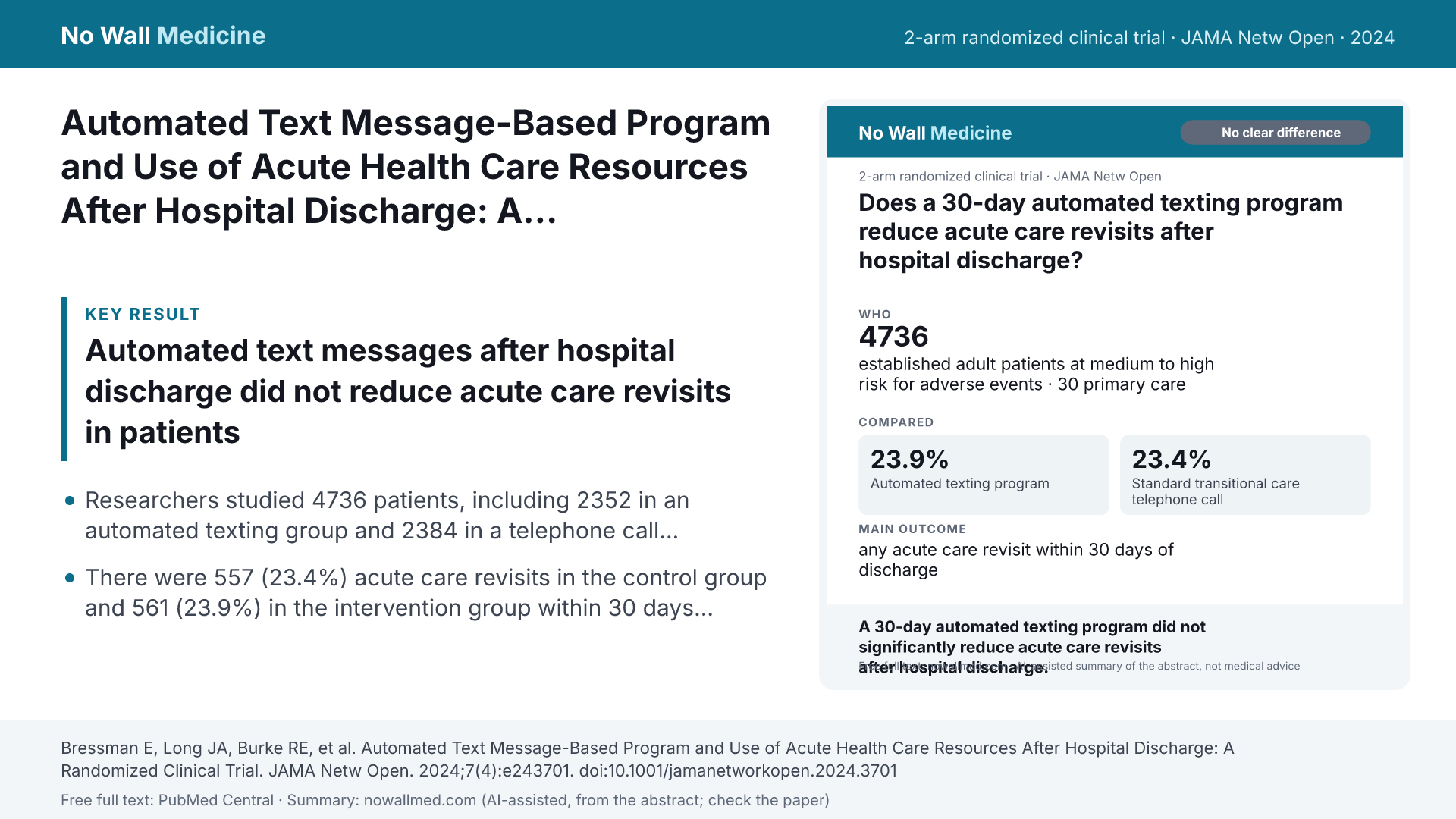
Automated Text Message-Based Program and Use of Acute Health Care Resources After Hospital Discharge: A Randomized Clinical Trial
Key result: Automated text messages after hospital discharge did not reduce acute care revisits in patients
Key points
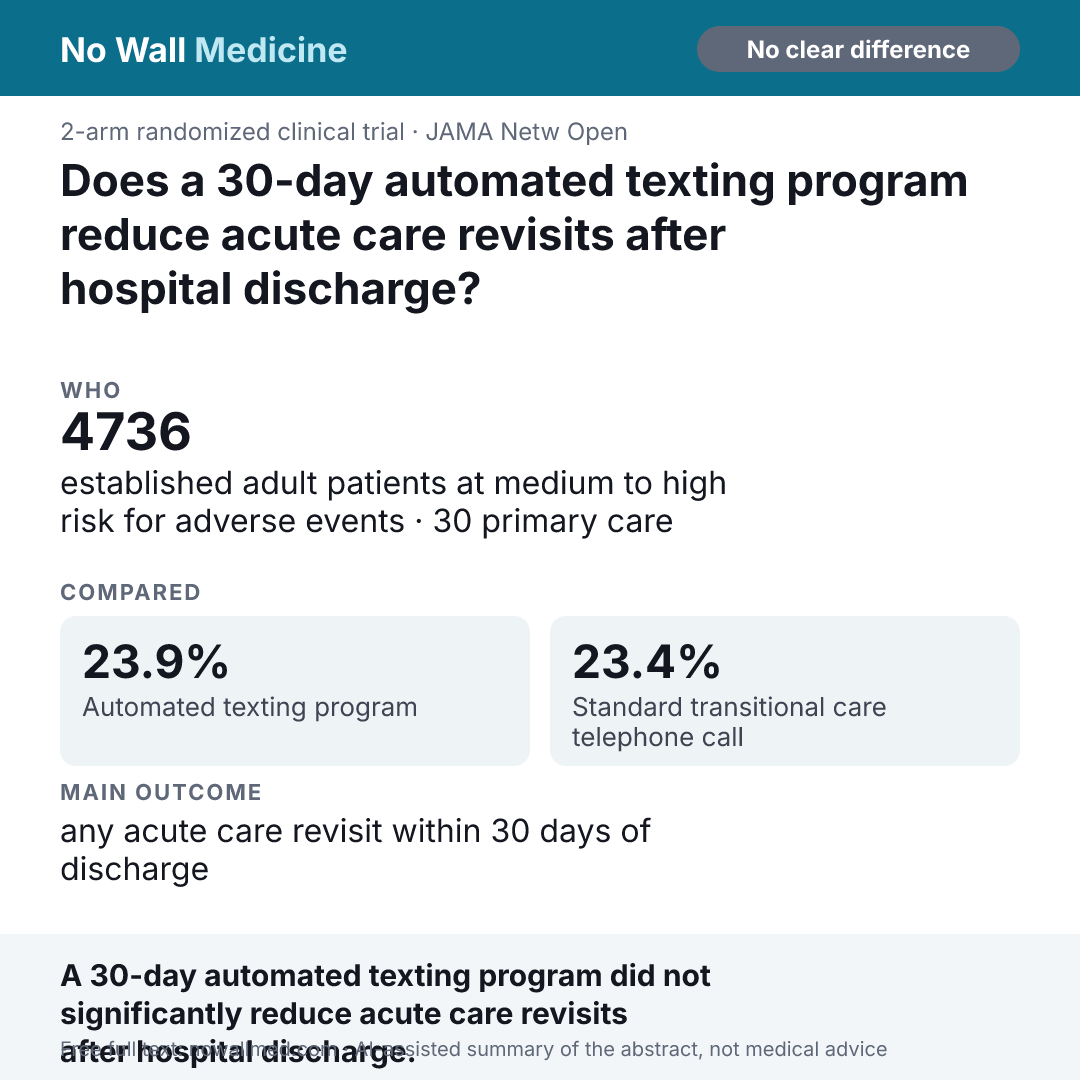
- Researchers studied 4736 patients, including 2352 in an automated texting group and 2384 in a telephone call control group, following them for 60 days after hospital discharge.
- There were 557 (23.4%) acute care revisits in the control group and 561 (23.9%) in the intervention group within 30 days of discharge.
- In the texting group, 79.5% of patients answered at least 1 message and 41.9% had at least 1 need identified for staff follow-up.
Why it matters: Telephone calls for transitional care support are labor intensive and limited in scope, leaving it unknown if automated texting can reduce hospital readmissions or emergency department visits.
Discussion prompts
- Would these patients look like yours? Who was left out?
- Is the main outcome one that matters to patients?
- Is the difference large enough to change what you do?
Cite: Bressman E, Long JA, Burke RE, et al. Automated Text Message-Based Program and Use of Acute Health Care Resources After Hospital Discharge: A Randomized Clinical Trial. JAMA Netw Open. 2024;7(4):e243701. doi:10.1001/jamanetworkopen.2024.3701
Free full text: PubMed Central · Summary and visual abstract: nowallmed.com/a/automated-text-message-based-program-and-use-of-acute-health-care-1czgowt/ (AI-assisted from the abstract; check the paper before relying on it).