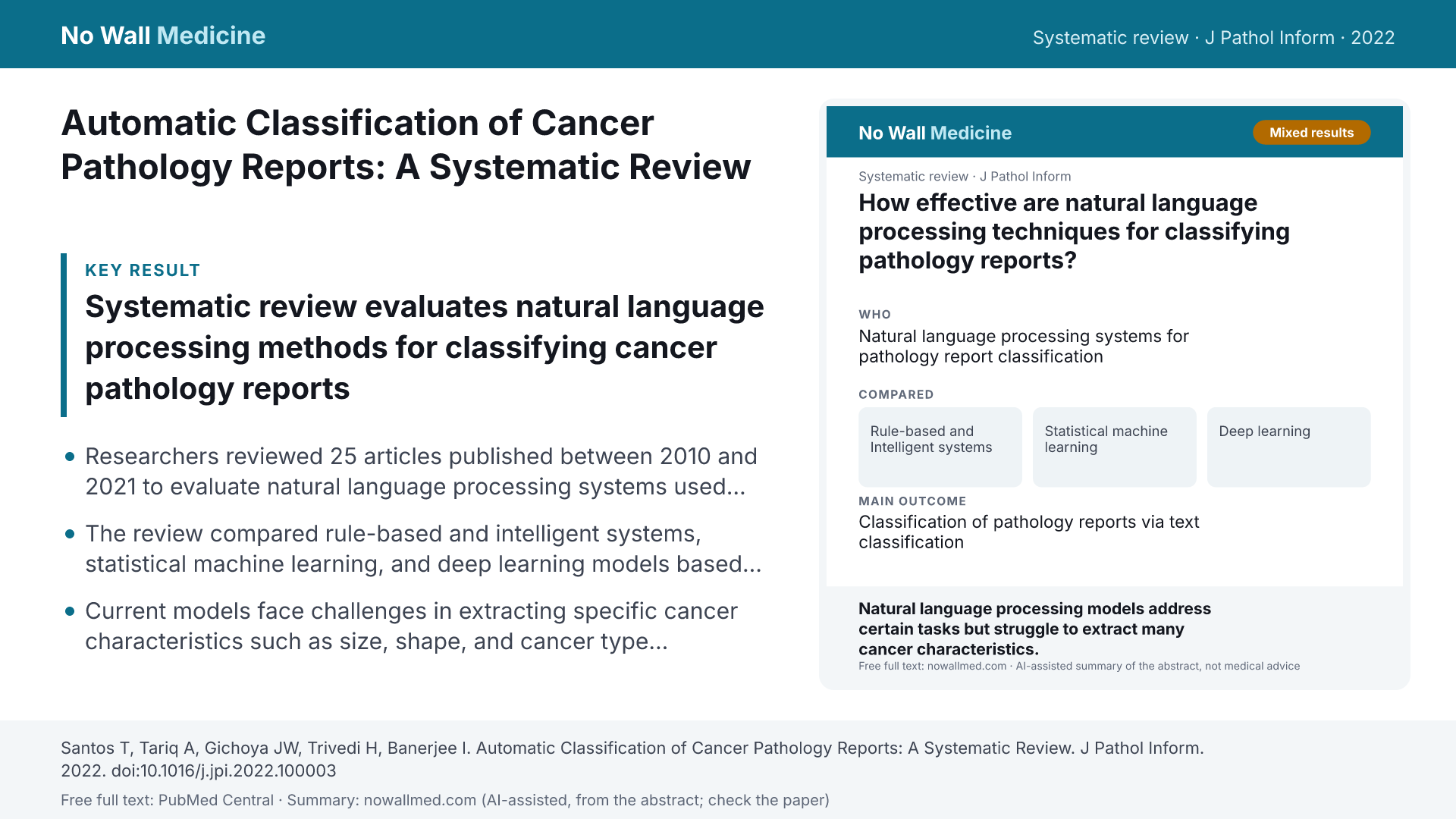
Automatic Classification of Cancer Pathology Reports: A Systematic Review
Key result: Systematic review evaluates natural language processing methods for classifying cancer pathology reports
Systematic reviewMixed results
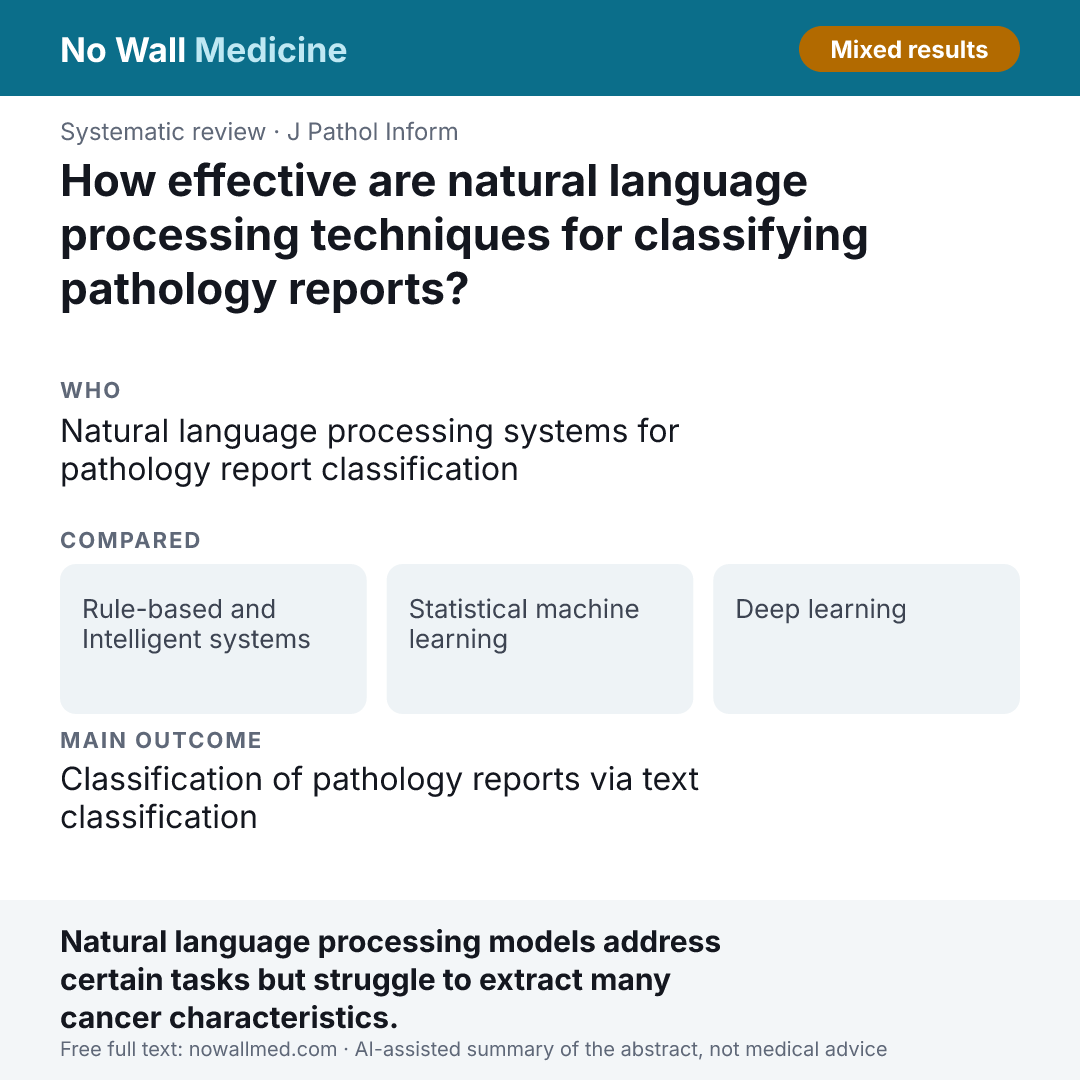
How effective are natural language processing techniques for classifying pathology reports?
Who
Natural language processing systems for pathology report classification
Compared
Rule-based and Intelligent systems
Statistical machine learning
Deep learning
Main outcome
Classification of pathology reports via text classification
Bottom line: Natural language processing models address certain tasks but struggle to extract many cancer characteristics.
Limitation: Extraction of many cancer characteristics remains an open challenge.
J Pathol Inform · 2022-01-20 · Save PNG
Key points
- Researchers reviewed 25 articles published between 2010 and 2021 to evaluate natural language processing systems used for classifying pathology reports.
- The review compared rule-based and intelligent systems, statistical machine learning, and deep learning models based on methodology and task complexity.
- Current models face challenges in extracting specific cancer characteristics such as size, shape, and cancer type from unstructured text.
Why it matters: Clinical information in pathology reports is difficult to access and query because the reports primarily consist of unstructured free text.
Discussion prompts
- Would these patients look like yours? Who was left out?
- Is the main outcome one that matters to patients?
- Is the difference large enough to change what you do?
Cite: Santos T, Tariq A, Gichoya JW, Trivedi H, Banerjee I. Automatic Classification of Cancer Pathology Reports: A Systematic Review. J Pathol Inform. 2022. doi:10.1016/j.jpi.2022.100003
Free full text: PubMed Central · Summary and visual abstract: nowallmed.com/a/automatic-classification-of-cancer-pathology-reports-a-systematic-sb1g7o/ (AI-assisted from the abstract; check the paper before relying on it).