Autonomous artificial intelligence increased specialist clinic productivity during a cluster-randomized clinical trial
Autonomous artificial intelligence increases real-world specialist clinic productivity in a cluster-randomized trial
Preregistered cluster-randomized clinical trialBenefit found
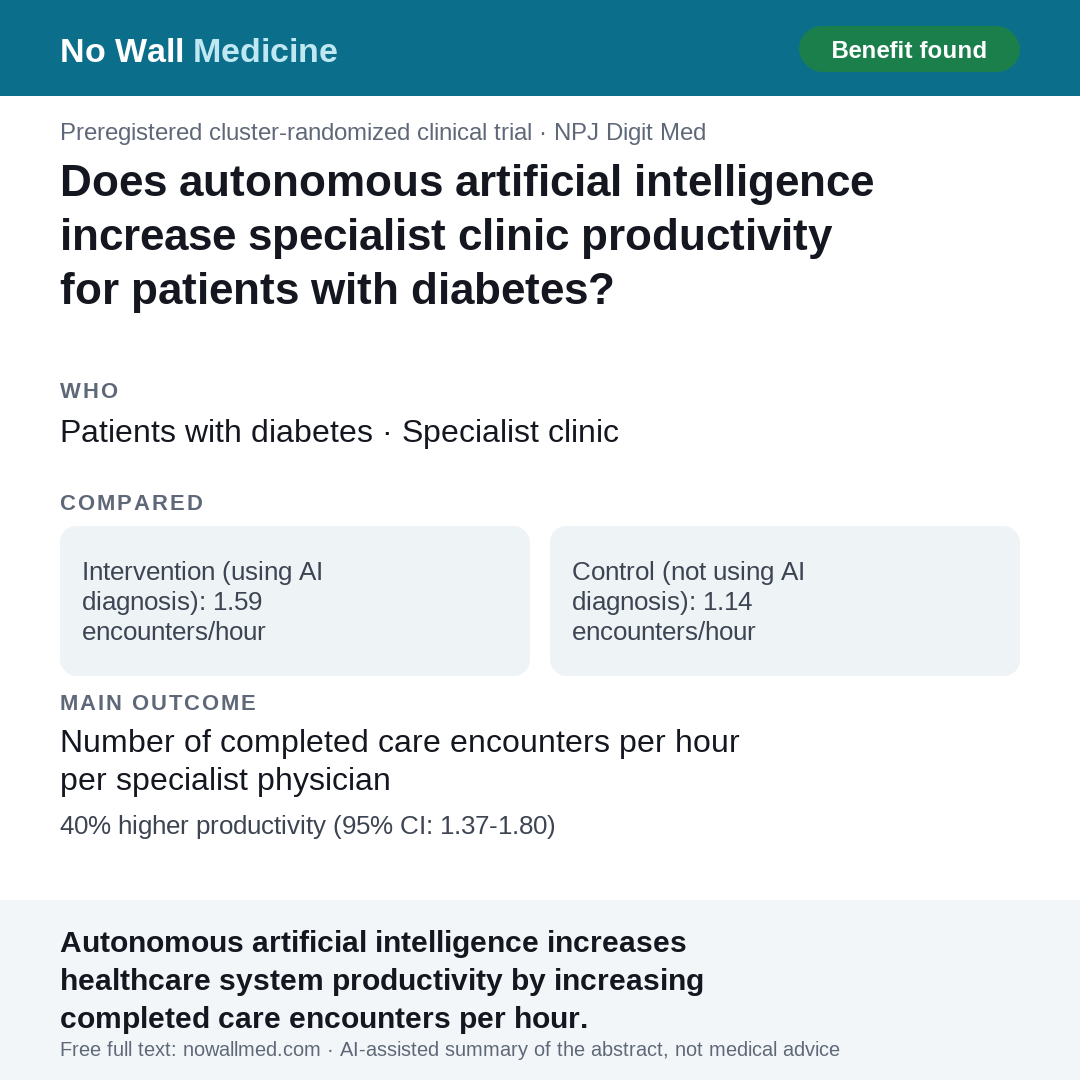
Does autonomous artificial intelligence increase specialist clinic productivity for patients with diabetes?
Who
Patients with diabetes · Specialist clinic
Compared
Intervention (using AI diagnosis): 1.59 encounters/hour
Control (not using AI diagnosis): 1.14 encounters/hour
Main outcome
Number of completed care encounters per hour per specialist physician
Result: 40% higher productivity (95% CI: 1.37-1.80)
Bottom line: Autonomous artificial intelligence increases healthcare system productivity by increasing completed care encounters per hour.
NPJ Digit Med · 2023-10-04Download image
Clinical question: Does autonomous artificial intelligence increase specialist clinic productivity for patients with diabetes?
Why it matters: Real-world evidence is lacking regarding whether autonomous artificial intelligence can increase healthcare productivity in specialist clinics.
Key points
- Researchers conducted a cluster-randomized trial involving 105 clinic days with 494 patients using artificial intelligence and 499 patients in a control group.
- The use of artificial intelligence for diabetic eye exams was associated with 40% higher productivity, resulting in 1.59 encounters per hour compared to 1.14 encounters per hour in the control group.
- The study also met its secondary endpoint regarding productivity across all patients.
Headline and key points written with AI from the paper’s abstract, with every number checked against it. Read the paper before relying on them.
Was this summary helpful?
Cite this article
Abramoff MD, Whitestone N, Patnaik JL, Rich E, Ahmed M, Husain L. Autonomous artificial intelligence increases real-world specialist clinic productivity in a cluster-randomized trial. NPJ Digit Med. 2023. doi:10.1038/s41746-023-00931-7
Spotted a mistake? Suggest a correction
Top studies every Monday
The week’s key trials and guidelines in your specialties, plus any topics you follow. By email, free.
Get the weekly digest