ResearchJournal of Allergy and Clinical Immunology · Sep 28, 2026

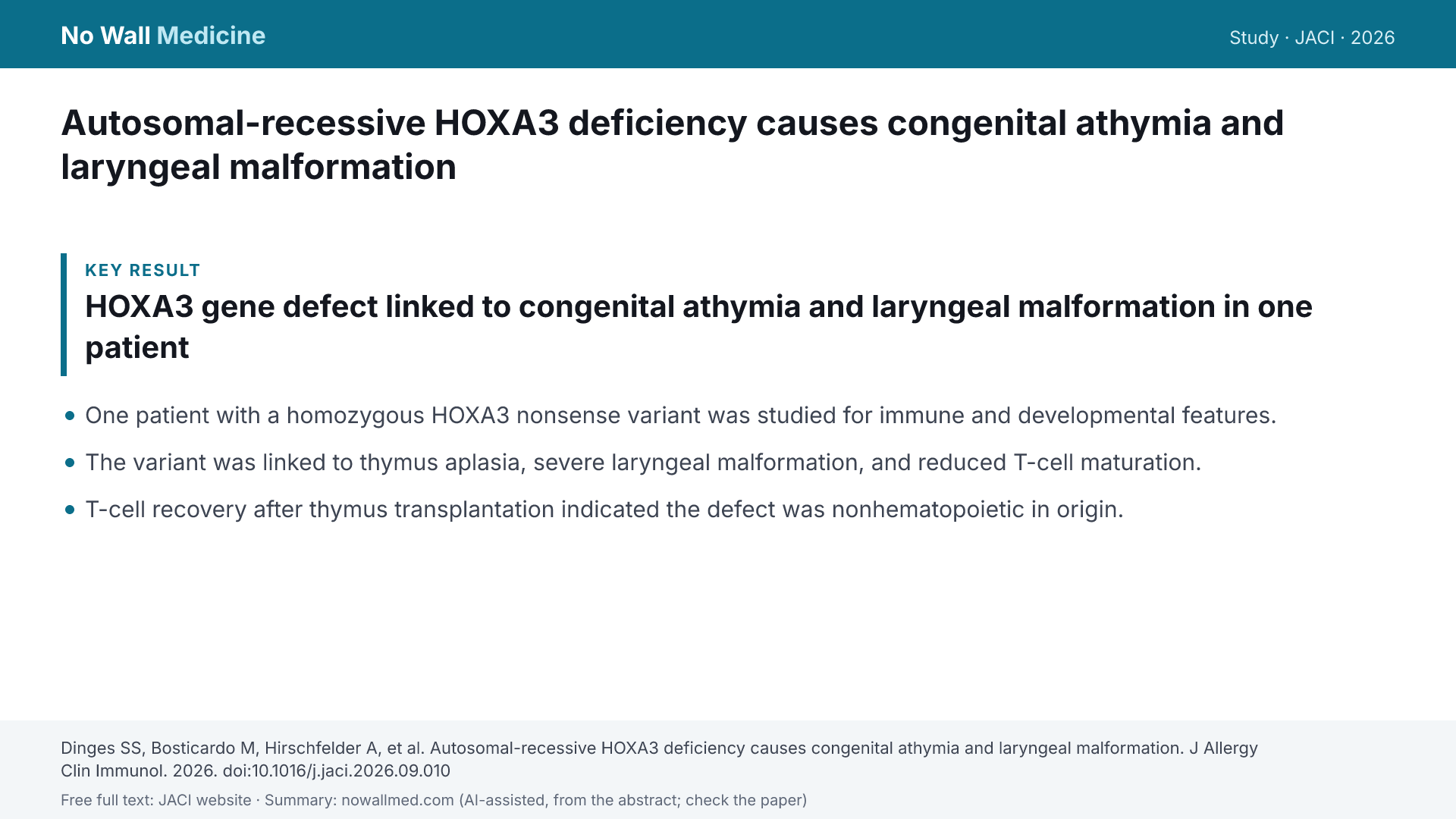
HOXA3 gene defect linked to congenital athymia and laryngeal malformation in one patient

Autosomal-recessive HOXA3 deficiency causes congenital athymia and laryngeal malformation

Dinges SS, Bosticardo M, Hirschfelder A, Pala F, Kopp J, Glaser V, et al
Allergy & ImmunologyAdult
Key points

Headline and key points written with AI from the paper’s abstract, with every number checked against it. Read the paper before relying on them.

Was this summary helpful?
Read the full paper free at the publisher ↗⬇ Slide🖨 Handout

DOI: 10.1016/j.jaci.2026.09.010 · PubMed: 42805310

Headline, design, result, key points, caveat and citation as plain text.

Cite this article

Dinges SS, Bosticardo M, Hirschfelder A, et al. Autosomal-recessive HOXA3 deficiency causes congenital athymia and laryngeal malformation. J Allergy Clin Immunol. 2026. doi:10.1016/j.jaci.2026.09.010

RIS (EndNote, Zotero, Mendeley)BibTeX

Spotted a mistake? Suggest a correction

Top Allergy & Immunology studies every Monday

The week’s key trials and guidelines, free to read, in one short email. No account; unsubscribe in one click.

Choose specialties and topics

More in Allergy & Immunology

Randomized trial n = 43 · Eur Respir J · Nov 23, 2026 · Pulmonology, Allergy & Immunology

Inhaled itraconazole 40mg improved lung function and asthma control in adults with asthma and ABPA in a small phase 2 trial

Meta-analysis · J Allergy Clin Immunol Pract · Nov 22, 2026 · Allergy & Immunology

Adding TNF inhibitors to steroids showed earlier disease control in skin necrosis patients

Meta-analysis n = 25,134 · J Allergy Clin Immunol Pract · Nov 21, 2026 · Allergy & Immunology

Twice-daily and once-daily intranasal sprays showed no difference in allergic rhinitis outcomes

Research · JACI · Nov 20, 2026 · Allergy & Immunology

Non-immune features persisted in 98 percent of patients despite metabolic detoxification

Research · Am J Ophthalmol · Nov 20, 2026 · Pediatric · Ophthalmology, Pediatrics

Higher severity of allergic conjunctivitis was linked to more meibomian gland loss in children