Atrioventricular junction ablation and biventricular pacing reduced mortality in patients with permanent atrial fibrillation
AV junction ablation and cardiac resynchronization for patients with permanent atrial fibrillation and narrow QRS: the APAF-CRT mortality trial
International, open-label, blinded outcome trialBenefit found
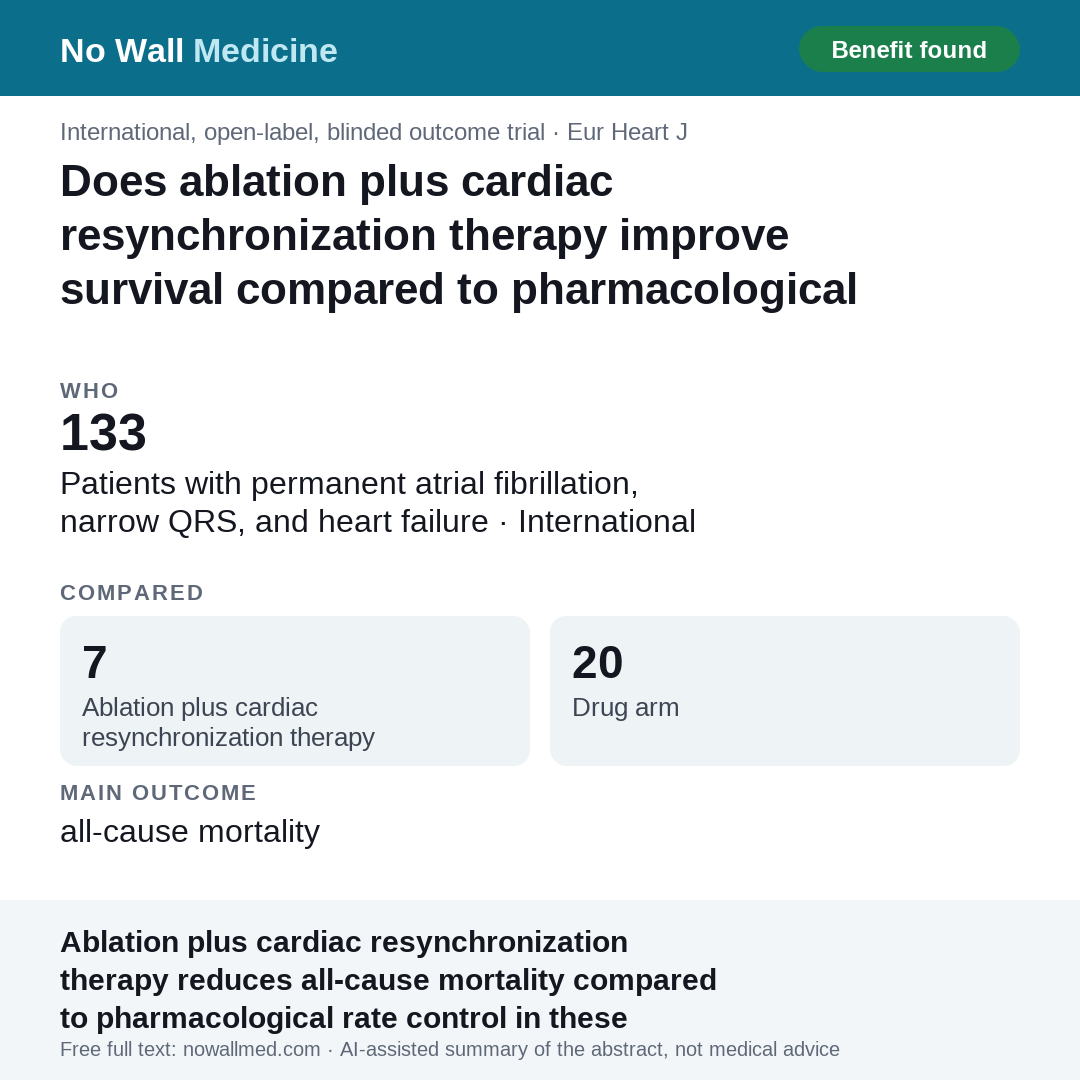
Does ablation plus cardiac resynchronization therapy improve survival compared to pharmacological rate control?
Who
133
Patients with permanent atrial fibrillation, narrow QRS, and heart failure · International
Compared
7Ablation plus cardiac resynchronization therapy (11%)
20Drug arm (29%)
Main outcome
all-cause mortality
Result: hazard ratio 0.26 (95% CI 0.10-0.65)
Bottom line: Ablation plus cardiac resynchronization therapy reduces all-cause mortality compared to pharmacological rate control in these patients.
Eur Heart J · 2021-08-29Download image
Clinical question: Does ablation plus cardiac resynchronization therapy improve survival compared to pharmacological rate control?
Why it matters: It was unknown whether combining atrioventricular junction ablation with biventricular pacemaker therapy improves survival compared to using drugs alone for rate control in these patients.
Key points
- The trial randomized 133 patients with permanent atrial fibrillation and narrow QRS complexes to receive either ablation plus cardiac resynchronization therapy or pharmacological rate control.
- All-cause mortality occurred in 11% of the ablation and pacing group compared to 29% in the drug group, with 2-year death rates of 5% and 21%.
- The combined endpoint of all-cause mortality or heart failure hospitalization was 29% in the ablation and pacing group versus 51% in the drug group.
Headline and key points written with AI from the paper’s abstract, with every number checked against it. Read the paper before relying on them.
Was this summary helpful?
Subject terms
Cite this article
Brignole M, Pentimalli F, Palmisano P, Landolina M, Quartieri F, Occhetta E. AV junction ablation and cardiac resynchronization for patients with permanent atrial fibrillation and narrow QRS: the APAF-CRT mortality trial. Eur Heart J. 2021. doi:10.1093/eurheartj/ehab569
Spotted a mistake? Suggest a correction
Top studies every Monday
The week’s key trials and guidelines in your specialties, plus any topics you follow. By email, free.
Get the weekly digest