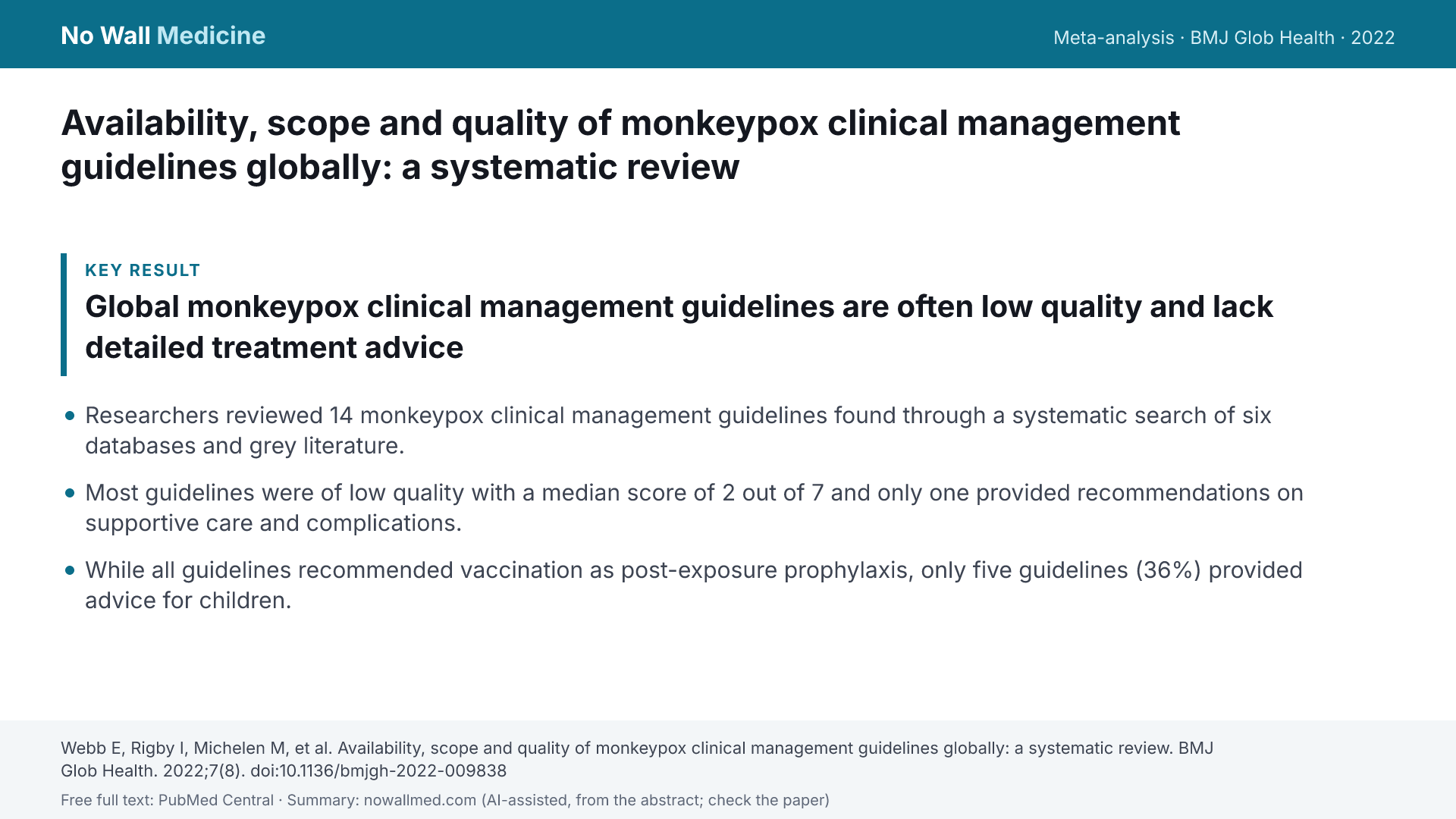
Global monkeypox clinical management guidelines are often low quality and lack detailed treatment advice
Availability, scope and quality of monkeypox clinical management guidelines globally: a systematic review
Public & Global HealthAdult and pediatric
Key points
- Researchers reviewed 14 monkeypox clinical management guidelines found through a systematic search of six databases and grey literature.
- Most guidelines were of low quality with a median score of 2 out of 7 and only one provided recommendations on supportive care and complications.
- While all guidelines recommended vaccination as post-exposure prophylaxis, only five guidelines (36%) provided advice for children.
Headline and key points written with AI from the paper’s abstract, with every number checked against it. Read the paper before relying on them.
Was this summary helpful?
Abstract
Background
Monkeypox (MPX) is an important human Orthopoxvirus infection. There has been an increase in MPX cases and outbreaks in endemic and non-endemic regions in recent decades. We appraised the availability, scope, quality and inclusivity of clinical management guidelines for MPX globally. Methods
For this systematic review, we searched six databases from inception until 14 October 2021, augmented by a grey literature search until 17 May 2022. MPX guidelines providing treatment and supportive care recommendations were included, with no exclusions for language. Two reviewers assessed the guidelines. Quality was assessed using the Appraisal of Guidelines for Research and Evaluation II tool. Results
Of 2026 records screened, 14 guidelines were included. Overall, most guidelines were of low-quality with a median score of 2 out of 7 (range: 1-7), lacked detail and covered a narrow range of topics. Most guidelines focused on adults, five (36%) provided some advice for children, three (21%) for pregnant women and three (21%) for people living with HIV. Treatment guidance was mostly limited to advice on antivirals; seven guidelines advised cidofovir (four specified for severe MPX only); 29% (4/14) tecovirimat, and 7% (1/14) brincidofovir. Only one guideline provided recommendations on supportive care and treatment of complications. All guidelines recommended vaccination as post-exposure prophylaxis (PEP). Three guidelines advised on vaccinia immune globulin as PEP for severe cases in people with immunosuppression. Conclusion
Our results highlight a lack of evidence-based clinical management guidelines for MPX globally. There is a clear and urgent need for research into treatment and prophylaxis including for different risk populations. The current outbreak provides an opportunity to accelerate this research through coordinated high-quality studies. New evidence should be incorporated into globally accessible guidelines, to benefit patient and epidemic outcomes. A 'living guideline' framework is recommended. Prospero registration number
CRD42020167361.
Abstract reproduced under the article’s CC BY licence.
Subject terms
Headline, design, result, key points, caveat and citation as plain text.
Cite this article
Webb E, Rigby I, Michelen M, et al. Availability, scope and quality of monkeypox clinical management guidelines globally: a systematic review. BMJ Glob Health. 2022;7(8). doi:10.1136/bmjgh-2022-009838
Spotted a mistake? Suggest a correction